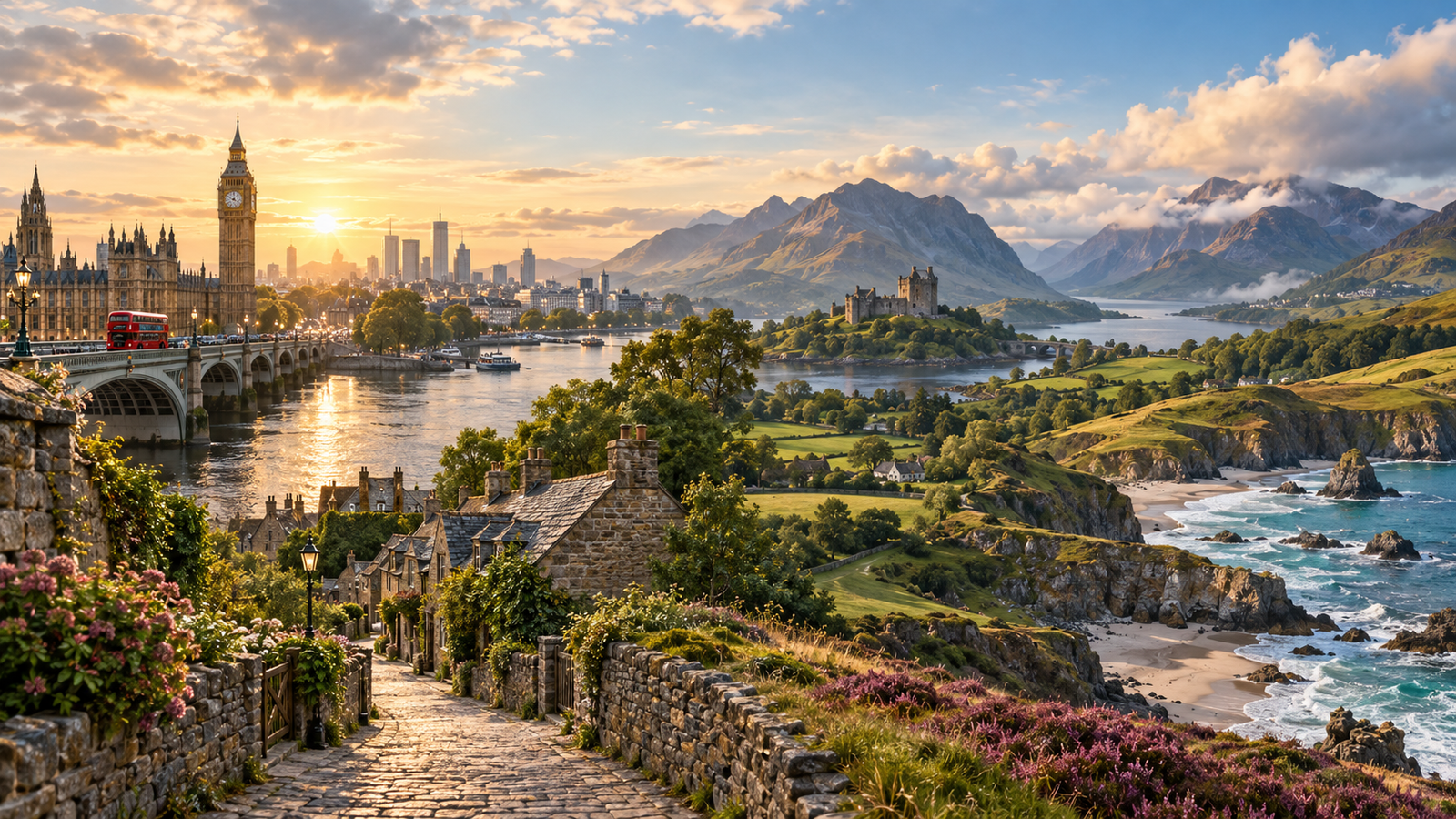
Editorial note: researched from official tourism, government and transport sources. Prices and rules checked 11 October 2026; always reconfirm before booking. The hero image is original AI-generated editorial artwork and does not depict one literal viewpoint.
The United Kingdom is not one destination wearing four costumes. England, Scotland, Wales and Northern Ireland have distinct landscapes, institutions, languages, food traditions and transport realities. This guide is built for a first visit that goes beyond London without turning the trip into an exhausting race. It explains fifty experiences, how to connect them, what commonly goes wrong and which official source should settle a time-sensitive question.
United Kingdom at a glance
- Ideal first trip: 10–14 days for London plus two regions; three weeks for a balanced four-nation journey.
- Currency: pound sterling. Card payment is widespread, but keep a small backup method.
- Best planning principle: reserve the few high-demand anchors, then keep weather-sensitive countryside days flexible.
- Transport: rail is strongest between major cities; rural coasts, islands and national parks need separate bus, ferry or car planning.
- Price check: use live operator totals, including booking conditions, city taxes where applicable, parking and mandatory fees.
Entry, ETA and arrival planning
Use the UK government’s visitor and Electronic Travel Authorisation pages to determine what applies to your passport. Do not rely on a travel blog, airline advertisement or AI summary for permission to travel. Names, document numbers and validity dates must match the booking. Keep evidence required by your individual circumstances accessible, but do not carry unnecessary sensitive documents during daily sightseeing.
London Heathrow, Gatwick, Manchester and Edinburgh are common long-haul gateways, while Belfast, Glasgow and regional airports may be more efficient for an open-jaw itinerary. Compare the full journey: airport transfer, baggage rules, hotel check-in time and the cost of returning to the first airport. A slightly higher open-jaw airfare can save a hotel night and a full day of backtracking.
When to go
Late spring and early autumn often balance daylight, landscapes and city comfort, but there is no weather guarantee. Summer brings the longest days and the strongest demand in London, Edinburgh, Cornwall, the Lake District and island destinations. Winter supports museums, theatre and seasonal city breaks, while mountain and island travel requires larger disruption buffers. Check bank holidays, school holidays and major sports or festival dates before booking accommodation.
Budget and accommodation strategy
Use three live scenarios rather than one national average. A value trip combines advance rail planning, simple central lodging, supermarkets or bakeries and mostly free museums and landscapes. A mid-range trip adds well-located hotels, reserved attractions and occasional taxis. A premium trip pays for historic properties, flexible rail tickets, private interpretation and remote transfers. London and festival Edinburgh can cost far more than regional cities on the same date.
For every hotel, compare the final cancellable total on the official property site with a reputable booking platform, then read the exact room description. “Central” is not a transport guarantee. Check the walk from the station, late-evening route, lift access, air conditioning where summer heat matters, breakfast terms and luggage storage. Review scores are clues, not proof; recent recurring comments about noise, cleanliness and access matter more than the headline number.
Fifty things to do in the United Kingdom
1. Westminster and the Thames walk
Where: London. Walk from Westminster Bridge through Parliament Square and along the South Bank for the clearest introduction to London’s political, architectural and river history. This stop earns its place in a first-visit itinerary because it contributes a distinct part of the country’s story instead of repeating a view or experience found elsewhere in the route.
How to plan it: Start early at Westminster Underground station, reserve Westminster Abbey separately if entering, and keep the riverside walk flexible so weather and security closures do not break the day. Build the rest of the day around the actual door-to-door travel time, not the distance shown on a map. Check the official attraction, park or transport page again the evening before travel because seasonal hours, engineering work and weather restrictions can change.
Best for: First-time visitors, photographers and travellers who want a low-cost orientation. Important: Pavements and bridges are mostly straightforward, but crowds around Westminster can be dense; use step-free station maps rather than assuming every interchange is accessible. Travellers who need step-free access, seating, sensory adjustments or assistance should contact the operator directly; a historic site described as “accessible” may still contain cobbles, slopes or restricted upper floors.
Place it in the larger route: Treat Westminster and the Thames walk as the day’s anchor, then add only a nearby meal, park or short walk. In London, the most memorable detail is often the transition between the headline site and the surrounding streets or landscape. That slower structure creates time for interpretation, photographs, rest and an unexpected closure without forcing the next reservation to fail. If the journey requires more than two hours each way, compare an overnight base with the true cost and fatigue of returning the same day.
2. Tower of London and Tower Bridge
Where: London. Pair the medieval fortress, Crown Jewels and Thames-side defensive history with the engineering story and high-level walkways of Tower Bridge. This stop earns its place in a first-visit itinerary because it contributes a distinct part of the country’s story instead of repeating a view or experience found elsewhere in the route.
How to plan it: Book the Tower’s earliest practical timed entry, allow three hours inside, eat away from the busiest gate, then walk to Tower Bridge rather than adding another transport leg. Build the rest of the day around the actual door-to-door travel time, not the distance shown on a map. Check the official attraction, park or transport page again the evening before travel because seasonal hours, engineering work and weather restrictions can change.
Best for: History-focused travellers and families with school-age children. Important: Both sites can fill a large day; do not add Greenwich or multiple museums, and verify lift availability on each official accessibility page. Travellers who need step-free access, seating, sensory adjustments or assistance should contact the operator directly; a historic site described as “accessible” may still contain cobbles, slopes or restricted upper floors.
Make the visit more useful: Before arriving at Tower of London and Tower Bridge, read the official overview and decide one question you want the experience to answer. Once there, spend the first part orienting yourself instead of immediately taking photographs. In London, local museums, visitor centres, guides and community businesses add context that a quick social-media stop cannot provide. Leave with enough daylight for the onward journey, and record any changed access information so the rest of the itinerary can be adjusted while options remain open.
3. British Museum with a collection plan
Where: London. Use a short, ethical collection plan instead of racing through every gallery, leaving time to understand provenance, conservation and the global contexts of selected objects. This stop earns its place in a first-visit itinerary because it contributes a distinct part of the country’s story instead of repeating a view or experience found elsewhere in the route.
How to plan it: Choose three collection areas in advance, download the museum map, check gallery closures on the official site and schedule a seated break before attention fades. Build the rest of the day around the actual door-to-door travel time, not the distance shown on a map. Check the official attraction, park or transport page again the evening before travel because seasonal hours, engineering work and weather restrictions can change.
Best for: Museum lovers, rainy-day planners and budget-conscious travellers. Important: General admission is normally free but special exhibitions may be ticketed; crowd controls, bag checks and gallery access can change. Travellers who need step-free access, seating, sensory adjustments or assistance should contact the operator directly; a historic site described as “accessible” may still contain cobbles, slopes or restricted upper floors.
Pacing advice: A successful visit to British Museum with a collection plan includes travel, queues, toilets, meals and recovery time, not just the minutes spent at the main viewpoint or building. For a mixed-ability group in London, agree on a shorter shared core and one optional extension rather than making everyone follow the hardest version. Keep a warm, dry or indoor alternative nearby. This approach is especially valuable in Britain, where a bright forecast and practical operating conditions can diverge within the same day.
4. South Kensington museums
Where: London. The Natural History, Science and Victoria and Albert museums form one of Europe’s strongest free museum clusters and work especially well when weather is poor. This stop earns its place in a first-visit itinerary because it contributes a distinct part of the country’s story instead of repeating a view or experience found elsewhere in the route.
How to plan it: Select one primary museum and one backup, arrive near opening, and use the pedestrian tunnel from South Kensington station when it is available. Build the rest of the day around the actual door-to-door travel time, not the distance shown on a map. Check the official attraction, park or transport page again the evening before travel because seasonal hours, engineering work and weather restrictions can change.
Best for: Families, design travellers and science enthusiasts. Important: Trying to cover all three in one day produces shallow visits; confirm timed-entry guidance and accessible entrances independently. Travellers who need step-free access, seating, sensory adjustments or assistance should contact the operator directly; a historic site described as “accessible” may still contain cobbles, slopes or restricted upper floors.
Responsible travel: The quality of South Kensington museums depends on behaviour as much as planning. In London, use marked routes, lawful parking and local services; keep voices low around worship, memorial or residential spaces; and never trade safety for a photograph. Carry out litter, follow dog and livestock rules, and avoid publishing the precise location of a fragile informal viewpoint. Spending on a local meal, guide or independent shop usually contributes more than arriving briefly, blocking access and leaving.
5. Greenwich by river
Where: London. Approaching Greenwich by scheduled river service connects maritime London, the Thames, the Royal Observatory area and the historic town centre in one coherent day. This stop earns its place in a first-visit itinerary because it contributes a distinct part of the country’s story instead of repeating a view or experience found elsewhere in the route.
How to plan it: Travel one way by river and return by rail or DLR, allowing time for the climb through Greenwich Park and for the market without building the day around a single boat departure. Build the rest of the day around the actual door-to-door travel time, not the distance shown on a map. Check the official attraction, park or transport page again the evening before travel because seasonal hours, engineering work and weather restrictions can change.
Best for: Maritime-history fans, walkers and repeat London visitors. Important: River fares and weather policies vary by operator; the hill to the observatory is steep, so check accessible routes and mobility options. Travellers who need step-free access, seating, sensory adjustments or assistance should contact the operator directly; a historic site described as “accessible” may still contain cobbles, slopes or restricted upper floors.
Decision check: Keep Greenwich by river when it matches the group’s real interests, not merely because it appears on every list. Compare its time, admission, physical demands and location with another option in London. If it survives that comparison, protect enough time to experience it properly. If not, remove it without guilt. First trips improve when the itinerary has a clear point of view: two excellent days with breathing room are more valuable than a sequence of famous names experienced through transport windows.
6. Royal parks and Buckingham Palace area
Where: London. St James’s Park, Green Park and the ceremonial streets provide a spacious counterpoint to indoor attractions and reveal how royal London fits together geographically. This stop earns its place in a first-visit itinerary because it contributes a distinct part of the country’s story instead of repeating a view or experience found elsewhere in the route.
How to plan it: Check official ceremony dates, avoid blocking gates or pavements, and combine the area with a park picnic or nearby gallery instead of waiting for hours at the palace railings. Build the rest of the day around the actual door-to-door travel time, not the distance shown on a map. Check the official attraction, park or transport page again the evening before travel because seasonal hours, engineering work and weather restrictions can change.
Best for: First-time visitors, families and travellers seeking a lighter day. Important: Palace access is seasonal and ticketed; ceremonies can be cancelled, and large events may close routes without much notice. Travellers who need step-free access, seating, sensory adjustments or assistance should contact the operator directly; a historic site described as “accessible” may still contain cobbles, slopes or restricted upper floors.
Place it in the larger route: Treat Royal parks and Buckingham Palace area as the day’s anchor, then add only a nearby meal, park or short walk. In London, the most memorable detail is often the transition between the headline site and the surrounding streets or landscape. That slower structure creates time for interpretation, photographs, rest and an unexpected closure without forcing the next reservation to fail. If the journey requires more than two hours each way, compare an overnight base with the true cost and fatigue of returning the same day.
7. West End theatre planning
Where: London. A carefully chosen West End performance adds living culture to a sightseeing trip and can be better value than another full-price daytime attraction. This stop earns its place in a first-visit itinerary because it contributes a distinct part of the country’s story instead of repeating a view or experience found elsewhere in the route.
How to plan it: Compare official theatre or authorised ticket channels, check sightlines and running time, eat before peak curtain time and plan the late-evening route back to the hotel. Build the rest of the day around the actual door-to-door travel time, not the distance shown on a map. Check the official attraction, park or transport page again the evening before travel because seasonal hours, engineering work and weather restrictions can change.
Best for: Theatre fans, couples and older families. Important: Do not buy from unofficial street sellers; accessible seats, captioned performances and step-free access differ sharply between historic venues. Travellers who need step-free access, seating, sensory adjustments or assistance should contact the operator directly; a historic site described as “accessible” may still contain cobbles, slopes or restricted upper floors.
Make the visit more useful: Before arriving at West End theatre planning, read the official overview and decide one question you want the experience to answer. Once there, spend the first part orienting yourself instead of immediately taking photographs. In London, local museums, visitor centres, guides and community businesses add context that a quick social-media stop cannot provide. Leave with enough daylight for the onward journey, and record any changed access information so the rest of the itinerary can be adjusted while options remain open.
8. Borough Market and a food-neighbourhood route
Where: London. Borough Market works best as part of a Southwark walk that includes the river, historic lanes and smaller food businesses rather than as a single crowded meal stop. This stop earns its place in a first-visit itinerary because it contributes a distinct part of the country’s story instead of repeating a view or experience found elsewhere in the route.
How to plan it: Visit outside the lunch peak, share portions, carry water, then continue east or west on foot so the day is not dominated by queuing. Build the rest of the day around the actual door-to-door travel time, not the distance shown on a map. Check the official attraction, park or transport page again the evening before travel because seasonal hours, engineering work and weather restrictions can change.
Best for: Food-focused travellers and mixed-interest groups. Important: Trading days and stall line-ups change; ask about allergens directly and avoid treating the market as representative of all British food. Travellers who need step-free access, seating, sensory adjustments or assistance should contact the operator directly; a historic site described as “accessible” may still contain cobbles, slopes or restricted upper floors.
Pacing advice: A successful visit to Borough Market and a food-neighbourhood route includes travel, queues, toilets, meals and recovery time, not just the minutes spent at the main viewpoint or building. For a mixed-ability group in London, agree on a shorter shared core and one optional extension rather than making everyone follow the hardest version. Keep a warm, dry or indoor alternative nearby. This approach is especially valuable in Britain, where a bright forecast and practical operating conditions can diverge within the same day.
9. East London markets and street-art etiquette
Where: London. Spitalfields, Brick Lane and surrounding streets show migration, independent retail and changing creative culture beyond ceremonial central London. This stop earns its place in a first-visit itinerary because it contributes a distinct part of the country’s story instead of repeating a view or experience found elsewhere in the route.
How to plan it: Pick one main market, walk in daylight, support businesses rather than photographing people without consent and check whether a market is operating on the chosen day. Build the rest of the day around the actual door-to-door travel time, not the distance shown on a map. Check the official attraction, park or transport page again the evening before travel because seasonal hours, engineering work and weather restrictions can change.
Best for: Design, fashion and contemporary-culture travellers. Important: Street art is temporary and neighbourhoods are residential; keep groups small, respect doorways and watch belongings in dense crowds. Travellers who need step-free access, seating, sensory adjustments or assistance should contact the operator directly; a historic site described as “accessible” may still contain cobbles, slopes or restricted upper floors.
Responsible travel: The quality of East London markets and street-art etiquette depends on behaviour as much as planning. In London, use marked routes, lawful parking and local services; keep voices low around worship, memorial or residential spaces; and never trade safety for a photograph. Carry out litter, follow dog and livestock rules, and avoid publishing the precise location of a fragile informal viewpoint. Spending on a local meal, guide or independent shop usually contributes more than arriving briefly, blocking access and leaving.
10. Hampton Court or Windsor as a focused day trip
Where: Greater London and Berkshire. One royal day trip can deepen the story of monarchy and architecture without turning the itinerary into a rushed checklist of palaces. This stop earns its place in a first-visit itinerary because it contributes a distinct part of the country’s story instead of repeating a view or experience found elsewhere in the route.
How to plan it: Choose Hampton Court for Tudor rooms and gardens or Windsor for the working castle and town, then verify opening areas before buying non-refundable transport. Build the rest of the day around the actual door-to-door travel time, not the distance shown on a map. Check the official attraction, park or transport page again the evening before travel because seasonal hours, engineering work and weather restrictions can change.
Best for: Royal-history visitors and travellers with at least five London nights. Important: State events can close rooms, and combining both places in one day sacrifices the best details; check step-free routes and station-to-entrance distance. Travellers who need step-free access, seating, sensory adjustments or assistance should contact the operator directly; a historic site described as “accessible” may still contain cobbles, slopes or restricted upper floors.
Decision check: Keep Hampton Court or Windsor as a focused day trip when it matches the group’s real interests, not merely because it appears on every list. Compare its time, admission, physical demands and location with another option in Greater London and Berkshire. If it survives that comparison, protect enough time to experience it properly. If not, remove it without guilt. First trips improve when the itinerary has a clear point of view: two excellent days with breathing room are more valuable than a sequence of famous names experienced through transport windows.
11. Bath’s Roman and Georgian heritage
Where: South West England. Bath layers Roman archaeology, Georgian planning, literature and a walkable modern city, making it one of Britain’s most complete heritage stops. This stop earns its place in a first-visit itinerary because it contributes a distinct part of the country’s story instead of repeating a view or experience found elsewhere in the route.
How to plan it: Stay overnight if possible, reserve the Roman Baths for a defined time, walk the crescents in daylight and leave space for the free cityscape rather than adding Stonehenge automatically. Build the rest of the day around the actual door-to-door travel time, not the distance shown on a map. Check the official attraction, park or transport page again the evening before travel because seasonal hours, engineering work and weather restrictions can change.
Best for: Architecture, history and wellness travellers. Important: The historic Roman site is not a bathing facility; modern spa sessions are separate and should be booked through the operator. Travellers who need step-free access, seating, sensory adjustments or assistance should contact the operator directly; a historic site described as “accessible” may still contain cobbles, slopes or restricted upper floors.
Place it in the larger route: Treat Bath’s Roman and Georgian heritage as the day’s anchor, then add only a nearby meal, park or short walk. In South West England, the most memorable detail is often the transition between the headline site and the surrounding streets or landscape. That slower structure creates time for interpretation, photographs, rest and an unexpected closure without forcing the next reservation to fail. If the journey requires more than two hours each way, compare an overnight base with the true cost and fatigue of returning the same day.
12. Stonehenge with Salisbury
Where: Wiltshire. Pairing Stonehenge with Salisbury Cathedral and its compact centre creates a fuller day about landscape, belief and medieval urban life. This stop earns its place in a first-visit itinerary because it contributes a distinct part of the country’s story instead of repeating a view or experience found elsewhere in the route.
How to plan it: Use the official visitor shuttle or a reputable transport plan, allow for wind and rain on the open plain, and keep Salisbury as a real visit rather than a transfer stop. Build the rest of the day around the actual door-to-door travel time, not the distance shown on a map. Check the official attraction, park or transport page again the evening before travel because seasonal hours, engineering work and weather restrictions can change.
Best for: Archaeology fans and travellers without a car. Important: Road traffic can make tight schedules fail; do not cross restricted land, and verify last admission and shuttle times. Travellers who need step-free access, seating, sensory adjustments or assistance should contact the operator directly; a historic site described as “accessible” may still contain cobbles, slopes or restricted upper floors.
Make the visit more useful: Before arriving at Stonehenge with Salisbury, read the official overview and decide one question you want the experience to answer. Once there, spend the first part orienting yourself instead of immediately taking photographs. In Wiltshire, local museums, visitor centres, guides and community businesses add context that a quick social-media stop cannot provide. Leave with enough daylight for the onward journey, and record any changed access information so the rest of the itinerary can be adjusted while options remain open.
13. Oxford college and museum day
Where: Oxfordshire. Oxford rewards a slow route through working colleges, libraries, museums and riverside spaces rather than a film-location scavenger hunt. This stop earns its place in a first-visit itinerary because it contributes a distinct part of the country’s story instead of repeating a view or experience found elsewhere in the route.
How to plan it: Check which colleges admit visitors that day, begin with one museum, walk between compact sights and avoid entering private academic areas. Build the rest of the day around the actual door-to-door travel time, not the distance shown on a map. Check the official attraction, park or transport page again the evening before travel because seasonal hours, engineering work and weather restrictions can change.
Best for: Book lovers, architecture travellers and families with teenagers. Important: University ceremonies and term activity affect access; commercial tours do not guarantee entry to every college. Travellers who need step-free access, seating, sensory adjustments or assistance should contact the operator directly; a historic site described as “accessible” may still contain cobbles, slopes or restricted upper floors.
Pacing advice: A successful visit to Oxford college and museum day includes travel, queues, toilets, meals and recovery time, not just the minutes spent at the main viewpoint or building. For a mixed-ability group in Oxfordshire, agree on a shorter shared core and one optional extension rather than making everyone follow the hardest version. Keep a warm, dry or indoor alternative nearby. This approach is especially valuable in Britain, where a bright forecast and practical operating conditions can diverge within the same day.
14. Cambridge by foot and river
Where: Cambridgeshire. Cambridge combines living university traditions, chapel architecture, museums and the River Cam in a city that is easy to explore without a car. This stop earns its place in a first-visit itinerary because it contributes a distinct part of the country’s story instead of repeating a view or experience found elsewhere in the route.
How to plan it: Arrive by rail, select one or two colleges, choose a licensed shared punt or riverside walk, and finish at a museum before the commuter peak. Build the rest of the day around the actual door-to-door travel time, not the distance shown on a map. Check the official attraction, park or transport page again the evening before travel because seasonal hours, engineering work and weather restrictions can change.
Best for: University-city visitors and relaxed day trippers. Important: Self-hire punts require confidence and weather awareness; college opening rules and photography restrictions vary. Travellers who need step-free access, seating, sensory adjustments or assistance should contact the operator directly; a historic site described as “accessible” may still contain cobbles, slopes or restricted upper floors.
Responsible travel: The quality of Cambridge by foot and river depends on behaviour as much as planning. In Cambridgeshire, use marked routes, lawful parking and local services; keep voices low around worship, memorial or residential spaces; and never trade safety for a photograph. Carry out litter, follow dog and livestock rules, and avoid publishing the precise location of a fragile informal viewpoint. Spending on a local meal, guide or independent shop usually contributes more than arriving briefly, blocking access and leaving.
15. Cotswolds without village congestion
Where: South West England. The Cotswolds are best understood through a small number of market towns, footpaths and lived-in villages rather than a car-based race between photo stops. This stop earns its place in a first-visit itinerary because it contributes a distinct part of the country’s story instead of repeating a view or experience found elsewhere in the route.
How to plan it: Base in a transport-connected town, use buses or a planned driver where practical, walk a signed section and spend money locally without blocking homes or lanes. Build the rest of the day around the actual door-to-door travel time, not the distance shown on a map. Check the official attraction, park or transport page again the evening before travel because seasonal hours, engineering work and weather restrictions can change.
Best for: Countryside walkers and slow-travel couples. Important: Public transport is limited on some days; roadside parking, drone use and entering private property create real community problems. Travellers who need step-free access, seating, sensory adjustments or assistance should contact the operator directly; a historic site described as “accessible” may still contain cobbles, slopes or restricted upper floors.
Decision check: Keep Cotswolds without village congestion when it matches the group’s real interests, not merely because it appears on every list. Compare its time, admission, physical demands and location with another option in South West England. If it survives that comparison, protect enough time to experience it properly. If not, remove it without guilt. First trips improve when the itinerary has a clear point of view: two excellent days with breathing room are more valuable than a sequence of famous names experienced through transport windows.
16. Bristol harbour and creative districts
Where: South West England. Bristol links maritime history, engineering, street art, music and independent food through a harbour-centred city break. This stop earns its place in a first-visit itinerary because it contributes a distinct part of the country’s story instead of repeating a view or experience found elsewhere in the route.
How to plan it: Walk the floating harbour, select one major paid attraction, cross into neighbourhoods by bus or on foot and check event calendars before choosing accommodation. Build the rest of the day around the actual door-to-door travel time, not the distance shown on a map. Check the official attraction, park or transport page again the evening before travel because seasonal hours, engineering work and weather restrictions can change.
Best for: Creative-city travellers and families. Important: Steep streets appear beyond the waterfront; nightlife noise varies by area, so verify hotel location rather than relying on a city-centre label. Travellers who need step-free access, seating, sensory adjustments or assistance should contact the operator directly; a historic site described as “accessible” may still contain cobbles, slopes or restricted upper floors.
Place it in the larger route: Treat Bristol harbour and creative districts as the day’s anchor, then add only a nearby meal, park or short walk. In South West England, the most memorable detail is often the transition between the headline site and the surrounding streets or landscape. That slower structure creates time for interpretation, photographs, rest and an unexpected closure without forcing the next reservation to fail. If the journey requires more than two hours each way, compare an overnight base with the true cost and fatigue of returning the same day.
17. Jurassic Coast with tide and cliff safety
Where: Dorset and East Devon. England’s Jurassic Coast offers geology, beaches and long-distance walking, but its value comes from reading the landscape safely rather than collecting fossils anywhere. This stop earns its place in a first-visit itinerary because it contributes a distinct part of the country’s story instead of repeating a view or experience found elsewhere in the route.
How to plan it: Choose one base and one signed coastal section, check tide and weather information, use official car parks or buses and obey local fossil-collecting guidance. Build the rest of the day around the actual door-to-door travel time, not the distance shown on a map. Check the official attraction, park or transport page again the evening before travel because seasonal hours, engineering work and weather restrictions can change.
Best for: Walkers, geology enthusiasts and families. Important: Cliff falls are unpredictable; stay back from edges and cliff bases, and never let a social-media viewpoint override warning signs. Travellers who need step-free access, seating, sensory adjustments or assistance should contact the operator directly; a historic site described as “accessible” may still contain cobbles, slopes or restricted upper floors.
Make the visit more useful: Before arriving at Jurassic Coast with tide and cliff safety, read the official overview and decide one question you want the experience to answer. Once there, spend the first part orienting yourself instead of immediately taking photographs. In Dorset and East Devon, local museums, visitor centres, guides and community businesses add context that a quick social-media stop cannot provide. Leave with enough daylight for the onward journey, and record any changed access information so the rest of the itinerary can be adjusted while options remain open.
18. Cornwall coast and fishing towns
Where: Cornwall. Cornwall combines Atlantic landscapes, mining heritage, fishing communities, gardens and contemporary food, deserving several nights rather than a London day trip. This stop earns its place in a first-visit itinerary because it contributes a distinct part of the country’s story instead of repeating a view or experience found elsewhere in the route.
How to plan it: Pick one coast as a base, reserve rail or car logistics early in summer, alternate a major attraction with a coastal walk and leave weather flexibility. Build the rest of the day around the actual door-to-door travel time, not the distance shown on a map. Check the official attraction, park or transport page again the evening before travel because seasonal hours, engineering work and weather restrictions can change.
Best for: Coastal travellers, surfers and food lovers. Important: Narrow roads and scarce parking make over-ambitious loops exhausting; sea conditions change quickly and holiday housing pressures deserve respectful choices. Travellers who need step-free access, seating, sensory adjustments or assistance should contact the operator directly; a historic site described as “accessible” may still contain cobbles, slopes or restricted upper floors.
Pacing advice: A successful visit to Cornwall coast and fishing towns includes travel, queues, toilets, meals and recovery time, not just the minutes spent at the main viewpoint or building. For a mixed-ability group in Cornwall, agree on a shorter shared core and one optional extension rather than making everyone follow the hardest version. Keep a warm, dry or indoor alternative nearby. This approach is especially valuable in Britain, where a bright forecast and practical operating conditions can diverge within the same day.
19. Brighton and the South Downs
Where: East Sussex. Brighton’s seaside architecture, independent lanes and cultural energy pair naturally with the open landscapes of the South Downs. This stop earns its place in a first-visit itinerary because it contributes a distinct part of the country’s story instead of repeating a view or experience found elsewhere in the route.
How to plan it: Travel by train, explore the seafront and North Laine on foot, then add a separate downs walk only with suitable footwear and daylight. Build the rest of the day around the actual door-to-door travel time, not the distance shown on a map. Check the official attraction, park or transport page again the evening before travel because seasonal hours, engineering work and weather restrictions can change.
Best for: Short-break visitors, LGBTQ+ travellers and walkers. Important: Beach stones and steep downland paths affect mobility; weekend trains and events can be crowded, so avoid the last possible return service. Travellers who need step-free access, seating, sensory adjustments or assistance should contact the operator directly; a historic site described as “accessible” may still contain cobbles, slopes or restricted upper floors.
Responsible travel: The quality of Brighton and the South Downs depends on behaviour as much as planning. In East Sussex, use marked routes, lawful parking and local services; keep voices low around worship, memorial or residential spaces; and never trade safety for a photograph. Carry out litter, follow dog and livestock rules, and avoid publishing the precise location of a fragile informal viewpoint. Spending on a local meal, guide or independent shop usually contributes more than arriving briefly, blocking access and leaving.
20. Canterbury and the Kent coast
Where: Kent. Canterbury’s cathedral cityscape gains depth when paired with a Kent coast stop, connecting pilgrimage, maritime history and contemporary seaside culture. This stop earns its place in a first-visit itinerary because it contributes a distinct part of the country’s story instead of repeating a view or experience found elsewhere in the route.
How to plan it: Give the cathedral and old centre a half day, then choose one coastal town based on rail time rather than trying to cover the entire county. Build the rest of the day around the actual door-to-door travel time, not the distance shown on a map. Check the official attraction, park or transport page again the evening before travel because seasonal hours, engineering work and weather restrictions can change.
Best for: History travellers and visitors based in London. Important: Cathedral worship and events alter visitor access; coastal weather can change quickly and some paths have exposed sections. Travellers who need step-free access, seating, sensory adjustments or assistance should contact the operator directly; a historic site described as “accessible” may still contain cobbles, slopes or restricted upper floors.
Decision check: Keep Canterbury and the Kent coast when it matches the group’s real interests, not merely because it appears on every list. Compare its time, admission, physical demands and location with another option in Kent. If it survives that comparison, protect enough time to experience it properly. If not, remove it without guilt. First trips improve when the itinerary has a clear point of view: two excellent days with breathing room are more valuable than a sequence of famous names experienced through transport windows.
21. Peak District walking base
Where: Central England. The Peak District offers moorland, limestone valleys, villages and industrial history within reach of major northern cities. This stop earns its place in a first-visit itinerary because it contributes a distinct part of the country’s story instead of repeating a view or experience found elsewhere in the route.
How to plan it: Choose a base matched to the landscape you want, download a proper route, carry layers and build a shorter bad-weather alternative. Build the rest of the day around the actual door-to-door travel time, not the distance shown on a map. Check the official attraction, park or transport page again the evening before travel because seasonal hours, engineering work and weather restrictions can change.
Best for: Hikers, photographers and active families. Important: Mobile signal is unreliable in places; moorland weather, livestock and seasonal fire risks require current local guidance. Travellers who need step-free access, seating, sensory adjustments or assistance should contact the operator directly; a historic site described as “accessible” may still contain cobbles, slopes or restricted upper floors.
Place it in the larger route: Treat Peak District walking base as the day’s anchor, then add only a nearby meal, park or short walk. In Central England, the most memorable detail is often the transition between the headline site and the surrounding streets or landscape. That slower structure creates time for interpretation, photographs, rest and an unexpected closure without forcing the next reservation to fail. If the journey requires more than two hours each way, compare an overnight base with the true cost and fatigue of returning the same day.
22. Lake District with weather and parking planning
Where: Cumbria. The Lake District rewards travellers who balance lakeside transport, valley walks and one carefully matched mountain route instead of chasing every famous viewpoint. This stop earns its place in a first-visit itinerary because it contributes a distinct part of the country’s story instead of repeating a view or experience found elsewhere in the route.
How to plan it: Stay in one transport hub, use buses or boats where they fit, check mountain forecasts and start with a route below your maximum ability. Build the rest of the day around the actual door-to-door travel time, not the distance shown on a map. Check the official attraction, park or transport page again the evening before travel because seasonal hours, engineering work and weather restrictions can change.
Best for: Landscape lovers, hikers and multigenerational groups. Important: Parking fills early, water and fell conditions are serious, and navigation should not depend on a single phone battery. Travellers who need step-free access, seating, sensory adjustments or assistance should contact the operator directly; a historic site described as “accessible” may still contain cobbles, slopes or restricted upper floors.
Make the visit more useful: Before arriving at Lake District with weather and parking planning, read the official overview and decide one question you want the experience to answer. Once there, spend the first part orienting yourself instead of immediately taking photographs. In Cumbria, local museums, visitor centres, guides and community businesses add context that a quick social-media stop cannot provide. Leave with enough daylight for the onward journey, and record any changed access information so the rest of the itinerary can be adjusted while options remain open.
23. York walls, Minster and railway history
Where: North Yorkshire. York’s intact medieval street pattern, city walls, cathedral and railway heritage make it a strong two-night stop on a north–south rail itinerary. This stop earns its place in a first-visit itinerary because it contributes a distinct part of the country’s story instead of repeating a view or experience found elsewhere in the route.
How to plan it: Walk the walls when open, reserve the Minster if needed, choose one museum in depth and explore early before day-trip crowds arrive. Build the rest of the day around the actual door-to-door travel time, not the distance shown on a map. Check the official attraction, park or transport page again the evening before travel because seasonal hours, engineering work and weather restrictions can change.
Best for: History families, rail travellers and first-time England visitors. Important: Wall sections involve steps and exposed edges; use street-level alternatives and verify accessibility at historic buildings. Travellers who need step-free access, seating, sensory adjustments or assistance should contact the operator directly; a historic site described as “accessible” may still contain cobbles, slopes or restricted upper floors.
Pacing advice: A successful visit to York walls, Minster and railway history includes travel, queues, toilets, meals and recovery time, not just the minutes spent at the main viewpoint or building. For a mixed-ability group in North Yorkshire, agree on a shorter shared core and one optional extension rather than making everyone follow the hardest version. Keep a warm, dry or indoor alternative nearby. This approach is especially valuable in Britain, where a bright forecast and practical operating conditions can diverge within the same day.
24. Yorkshire Dales villages and trails
Where: North Yorkshire and Cumbria. The Yorkshire Dales combine limestone scenery, dry-stone landscapes, market towns and working farms best experienced from a stable base. This stop earns its place in a first-visit itinerary because it contributes a distinct part of the country’s story instead of repeating a view or experience found elsewhere in the route.
How to plan it: Choose one dale, use signed rights of way, close gates, keep dogs controlled around livestock and support village services without parking obstructively. Build the rest of the day around the actual door-to-door travel time, not the distance shown on a map. Check the official attraction, park or transport page again the evening before travel because seasonal hours, engineering work and weather restrictions can change.
Best for: Walkers and travellers seeking rural England. Important: Bus frequency is limited and weather can erase visibility; carry a map and avoid routes that exceed the group’s slowest member. Travellers who need step-free access, seating, sensory adjustments or assistance should contact the operator directly; a historic site described as “accessible” may still contain cobbles, slopes or restricted upper floors.
Responsible travel: The quality of Yorkshire Dales villages and trails depends on behaviour as much as planning. In North Yorkshire and Cumbria, use marked routes, lawful parking and local services; keep voices low around worship, memorial or residential spaces; and never trade safety for a photograph. Carry out litter, follow dog and livestock rules, and avoid publishing the precise location of a fragile informal viewpoint. Spending on a local meal, guide or independent shop usually contributes more than arriving briefly, blocking access and leaving.
25. Liverpool music, waterfront and museums
Where: North West England. Liverpool’s waterfront, migration history, football culture, museums and globally influential music scene justify more than a Beatles-only visit. This stop earns its place in a first-visit itinerary because it contributes a distinct part of the country’s story instead of repeating a view or experience found elsewhere in the route.
How to plan it: Group the waterfront institutions, reserve music or football tours through official channels and spend an evening in a neighbourhood beyond the busiest nightlife streets. Build the rest of the day around the actual door-to-door travel time, not the distance shown on a map. Check the official attraction, park or transport page again the evening before travel because seasonal hours, engineering work and weather restrictions can change.
Best for: Music fans, social-history travellers and sports visitors. Important: Match days transform prices and transport; verify authorised ticket sellers and consider noise when choosing a central hotel. Travellers who need step-free access, seating, sensory adjustments or assistance should contact the operator directly; a historic site described as “accessible” may still contain cobbles, slopes or restricted upper floors.
Decision check: Keep Liverpool music, waterfront and museums when it matches the group’s real interests, not merely because it appears on every list. Compare its time, admission, physical demands and location with another option in North West England. If it survives that comparison, protect enough time to experience it properly. If not, remove it without guilt. First trips improve when the itinerary has a clear point of view: two excellent days with breathing room are more valuable than a sequence of famous names experienced through transport windows.
26. Manchester industrial and contemporary culture
Where: North West England. Manchester layers industrial heritage with football, music, design, universities and one of Britain’s most varied food scenes. This stop earns its place in a first-visit itinerary because it contributes a distinct part of the country’s story instead of repeating a view or experience found elsewhere in the route.
How to plan it: Use tram corridors to group districts, pick one major museum or stadium experience, and check live-event dates before locking accommodation. Build the rest of the day around the actual door-to-door travel time, not the distance shown on a map. Check the official attraction, park or transport page again the evening before travel because seasonal hours, engineering work and weather restrictions can change.
Best for: Urban-culture, football and music travellers. Important: Large events drive room rates sharply; accessible routes through redeveloped areas may include detours, so use current operator maps. Travellers who need step-free access, seating, sensory adjustments or assistance should contact the operator directly; a historic site described as “accessible” may still contain cobbles, slopes or restricted upper floors.
Place it in the larger route: Treat Manchester industrial and contemporary culture as the day’s anchor, then add only a nearby meal, park or short walk. In North West England, the most memorable detail is often the transition between the headline site and the surrounding streets or landscape. That slower structure creates time for interpretation, photographs, rest and an unexpected closure without forcing the next reservation to fail. If the journey requires more than two hours each way, compare an overnight base with the true cost and fatigue of returning the same day.
27. Northumberland coast, castles and Hadrian’s Wall
Where: North East England. Northumberland combines spacious beaches, border castles, dark skies and Roman frontier landscapes, rewarding a multi-base or carefully paced driving plan. This stop earns its place in a first-visit itinerary because it contributes a distinct part of the country’s story instead of repeating a view or experience found elsewhere in the route.
How to plan it: Choose either coast or wall as the primary theme, verify tidal access for island sites, and allow long rural travel times. Build the rest of the day around the actual door-to-door travel time, not the distance shown on a map. Check the official attraction, park or transport page again the evening before travel because seasonal hours, engineering work and weather restrictions can change.
Best for: Archaeology, castle and landscape travellers. Important: Tides, exposed weather and limited evening transport are real constraints; never improvise a crossing outside official guidance. Travellers who need step-free access, seating, sensory adjustments or assistance should contact the operator directly; a historic site described as “accessible” may still contain cobbles, slopes or restricted upper floors.
Make the visit more useful: Before arriving at Northumberland coast, castles and Hadrian’s Wall, read the official overview and decide one question you want the experience to answer. Once there, spend the first part orienting yourself instead of immediately taking photographs. In North East England, local museums, visitor centres, guides and community businesses add context that a quick social-media stop cannot provide. Leave with enough daylight for the onward journey, and record any changed access information so the rest of the itinerary can be adjusted while options remain open.
28. Durham Cathedral and historic centre
Where: North East England. Durham’s cathedral, castle setting and river loop create a compact heritage stop that fits naturally between York, Newcastle and Scotland. This stop earns its place in a first-visit itinerary because it contributes a distinct part of the country’s story instead of repeating a view or experience found elsewhere in the route.
How to plan it: Arrive by rail, allow for the steep approach, check worship and tour times, and walk the river only in suitable light and weather. Build the rest of the day around the actual door-to-door travel time, not the distance shown on a map. Check the official attraction, park or transport page again the evening before travel because seasonal hours, engineering work and weather restrictions can change.
Best for: Architecture travellers and rail itineraries. Important: Cobbles and gradients affect accessibility; the cathedral remains a place of worship, so visitor behaviour and opening areas matter. Travellers who need step-free access, seating, sensory adjustments or assistance should contact the operator directly; a historic site described as “accessible” may still contain cobbles, slopes or restricted upper floors.
Pacing advice: A successful visit to Durham Cathedral and historic centre includes travel, queues, toilets, meals and recovery time, not just the minutes spent at the main viewpoint or building. For a mixed-ability group in North East England, agree on a shorter shared core and one optional extension rather than making everyone follow the hardest version. Keep a warm, dry or indoor alternative nearby. This approach is especially valuable in Britain, where a bright forecast and practical operating conditions can diverge within the same day.
29. Edinburgh Old and New Towns
Where: Scotland. Edinburgh’s UNESCO-listed urban landscape works as a conversation between medieval closes, Enlightenment planning, museums and living neighbourhoods. This stop earns its place in a first-visit itinerary because it contributes a distinct part of the country’s story instead of repeating a view or experience found elsewhere in the route.
How to plan it: Walk one area at a time, reserve major attractions, explore a free museum and leave unscheduled time for viewpoints and weather changes. Build the rest of the day around the actual door-to-door travel time, not the distance shown on a map. Check the official attraction, park or transport page again the evening before travel because seasonal hours, engineering work and weather restrictions can change.
Best for: First-time Scotland visitors, history and festival travellers. Important: Festival periods transform crowding and prices; steep streets and steps make an accessible route plan essential. Travellers who need step-free access, seating, sensory adjustments or assistance should contact the operator directly; a historic site described as “accessible” may still contain cobbles, slopes or restricted upper floors.
Responsible travel: The quality of Edinburgh Old and New Towns depends on behaviour as much as planning. In Scotland, use marked routes, lawful parking and local services; keep voices low around worship, memorial or residential spaces; and never trade safety for a photograph. Carry out litter, follow dog and livestock rules, and avoid publishing the precise location of a fragile informal viewpoint. Spending on a local meal, guide or independent shop usually contributes more than arriving briefly, blocking access and leaving.
30. Edinburgh Castle and Arthur’s Seat
Where: Scotland. The castle explains national history while Arthur’s Seat reveals the city’s volcanic setting, but they should be treated as two demanding experiences rather than quick photo stops. This stop earns its place in a first-visit itinerary because it contributes a distinct part of the country’s story instead of repeating a view or experience found elsewhere in the route.
How to plan it: Book the castle early, check hill conditions separately, carry layers and choose Calton Hill as a lower-effort viewpoint when appropriate. Build the rest of the day around the actual door-to-door travel time, not the distance shown on a map. Check the official attraction, park or transport page again the evening before travel because seasonal hours, engineering work and weather restrictions can change.
Best for: Active history travellers and photographers. Important: Arthur’s Seat is an outdoor hill walk, not a paved attraction; wind, wet rock and limited mobility require a different plan. Travellers who need step-free access, seating, sensory adjustments or assistance should contact the operator directly; a historic site described as “accessible” may still contain cobbles, slopes or restricted upper floors.
Decision check: Keep Edinburgh Castle and Arthur’s Seat when it matches the group’s real interests, not merely because it appears on every list. Compare its time, admission, physical demands and location with another option in Scotland. If it survives that comparison, protect enough time to experience it properly. If not, remove it without guilt. First trips improve when the itinerary has a clear point of view: two excellent days with breathing room are more valuable than a sequence of famous names experienced through transport windows.
31. Glasgow architecture, music and museums
Where: Scotland. Glasgow’s strength lies in its creative energy, civic museums, architecture, live music and neighbourhood food rather than a single landmark checklist. This stop earns its place in a first-visit itinerary because it contributes a distinct part of the country’s story instead of repeating a view or experience found elsewhere in the route.
How to plan it: Use the subway and buses to connect the centre, West End and riverside, reserve performances, and verify museum opening days. Build the rest of the day around the actual door-to-door travel time, not the distance shown on a map. Check the official attraction, park or transport page again the evening before travel because seasonal hours, engineering work and weather restrictions can change.
Best for: Art, design and music travellers. Important: Late-night transport and venue accessibility vary; check official information and choose accommodation around the activities that end latest. Travellers who need step-free access, seating, sensory adjustments or assistance should contact the operator directly; a historic site described as “accessible” may still contain cobbles, slopes or restricted upper floors.
Place it in the larger route: Treat Glasgow architecture, music and museums as the day’s anchor, then add only a nearby meal, park or short walk. In Scotland, the most memorable detail is often the transition between the headline site and the surrounding streets or landscape. That slower structure creates time for interpretation, photographs, rest and an unexpected closure without forcing the next reservation to fail. If the journey requires more than two hours each way, compare an overnight base with the true cost and fatigue of returning the same day.
32. Loch Lomond and the Trossachs
Where: Scotland. This national park offers loch travel, woodland, villages and mountains within reach of Glasgow, with options from gentle shoreside time to serious hikes. This stop earns its place in a first-visit itinerary because it contributes a distinct part of the country’s story instead of repeating a view or experience found elsewhere in the route.
How to plan it: Select one gateway, check seasonal boat or bus schedules, and match the route to weather and daylight rather than internet popularity. Build the rest of the day around the actual door-to-door travel time, not the distance shown on a map. Check the official attraction, park or transport page again the evening before travel because seasonal hours, engineering work and weather restrictions can change.
Best for: Nature lovers, families and walkers of mixed ability. Important: Water and mountain conditions change quickly; parking and narrow roads require early, lawful planning. Travellers who need step-free access, seating, sensory adjustments or assistance should contact the operator directly; a historic site described as “accessible” may still contain cobbles, slopes or restricted upper floors.
Make the visit more useful: Before arriving at Loch Lomond and the Trossachs, read the official overview and decide one question you want the experience to answer. Once there, spend the first part orienting yourself instead of immediately taking photographs. In Scotland, local museums, visitor centres, guides and community businesses add context that a quick social-media stop cannot provide. Leave with enough daylight for the onward journey, and record any changed access information so the rest of the itinerary can be adjusted while options remain open.
33. Glencoe with responsible stopping
Where: Scottish Highlands. Glencoe’s geology, history and dramatic mountain corridor deserve time at the visitor centre and on an appropriate trail, not hazardous roadside stopping. This stop earns its place in a first-visit itinerary because it contributes a distinct part of the country’s story instead of repeating a view or experience found elsewhere in the route.
How to plan it: Use designated parking, begin with official ranger information, choose a low-level or mountain route based on forecast and keep onward driving modest. Build the rest of the day around the actual door-to-door travel time, not the distance shown on a map. Check the official attraction, park or transport page again the evening before travel because seasonal hours, engineering work and weather restrictions can change.
Best for: Landscape photographers and hikers. Important: Never stop in passing places or road verges; mountain rescue risk is real and winter equipment may be necessary. Travellers who need step-free access, seating, sensory adjustments or assistance should contact the operator directly; a historic site described as “accessible” may still contain cobbles, slopes or restricted upper floors.
Pacing advice: A successful visit to Glencoe with responsible stopping includes travel, queues, toilets, meals and recovery time, not just the minutes spent at the main viewpoint or building. For a mixed-ability group in Scottish Highlands, agree on a shorter shared core and one optional extension rather than making everyone follow the hardest version. Keep a warm, dry or indoor alternative nearby. This approach is especially valuable in Britain, where a bright forecast and practical operating conditions can diverge within the same day.
34. Fort William and Ben Nevis options
Where: Scottish Highlands. Fort William is a practical outdoor base for loch, glen and mountain experiences, including but not limited to Britain’s highest summit. This stop earns its place in a first-visit itinerary because it contributes a distinct part of the country’s story instead of repeating a view or experience found elsewhere in the route.
How to plan it: Decide whether the summit is truly suitable, consider gondola views or lower trails, and reserve recovery time before a long drive. Build the rest of the day around the actual door-to-door travel time, not the distance shown on a map. Check the official attraction, park or transport page again the evening before travel because seasonal hours, engineering work and weather restrictions can change.
Best for: Outdoor travellers and West Highland routes. Important: Ben Nevis is a serious mountain day with rapidly changing conditions; summit plans need navigation, equipment and turnaround discipline. Travellers who need step-free access, seating, sensory adjustments or assistance should contact the operator directly; a historic site described as “accessible” may still contain cobbles, slopes or restricted upper floors.
Responsible travel: The quality of Fort William and Ben Nevis options depends on behaviour as much as planning. In Scottish Highlands, use marked routes, lawful parking and local services; keep voices low around worship, memorial or residential spaces; and never trade safety for a photograph. Carry out litter, follow dog and livestock rules, and avoid publishing the precise location of a fragile informal viewpoint. Spending on a local meal, guide or independent shop usually contributes more than arriving briefly, blocking access and leaving.
35. Isle of Skye with congestion-aware routing
Where: Inner Hebrides, Scotland. Skye combines Cuillin scenery, coastal formations, Gaelic culture and craft, but a thoughtful stay avoids the island becoming a loop of overcrowded lay-bys. This stop earns its place in a first-visit itinerary because it contributes a distinct part of the country’s story instead of repeating a view or experience found elsewhere in the route.
How to plan it: Stay at least two nights, divide the island by region, book meals and lodging early, and maintain a weather-flexible day. Build the rest of the day around the actual door-to-door travel time, not the distance shown on a map. Check the official attraction, park or transport page again the evening before travel because seasonal hours, engineering work and weather restrictions can change.
Best for: Road trippers, walkers and landscape photographers. Important: Single-track etiquette, livestock, limited parking and fragile ground matter; use passing places only for passing. Travellers who need step-free access, seating, sensory adjustments or assistance should contact the operator directly; a historic site described as “accessible” may still contain cobbles, slopes or restricted upper floors.
Decision check: Keep Isle of Skye with congestion-aware routing when it matches the group’s real interests, not merely because it appears on every list. Compare its time, admission, physical demands and location with another option in Inner Hebrides, Scotland. If it survives that comparison, protect enough time to experience it properly. If not, remove it without guilt. First trips improve when the itinerary has a clear point of view: two excellent days with breathing room are more valuable than a sequence of famous names experienced through transport windows.
36. Inverness, Culloden and Loch Ness
Where: Scottish Highlands. Inverness provides a transport base for Highland history, the Culloden battlefield landscape and Loch Ness without promising folklore as fact. This stop earns its place in a first-visit itinerary because it contributes a distinct part of the country’s story instead of repeating a view or experience found elsewhere in the route.
How to plan it: Visit the official battlefield centre, choose one loch cruise or shoreline stop, and leave room for city riverside time. Build the rest of the day around the actual door-to-door travel time, not the distance shown on a map. Check the official attraction, park or transport page again the evening before travel because seasonal hours, engineering work and weather restrictions can change.
Best for: History travellers, families and rail-based Highland visitors. Important: Attraction transfers take longer than maps suggest; check seasonal services and treat memorial areas respectfully. Travellers who need step-free access, seating, sensory adjustments or assistance should contact the operator directly; a historic site described as “accessible” may still contain cobbles, slopes or restricted upper floors.
Place it in the larger route: Treat Inverness, Culloden and Loch Ness as the day’s anchor, then add only a nearby meal, park or short walk. In Scottish Highlands, the most memorable detail is often the transition between the headline site and the surrounding streets or landscape. That slower structure creates time for interpretation, photographs, rest and an unexpected closure without forcing the next reservation to fail. If the journey requires more than two hours each way, compare an overnight base with the true cost and fatigue of returning the same day.
37. Cairngorms National Park
Where: Scotland. The Cairngorms combine high plateau, forests, wildlife, villages and winter conditions, with meaningful experiences available below the summits. This stop earns its place in a first-visit itinerary because it contributes a distinct part of the country’s story instead of repeating a view or experience found elsewhere in the route.
How to plan it: Base near a rail-connected town if possible, check ranger and weather guidance, and choose wildlife activities that follow responsible viewing standards. Build the rest of the day around the actual door-to-door travel time, not the distance shown on a map. Check the official attraction, park or transport page again the evening before travel because seasonal hours, engineering work and weather restrictions can change.
Best for: Wildlife watchers, hikers and families. Important: Conditions can be severe even when valleys are calm; disturbance of wildlife and off-route winter travel create avoidable harm. Travellers who need step-free access, seating, sensory adjustments or assistance should contact the operator directly; a historic site described as “accessible” may still contain cobbles, slopes or restricted upper floors.
Make the visit more useful: Before arriving at Cairngorms National Park, read the official overview and decide one question you want the experience to answer. Once there, spend the first part orienting yourself instead of immediately taking photographs. In Scotland, local museums, visitor centres, guides and community businesses add context that a quick social-media stop cannot provide. Leave with enough daylight for the onward journey, and record any changed access information so the rest of the itinerary can be adjusted while options remain open.
38. St Andrews and the Fife coast
Where: Scotland. St Andrews pairs university and golf heritage with cathedral ruins, beaches and an attractive coastal route through East Neuk fishing villages. This stop earns its place in a first-visit itinerary because it contributes a distinct part of the country’s story instead of repeating a view or experience found elsewhere in the route.
How to plan it: Travel by bus from the nearest rail hub, reserve golf-related visits, and add only one or two coast villages rather than a rushed circuit. Build the rest of the day around the actual door-to-door travel time, not the distance shown on a map. Check the official attraction, park or transport page again the evening before travel because seasonal hours, engineering work and weather restrictions can change.
Best for: Golf, university and coastal travellers. Important: Famous golf access is controlled; coastal paths face wind and weather, and Sunday or seasonal transport may be limited. Travellers who need step-free access, seating, sensory adjustments or assistance should contact the operator directly; a historic site described as “accessible” may still contain cobbles, slopes or restricted upper floors.
Pacing advice: A successful visit to St Andrews and the Fife coast includes travel, queues, toilets, meals and recovery time, not just the minutes spent at the main viewpoint or building. For a mixed-ability group in Scotland, agree on a shorter shared core and one optional extension rather than making everyone follow the hardest version. Keep a warm, dry or indoor alternative nearby. This approach is especially valuable in Britain, where a bright forecast and practical operating conditions can diverge within the same day.
39. Orkney archaeology
Where: Northern Isles, Scotland. Orkney’s Neolithic monuments, wartime heritage, wildlife and island communities form one of Britain’s most distinctive multi-day journeys. This stop earns its place in a first-visit itinerary because it contributes a distinct part of the country’s story instead of repeating a view or experience found elsewhere in the route.
How to plan it: Build ferry or flight buffers, reserve a local base, use official site guidance and combine headline monuments with community museums and food. Build the rest of the day around the actual door-to-door travel time, not the distance shown on a map. Check the official attraction, park or transport page again the evening before travel because seasonal hours, engineering work and weather restrictions can change.
Best for: Archaeology enthusiasts and slow travellers. Important: Weather disrupts transport; fragile sites demand strict path discipline, and a cruise-port rush cannot replace a properly paced stay. Travellers who need step-free access, seating, sensory adjustments or assistance should contact the operator directly; a historic site described as “accessible” may still contain cobbles, slopes or restricted upper floors.
Responsible travel: The quality of Orkney archaeology depends on behaviour as much as planning. In Northern Isles, Scotland, use marked routes, lawful parking and local services; keep voices low around worship, memorial or residential spaces; and never trade safety for a photograph. Carry out litter, follow dog and livestock rules, and avoid publishing the precise location of a fragile informal viewpoint. Spending on a local meal, guide or independent shop usually contributes more than arriving briefly, blocking access and leaving.
40. Cardiff Castle, arcades and bay
Where: Wales. Cardiff brings Welsh history, Victorian arcades, sport, music and a regenerated waterfront into a compact capital-city break. This stop earns its place in a first-visit itinerary because it contributes a distinct part of the country’s story instead of repeating a view or experience found elsewhere in the route.
How to plan it: Walk the centre and castle area, use local transport for the bay, and check whether stadium events affect hotels and routes. Build the rest of the day around the actual door-to-door travel time, not the distance shown on a map. Check the official attraction, park or transport page again the evening before travel because seasonal hours, engineering work and weather restrictions can change.
Best for: First-time Wales visitors, sports and culture travellers. Important: Event security and road closures can alter plans; historic interiors may have stairs, so verify accessible alternatives. Travellers who need step-free access, seating, sensory adjustments or assistance should contact the operator directly; a historic site described as “accessible” may still contain cobbles, slopes or restricted upper floors.
Decision check: Keep Cardiff Castle, arcades and bay when it matches the group’s real interests, not merely because it appears on every list. Compare its time, admission, physical demands and location with another option in Wales. If it survives that comparison, protect enough time to experience it properly. If not, remove it without guilt. First trips improve when the itinerary has a clear point of view: two excellent days with breathing room are more valuable than a sequence of famous names experienced through transport windows.
41. Bannau Brycheiniog dark skies and walks
Where: South Wales. Bannau Brycheiniog offers waterfalls, ridges, market towns and internationally valued dark skies within reach of Cardiff and the English border. This stop earns its place in a first-visit itinerary because it contributes a distinct part of the country’s story instead of repeating a view or experience found elsewhere in the route.
How to plan it: Pick one landscape zone, check weather and waterfall trail conditions, stay overnight for stargazing and use red-light etiquette. Build the rest of the day around the actual door-to-door travel time, not the distance shown on a map. Check the official attraction, park or transport page again the evening before travel because seasonal hours, engineering work and weather restrictions can change.
Best for: Hikers, stargazers and nature families. Important: Waterfalls and mountain ridges become dangerous in poor conditions; rural transport is sparse and night driving requires care. Travellers who need step-free access, seating, sensory adjustments or assistance should contact the operator directly; a historic site described as “accessible” may still contain cobbles, slopes or restricted upper floors.
Place it in the larger route: Treat Bannau Brycheiniog dark skies and walks as the day’s anchor, then add only a nearby meal, park or short walk. In South Wales, the most memorable detail is often the transition between the headline site and the surrounding streets or landscape. That slower structure creates time for interpretation, photographs, rest and an unexpected closure without forcing the next reservation to fail. If the journey requires more than two hours each way, compare an overnight base with the true cost and fatigue of returning the same day.
42. Pembrokeshire Coast
Where: West Wales. Pembrokeshire’s coast path, beaches, islands and small city of St Davids reward travellers who slow down and use a few well-chosen sections. This stop earns its place in a first-visit itinerary because it contributes a distinct part of the country’s story instead of repeating a view or experience found elsewhere in the route.
How to plan it: Base for several nights, check tide and boat status, choose a walk with a return plan and reserve wildlife trips through responsible operators. Build the rest of the day around the actual door-to-door travel time, not the distance shown on a map. Check the official attraction, park or transport page again the evening before travel because seasonal hours, engineering work and weather restrictions can change.
Best for: Coastal walkers, birders and families. Important: Cliffs are exposed, boat trips are weather-dependent and seals or nesting birds must never be approached closely. Travellers who need step-free access, seating, sensory adjustments or assistance should contact the operator directly; a historic site described as “accessible” may still contain cobbles, slopes or restricted upper floors.
Make the visit more useful: Before arriving at Pembrokeshire Coast, read the official overview and decide one question you want the experience to answer. Once there, spend the first part orienting yourself instead of immediately taking photographs. In West Wales, local museums, visitor centres, guides and community businesses add context that a quick social-media stop cannot provide. Leave with enough daylight for the onward journey, and record any changed access information so the rest of the itinerary can be adjusted while options remain open.
43. Eryri with mountain-safety alternatives
Where: North Wales. Eryri combines high mountains, slate heritage, lakes and Welsh-speaking communities, with rail and low-level options alongside summit routes. This stop earns its place in a first-visit itinerary because it contributes a distinct part of the country’s story instead of repeating a view or experience found elsewhere in the route.
How to plan it: Select a gateway town, pre-plan parking or public transport, check mountain weather and choose an alternative such as a heritage railway or valley walk. Build the rest of the day around the actual door-to-door travel time, not the distance shown on a map. Check the official attraction, park or transport page again the evening before travel because seasonal hours, engineering work and weather restrictions can change.
Best for: Mountain travellers, heritage visitors and families. Important: Yr Wyddfa is not guaranteed by a ticket or timetable; overcrowding, wind and poor visibility require flexible decisions. Travellers who need step-free access, seating, sensory adjustments or assistance should contact the operator directly; a historic site described as “accessible” may still contain cobbles, slopes or restricted upper floors.
Pacing advice: A successful visit to Eryri with mountain-safety alternatives includes travel, queues, toilets, meals and recovery time, not just the minutes spent at the main viewpoint or building. For a mixed-ability group in North Wales, agree on a shorter shared core and one optional extension rather than making everyone follow the hardest version. Keep a warm, dry or indoor alternative nearby. This approach is especially valuable in Britain, where a bright forecast and practical operating conditions can diverge within the same day.
44. Conwy and Caernarfon castle route
Where: North Wales. Conwy and Caernarfon present two major medieval castles within living Welsh towns, linked by coast, language and later industrial history. This stop earns its place in a first-visit itinerary because it contributes a distinct part of the country’s story instead of repeating a view or experience found elsewhere in the route.
How to plan it: Treat each town as more than a castle, travel by rail or bus where practical, and verify opening times before committing to a same-day pair. Build the rest of the day around the actual door-to-door travel time, not the distance shown on a map. Check the official attraction, park or transport page again the evening before travel because seasonal hours, engineering work and weather restrictions can change.
Best for: Castle enthusiasts and North Wales road or rail trips. Important: Stone stairs, walls and towers limit some access; use official accessibility notes and do not rush between sites on narrow roads. Travellers who need step-free access, seating, sensory adjustments or assistance should contact the operator directly; a historic site described as “accessible” may still contain cobbles, slopes or restricted upper floors.
Responsible travel: The quality of Conwy and Caernarfon castle route depends on behaviour as much as planning. In North Wales, use marked routes, lawful parking and local services; keep voices low around worship, memorial or residential spaces; and never trade safety for a photograph. Carry out litter, follow dog and livestock rules, and avoid publishing the precise location of a fragile informal viewpoint. Spending on a local meal, guide or independent shop usually contributes more than arriving briefly, blocking access and leaving.
45. Portmeirion and the Llŷn Peninsula
Where: North West Wales. Portmeirion’s designed village contrasts with the beaches, headlands and Welsh communities of the Llŷn Peninsula, creating a varied slower-travel day. This stop earns its place in a first-visit itinerary because it contributes a distinct part of the country’s story instead of repeating a view or experience found elsewhere in the route.
How to plan it: Reserve village entry if required, then choose one peninsula stop based on daylight and transport rather than circling the entire coast. Build the rest of the day around the actual door-to-door travel time, not the distance shown on a map. Check the official attraction, park or transport page again the evening before travel because seasonal hours, engineering work and weather restrictions can change.
Best for: Architecture, garden and coastal travellers. Important: Seasonal hours and limited buses matter; beaches and cliff paths require tide and weather awareness. Travellers who need step-free access, seating, sensory adjustments or assistance should contact the operator directly; a historic site described as “accessible” may still contain cobbles, slopes or restricted upper floors.
Decision check: Keep Portmeirion and the Llŷn Peninsula when it matches the group’s real interests, not merely because it appears on every list. Compare its time, admission, physical demands and location with another option in North West Wales. If it survives that comparison, protect enough time to experience it properly. If not, remove it without guilt. First trips improve when the itinerary has a clear point of view: two excellent days with breathing room are more valuable than a sequence of famous names experienced through transport windows.
46. Belfast city and Titanic Quarter
Where: Northern Ireland. Belfast’s industrial, maritime, political and cultural stories are best explored through museums, neighbourhood context and respectful guided interpretation. This stop earns its place in a first-visit itinerary because it contributes a distinct part of the country’s story instead of repeating a view or experience found elsewhere in the route.
How to plan it: Use a full day for the centre and Titanic Quarter, select a reputable history tour, and balance contested-history sites with food and arts. Build the rest of the day around the actual door-to-door travel time, not the distance shown on a map. Check the official attraction, park or transport page again the evening before travel because seasonal hours, engineering work and weather restrictions can change.
Best for: Urban-history travellers and short-break visitors. Important: Political murals and memorials are community spaces, not props; listen to context, avoid intrusive photography and check event-related closures. Travellers who need step-free access, seating, sensory adjustments or assistance should contact the operator directly; a historic site described as “accessible” may still contain cobbles, slopes or restricted upper floors.
Place it in the larger route: Treat Belfast city and Titanic Quarter as the day’s anchor, then add only a nearby meal, park or short walk. In Northern Ireland, the most memorable detail is often the transition between the headline site and the surrounding streets or landscape. That slower structure creates time for interpretation, photographs, rest and an unexpected closure without forcing the next reservation to fail. If the journey requires more than two hours each way, compare an overnight base with the true cost and fatigue of returning the same day.
47. Causeway Coastal Route and Giant’s Causeway
Where: Northern Ireland. The Causeway Coast joins geological heritage, castles, beaches and communities, but the route is stronger when travellers stop selectively and safely. This stop earns its place in a first-visit itinerary because it contributes a distinct part of the country’s story instead of repeating a view or experience found elsewhere in the route.
How to plan it: Pre-book the official visitor facilities if needed, use park-and-ride or tours where sensible, and allow one coast section rather than every advertised stop. Build the rest of the day around the actual door-to-door travel time, not the distance shown on a map. Check the official attraction, park or transport page again the evening before travel because seasonal hours, engineering work and weather restrictions can change.
Best for: Landscape, geology and road-trip travellers. Important: Wind, wet basalt and cliff edges are hazards; parking on roads or blocking residents is unacceptable. Travellers who need step-free access, seating, sensory adjustments or assistance should contact the operator directly; a historic site described as “accessible” may still contain cobbles, slopes or restricted upper floors.
Make the visit more useful: Before arriving at Causeway Coastal Route and Giant’s Causeway, read the official overview and decide one question you want the experience to answer. Once there, spend the first part orienting yourself instead of immediately taking photographs. In Northern Ireland, local museums, visitor centres, guides and community businesses add context that a quick social-media stop cannot provide. Leave with enough daylight for the onward journey, and record any changed access information so the rest of the itinerary can be adjusted while options remain open.
48. Derry~Londonderry walls and Peace Bridge
Where: Northern Ireland. The intact city walls, museums and Peace Bridge support a layered understanding of plantation history, conflict, civil rights and contemporary culture. This stop earns its place in a first-visit itinerary because it contributes a distinct part of the country’s story instead of repeating a view or experience found elsewhere in the route.
How to plan it: Walk the walls with interpretation, visit a museum or guided tour, cross the bridge and allow time for ordinary city life beyond conflict narratives. Build the rest of the day around the actual door-to-door travel time, not the distance shown on a map. Check the official attraction, park or transport page again the evening before travel because seasonal hours, engineering work and weather restrictions can change.
Best for: History travellers and visitors linking Belfast with Donegal. Important: Names and histories carry different meanings; use respectful language, avoid reducing residents to political symbols and verify tour credentials. Travellers who need step-free access, seating, sensory adjustments or assistance should contact the operator directly; a historic site described as “accessible” may still contain cobbles, slopes or restricted upper floors.
Pacing advice: A successful visit to Derry~Londonderry walls and Peace Bridge includes travel, queues, toilets, meals and recovery time, not just the minutes spent at the main viewpoint or building. For a mixed-ability group in Northern Ireland, agree on a shorter shared core and one optional extension rather than making everyone follow the hardest version. Keep a warm, dry or indoor alternative nearby. This approach is especially valuable in Britain, where a bright forecast and practical operating conditions can diverge within the same day.
49. Mourne Mountains or Strangford Lough
Where: Northern Ireland. The Mournes offer granite mountain landscapes while Strangford Lough provides gentler coastal, wildlife and heritage experiences; choosing one produces a better day. This stop earns its place in a first-visit itinerary because it contributes a distinct part of the country’s story instead of repeating a view or experience found elsewhere in the route.
How to plan it: Match the destination to weather and group ability, check local transport, carry proper navigation for mountain routes and use responsible wildlife operators. Build the rest of the day around the actual door-to-door travel time, not the distance shown on a map. Check the official attraction, park or transport page again the evening before travel because seasonal hours, engineering work and weather restrictions can change.
Best for: Outdoor travellers and families wanting an alternative to the Causeway. Important: Mountain weather and tidal water are separate hazards; do not treat either area as a casual roadside detour. Travellers who need step-free access, seating, sensory adjustments or assistance should contact the operator directly; a historic site described as “accessible” may still contain cobbles, slopes or restricted upper floors.
Responsible travel: The quality of Mourne Mountains or Strangford Lough depends on behaviour as much as planning. In Northern Ireland, use marked routes, lawful parking and local services; keep voices low around worship, memorial or residential spaces; and never trade safety for a photograph. Carry out litter, follow dog and livestock rules, and avoid publishing the precise location of a fragile informal viewpoint. Spending on a local meal, guide or independent shop usually contributes more than arriving briefly, blocking access and leaving.
50. Fermanagh Lakelands and Cuilcagh area
Where: Northern Ireland. Fermanagh’s lakes, caves, estates and border landscapes offer a slower final chapter far from the best-known city and coast itineraries. This stop earns its place in a first-visit itinerary because it contributes a distinct part of the country’s story instead of repeating a view or experience found elsewhere in the route.
How to plan it: Stay locally, reserve cave or boat experiences, choose the Cuilcagh boardwalk only with suitable conditions and explore nearby towns rather than driving in and out. Build the rest of the day around the actual door-to-door travel time, not the distance shown on a map. Check the official attraction, park or transport page again the evening before travel because seasonal hours, engineering work and weather restrictions can change.
Best for: Repeat visitors, paddlers and quiet-landscape travellers. Important: Boardwalk capacity, weather and water levels change; rural roads and limited evening services require advance planning. Travellers who need step-free access, seating, sensory adjustments or assistance should contact the operator directly; a historic site described as “accessible” may still contain cobbles, slopes or restricted upper floors.
Decision check: Keep Fermanagh Lakelands and Cuilcagh area when it matches the group’s real interests, not merely because it appears on every list. Compare its time, admission, physical demands and location with another option in Northern Ireland. If it survives that comparison, protect enough time to experience it properly. If not, remove it without guilt. First trips improve when the itinerary has a clear point of view: two excellent days with breathing room are more valuable than a sequence of famous names experienced through transport windows.
Food worth planning around
Build meals into geography instead of travelling across a city for every recommendation. Try a market lunch, a neighbourhood pub or café, and one regional speciality with clear provenance. Across the route that might include a Sunday roast, Cornish seafood, Welsh cakes, Lancashire or Yorkshire specialities, Scottish produce and Northern Irish breads. Ask directly about allergens; recipes and cross-contamination controls vary even when a dish has a familiar name.
Reservations are sensible for a destination restaurant or a remote hotel, but an over-booked dining plan removes spontaneity. Keep at least one flexible meal each day and use current hygiene information and official business pages when making decisions. Never reproduce online reviews as fact; a traveller’s experience is date, staff and room dependent.
What to buy
Useful souvenirs have a traceable maker, material and place connection: studio ceramics, textiles, books, regional food that can legally cross your home border, or work bought directly from an artist. “British” branding does not prove British manufacture. Ask where an item was made, retain receipts and check customs restrictions before buying plants, animal products, alcohol or high-value goods.
Transport that works
Use National Rail for live rail planning and each local operator for disruption and accessibility information. Advance tickets may be restricted to a booked service, while flexible tickets cost more. Split-ticket products, railcards and passes can help in the right itinerary but are not automatically cheaper. Calculate the route you will actually take and understand missed-connection protection before buying.
In cities, contactless payment and local apps are common but not universal. In rural areas, inspect the return journey before leaving, especially on Sundays. A rental car adds value for some coasts and valleys but also adds fuel, parking, insurance, narrow roads and one-way restrictions. Do not place a first-time left-side drive immediately after an overnight flight.
Accessibility and family planning
Historic buildings frequently combine accessible ground-floor routes with stairs, cobbles or unavailable upper rooms. Check the exact attraction accessibility page, station lift status and accessible toilet information. Families should count transfers, queues and meal timing as activities; one anchor experience plus outdoor flexibility is often a better day than four timed tickets.
Safety, weather and health
City precautions are familiar: secure valuables in dense crowds, use licensed transport and plan the route home after late events. Outdoor risks require a different mindset. Tide, cliff, mountain, heat, cold and daylight information must come from current official or specialist sources. Downloading a route is not a substitute for navigation skills. Travel insurance terms, medical exclusions and emergency assistance should be understood before departure.
Common planning mistakes
- Treating London as the whole country or, conversely, deleting London to appear unconventional.
- Changing hotels every night and losing mornings to packing and check-in rules.
- Planning remote islands or mountains without weather buffers.
- Assuming every rail ticket is flexible or every rural bus runs daily.
- Using road distance as a substitute for real driving time.
- Quoting old attraction prices without a checked date.
- Buying unofficial event or football tickets.
- Ignoring the accessibility details of historic sites.
Sample seven-day route
Spend four nights in London, with two central sightseeing days, one museum-and-neighbourhood day and one royal or university day trip. Take the train to York for one night, then continue to Edinburgh for two nights. This route is deliberately narrow: it uses the rail spine, avoids a rental car and gives each city at least one evening after day visitors leave.
Sample ten-day route
Use four nights in London, two in Bath or Bristol, one in York and three in Edinburgh. Choose a Cotswolds, coast or Stonehenge/Salisbury excursion from the south-west base, not all three. From Edinburgh, keep one day for the city and one for a weather-matched lowland or national-park trip. Fly home from Scotland if the fare and baggage terms make sense.
Sample fourteen-day four-nation route
Four nights London, two nights Bath or Bristol, two nights Cardiff, three nights Edinburgh and three nights Belfast creates a high-level four-nation introduction. Use a flight between Scotland and Northern Ireland only after comparing the airport journey with alternatives. The route is still fast; travellers who prioritise mountains, islands or long walks should remove a city and add those nights to one region.
United Kingdom travel FAQ
How many days are enough?
Seven days can support London and one additional city. Ten to fourteen days create a better first trip. Seeing all four nations with depth needs more time than a checklist route suggests.
Do I need a car?
No for London, major cities and many intercity routes. A car can help in selected rural regions, but only when parking, road confidence and one-way routing justify it.
Can I use one contactless card everywhere?
No. London’s contactless system does not define the whole country, and acceptance or fare rules differ. Check the local operator and keep a backup payment method.
Should I buy a rail pass?
Compare the pass price with the exact journeys and flexibility you need. Advance point-to-point fares may be cheaper; a pass may win when plans are frequent and flexible.
Official planning sources
- UK government visitor and visa guidance
- UK Electronic Travel Authorisation guidance
- VisitBritain trip planning
- National Rail journey planner
- Transport for London
- VisitScotland
- Visit Wales
- Discover Northern Ireland
Disclosure: This independent editorial guide is informational, not a booking guarantee. No ranking or price is guaranteed. Recheck all time-sensitive details before purchase.
Leave a Reply