Checked on 13 October 2026 against Hong Kong government, Hong Kong Tourism Board, MTR and public-museum sources. Services and access rules can change. Check the linked source when planning a visit.
What is Hong Kong actually like beyond its skyline? These 50 facts about Hong Kong explain the languages, green spaces, rail system, museums and neighbourhoods that shape a visit. Every item has a direct source. For a route rather than a fact list, use our Hong Kong travel guide.
Hong Kong mini quiz
Five quick questions. Learn the answer, open the official source, then try for a perfect score.
The map and everyday language
- Hong Kong has been a Special Administrative Region since 1 July 1997. That date explains the formal name Hong Kong SAR. Hong Kong government
- It sits at the south-eastern tip of China. The location helps explain its role as a coastal trading hub. Hong Kong government
- Hong Kong includes an island, a peninsula and the New Territories. A first visit need not stay on Hong Kong Island. Hong Kong government
- Lantau is part of Hong Kong too. The largest outlying island is not a separate destination or country. Hong Kong Tourism Board
- The territory includes 261 outlying islands. Ferries and trails can change the feel of a trip dramatically. Hong Kong government
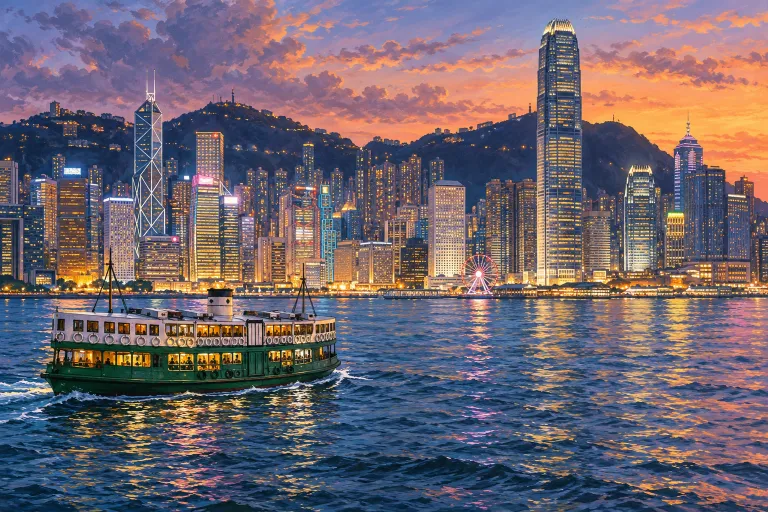
- Victoria Harbour lies between Hong Kong Island and Kowloon. Knowing which shore you need is more useful than simply searching for a skyline photo. Hong Kong government
- Less than a quarter of Hong Kong's land is developed. The built-up skyline is only one part of the map. Hong Kong government
- About 40% of the land is country parks and nature reserves. This is why a trail can be close to a dense urban district. Hong Kong government
- Chinese and English are official languages. That does not mean every conversation happens in both languages. Hong Kong government
- Cantonese is the most common usual spoken language. In the 2021 census, 88.2% of residents aged five or over reported it as their usual spoken language. Hong Kong government, 2021 census
Weather, trails and protected nature
- Hong Kong has a subtropical climate. Its seasons can feel very different from one another, so do not plan from a year-round average. Hong Kong government
- Summer can be hot and rainy. Check the Hong Kong Observatory before committing to a long outdoor day. Hong Kong government
- Autumn is generally warm, sunnier and drier. A seasonal description is not a forecast for your exact travel dates. Hong Kong government
- June and August are listed as the wettest months. Carry a flexible indoor alternative, not a promise that every day will be wet. Hong Kong government
- January and December are listed as the driest months. Always check the current forecast before a ferry or hike. Hong Kong government
- Hong Kong has 25 country parks. They are designated for conservation, recreation and outdoor education. Agriculture, Fisheries and Conservation Department
- It also has 22 special areas. These are created mainly for nature conservation and are not the same category as country parks. Agriculture, Fisheries and Conservation Department
- The protected park landscape spans more than 44,000 hectares. The official figure combines country parks and special areas. Agriculture, Fisheries and Conservation Department
- The parks contain reservoirs as well as mountains and coastline. Pick a trail by terrain and distance, not simply by how green it looks in a photo. Agriculture, Fisheries and Conservation Department
- Robin's Nest became a country park in March 2024. It is a reminder that protected-area maps can change. Agriculture, Fisheries and Conservation Department
Getting around without guesswork
- The MTR has nine main commuter lines. They serve Hong Kong Island, Kowloon and the New Territories, while other rail services cover additional journeys. MTR
- The Airport Express is a separate named service. It links Hong Kong International Airport with the central business area and AsiaWorld-Expo. MTR
- The Airport Express has five stations. They are AsiaWorld-Expo, Airport, Tsing Yi, Kowloon and Hong Kong. MTR
- The airport-to-city Airport Express trip can take as little as 24 minutes. That is a rail journey time, not a guarantee for your whole door-to-door trip. MTR
- AsiaWorld-Expo is a short Airport Express ride from the airport. MTR describes the station-to-station trip as two minutes. MTR
- Light Rail serves the north-western New Territories. It is distinct from the main MTR commuter lines. MTR
- The Disneyland Resort Line is part of the MTR network. It runs between Sunny Bay and Disneyland Resort. MTR
- The East Rail Line reaches cross-boundary stations. Its route includes Lo Wu and Lok Ma Chau, so check entry requirements before any cross-border plan. MTR
- MTR offers several ways to pay. Its ticket page lists Octopus, QR code, contactless bank card and single-journey tickets; acceptance can depend on the line and journey. MTR tickets and fares
- Station exit maps can save a detour. MTR publishes individual station layouts and location maps, useful when your destination is across a busy road or harbour-side block. MTR maps
Museums explain more than the skyline
- The government museum service runs 15 museums and two other art spaces. They cover art, history and science rather than one single theme. LCSD Museums
- The Hong Kong Museum of Art shows Hong Kong and Chinese art. It also presents works from other cultures. LCSD Museums
- The Heritage Museum covers living culture. Its themes include design, popular culture, photography and Cantonese opera. LCSD Museums
- The Museum of History has a collection of over 170,000 items. Its scope reaches beyond a single political era. LCSD Museums
- The Science Museum uses interactive displays. It is an option when weather makes an outdoor plan uncomfortable. LCSD Museums
- The Space Museum is a planetarium. Its distinctive egg-shaped dome encloses a Space Theatre with a hemispherical screen. LCSD Museums
- The coastal-defence museum sits at Lyemun Pass. Its exhibition and outdoor trail explain military and coastal history. LCSD Museums
- Dr Sun Yat-sen has a dedicated Hong Kong museum. The museum connects his life with the city's history. LCSD Museums
- Law Uk Folk Museum preserves an eighteenth-century Hakka village house. It is furnished to show an earlier domestic setting. LCSD Museums
- Lei Cheng Uk Han Tomb is preserved in place. The museum includes an exhibition on finds from the brick tomb. LCSD Museums
Landmarks and living neighbourhoods
- The Star Ferry crosses Victoria Harbour. Its routes connect piers on the Kowloon and Hong Kong Island sides. Hong Kong Tourism Board
- The Peak Tram takes visitors up toward Victoria Peak. It is a transport experience as well as a way to reach a viewpoint. Hong Kong Tourism Board
- Hong Kong Island also has street trams called “ding dings.” The Tourism Board recommends them for a slower street-level look at the city. Hong Kong Tourism Board
- The Big Buddha is on Lantau Island. The Tourism Board pairs it with nearby Po Lin Monastery and a cable-car journey. Hong Kong Tourism Board
- Tai O is known for stilt houses. It remains a fishing-village setting, not a theme-park recreation of one. Hong Kong Tourism Board
- Old Town Central includes Central and Sheung Wan. Its street mix puts historic temples near galleries and restaurants. Hong Kong Tourism Board
- Man Mo Temple is a declared monument. It sits in Sheung Wan and is among Hong Kong's older temples. Hong Kong Tourism Board
- Sham Shui Po has a strong maker and market identity. The Tourism Board highlights fabric finds and independent shops alongside food. Hong Kong Tourism Board
- West Kowloon is a waterfront arts district. Its museums and open spaces offer a different harbour experience from the classic skyline lookout. Hong Kong Tourism Board
- Ping Shan Heritage Trail tells an older New Territories story. The Tourism Board links it to 13th-century clan settlers and surviving halls, temples and a walled village. Hong Kong Tourism Board
Hong Kong questions people actually ask
Is Hong Kong a country or a city?
Hong Kong is a Special Administrative Region of China. It includes Hong Kong Island, Kowloon, the New Territories and many outlying islands. Hong Kong government source.
What language is spoken in Hong Kong?
Chinese and English are official languages. Cantonese is the most common usual spoken language in the 2021 census, but do not assume one language fits every person or setting. Hong Kong government source.
Does Hong Kong have nature trails?
Yes. Its country parks protect hills, woodlands, reservoirs and coast. Check the official park or weather information before selecting a trail. AFCD source.
How do I get from Hong Kong airport to the city?
The Airport Express links the airport with Tsing Yi, Kowloon and Hong Kong stations. Compare its current fare and onward connection with other transport before booking. MTR source.
What can I see in Hong Kong besides the skyline?
Try a public museum, a country park, Tai O or a heritage walk in the New Territories. Pick one area per outing and check opening hours or trail conditions first. LCSD Museums; Hong Kong Tourism Board.
Planning note: A fact about a place is not a promise of admission, accessibility, operating hours or entry permission. Recheck official transport, attraction, immigration and weather pages before making plans.