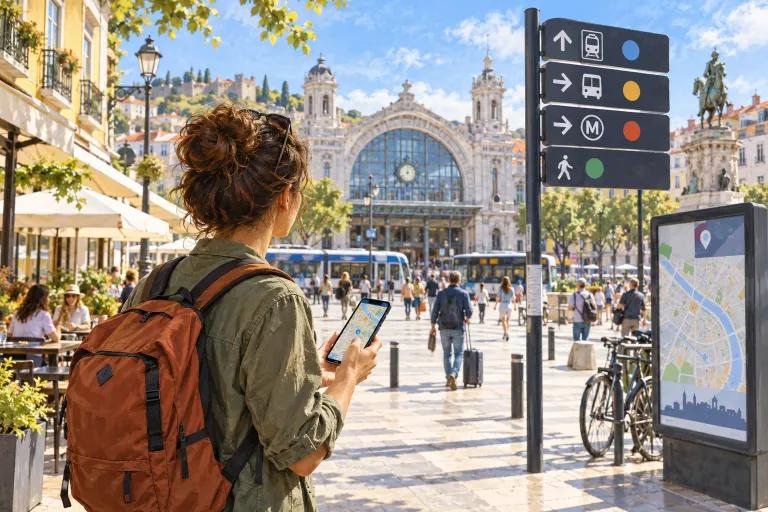
Solo travel safety: a calm plan you can actually use
Simple checks before departure, on arrival and when plans change. Updated 14 October 2026.
Quick answer: Choose a destination you can navigate, arrive at a sensible hour, keep your first night simple and have one trusted person who knows your basic route. Check government travel advice, entry rules and health information for your exact country and dates. No checklist can make travel risk-free, but a few clear habits make problems easier to handle without turning the trip into constant worry.
| When | Five-minute action | Why it helps |
|---|---|---|
| Before booking | Read official destination advice and transport options. | Know entry rules and realistic arrival choices. |
| Before departure | Save documents and emergency contacts offline. | Useful when the phone has no signal. |
| On arrival | Use a known route to your first lodging. | Avoid deciding everything while tired. |
| Each day | Share a simple check-in plan with one trusted person. | Someone notices if plans change unexpectedly. |
Compare document organisers ↗Compare power banks ↗
Start with destination facts, not fear
Look up the government travel advisory for your nationality, plus the destination’s official entry, health and local-law information. An advisory describes risks and practical steps; it does not tell you how every day will feel. Read the specific city or region notes rather than relying on a social-media headline about an entire country.
Check whether your passport remains valid long enough, whether you need a visa or travel authorisation, and whether any health requirement applies. The US State Department’s traveller checklist recommends checking these before departure and keeping copies of documents. Travellers from the UK, Canada, Australia or elsewhere should use their own government’s advice as the primary source for consular help and entry guidance.
Choose your first lodging for access, not only price. A room near a reliable airport route or station can make arrival much easier. Read recent reviews for practical details such as check-in, stairs, street noise and how to reach the entrance. A low headline rate that leaves you walking far with luggage at midnight may be poor value.
Make arrival day easy
Before flying, write down the lodging address in the local language where useful, the check-in instructions and the route from the airport or station. Check the transport operator’s current hours. If your flight arrives late, compare an official taxi or prearranged transfer with public transport; the best choice depends on the place, time and your comfort.
On arrival, use the route you planned. If a driver or helper approaches you outside the official pickup area, you can decline and use the marked service. Confirm the destination and payment method before the journey. If you get confused, step into a staffed area, café or official information desk to work out the next step.
Do not schedule a costly timed attraction after an overnight flight. Eat, check in and rest. A solo traveller does not need to prove independence by making the first day difficult.
Keep documents accessible but protected
Carry the document you need for local identification according to local rules. Keep backup copies separate from originals. The US State Department recommends multiple copies and leaving one with a trusted person. For digital copies, use an account with a strong password and avoid a public link. Do not share passport photos with a stranger who does not have a clear need for them.
Save booking confirmations, insurance details, the emergency contact for your insurer, your bank’s lost-card number and your consulate’s details offline. If your phone is lost, you need another way to reach that information. A small paper card in a separate bag can be useful. Keep a backup payment method somewhere secure rather than in the same pocket as your main card.
Check medication rules for the destination and keep essential medicine in hand luggage. A new city is not the right place to discover that a prescription cannot be easily replaced. Ask a clinician about travel health needs for your circumstances; a general article cannot give individual medical advice.
A check-in plan that respects your freedom
Tell one trusted person your rough route and when you expect to check in. Agree on what they should do if you miss a message—first try again, then use your lodging or emergency contact if the delay is unusual. Avoid giving a public audience your live location or room number. Share only with people who need it.
A check-in can be as simple as “arrived at the hotel” and “travelling to the next city tomorrow.” You do not need to report every café visit. If plans change, send a short update. The system works best when it is easy enough that you will actually use it.
US citizens can consider the State Department’s Smart Traveler Enrollment Program for embassy alerts and emergency contact. Other countries have their own registration or alert services. Use the one relevant to your citizenship, not an unrelated programme just because a travel blog mentions it.
Move around without drawing attention to valuables
Learn the local transport payment method before you need it. Check the last service and the route back to your lodging. Keep your phone charged but do not stare at it while crossing roads or moving through a crowded station. Step aside in a safe place to read directions.
Use a bag you can keep close and close it properly. Do not leave it on the back of a chair or a station floor while distracted. If a venue has a locker, read its rules and keep essential documents with you. Ordinary caution is more useful than expensive “anti-theft” products with exaggerated promises.
If you feel uncomfortable with a route, a person or a setting, leave. You do not owe an explanation. Go to a staffed place or use a licensed transport option. Trusting your judgment includes changing a plan that looked fine online.
Meeting people without giving up boundaries
Solo travel can be social. A group walk, class or organised activity may be an easy way to meet others. Choose reputable operators and confirm the meeting point. Tell a trusted person if you are going somewhere remote with a new group. Keep your own way back when possible.
Share personal details gradually. You can say no to a drink, invitation or change of location. Keep control of your own drink and payment. If an interaction feels pressured, move to staff or a public space. Being friendly does not require ignoring discomfort.
Online contacts are still strangers until you know them. Meet in public places and avoid sending copies of identity documents or financial details. A person claiming to work for a hotel or tour company should be checked through the company’s official channel before you act.
Money, insurance and a backup route
Know how to freeze a card in your bank app and contact the bank without the lost phone. Split payment methods. Check how much cash is sensible for your destination; there is no universal amount. Use official exchange or ATM information and avoid accepting help from someone who insists you use a particular machine.
Ask your health insurer whether overseas treatment is covered, then compare travel medical and evacuation insurance if needed. Read the policy terms, exclusions and emergency number. The US State Department says the US government does not pay medical bills for citizens abroad. Travellers from other countries should verify their own public and private cover.
Keep a backup for a missed connection: a later train, a safe nearby hotel or a way to contact the carrier. You do not need to reserve every backup in advance. You do need enough money and information to avoid a panicked decision.
If something goes wrong
For immediate danger, use the local emergency number. For illness or injury, get medical help first, then contact your insurer when practical. For theft, move somewhere safe, freeze cards, and follow local police or carrier reporting procedures. Contact your embassy or consulate for the help it can actually provide. It may assist with documents or referrals, but it is not a general insurer or bank.
Keep a short written record of what happened, when and who you contacted. This can help with insurance and replacement documents. If you are shaken, ask a trusted person to help you work through the next one or two steps. You do not need to solve every consequence at once.
A quick daily routine
- Check the day’s weather, transport and any official local notice.
- Know the route back to your lodging and the last safe transport option.
- Charge your phone and keep a backup way to access key information.
- Share a simple check-in if changing towns or taking a remote outing.
- Adjust plans when tired, unwell or uncomfortable.
Quick questions
Is solo travel automatically unsafe?
No. Risk depends on destination, timing, activities and individual circumstances. Use current official advice and practical habits rather than a blanket claim.
Should I share my live location with everyone?
No. Share it only with a trusted person if useful; avoid publishing a room number or real-time route publicly.
Do I need special safety gadgets?
Usually the fundamentals—planning, contacts, charged phone and judgment—matter more. No gadget guarantees safety.
What if my phone disappears?
Use offline or paper copies of lodging, insurance, bank and consular contacts, plus a separate payment method.
Leave a Reply