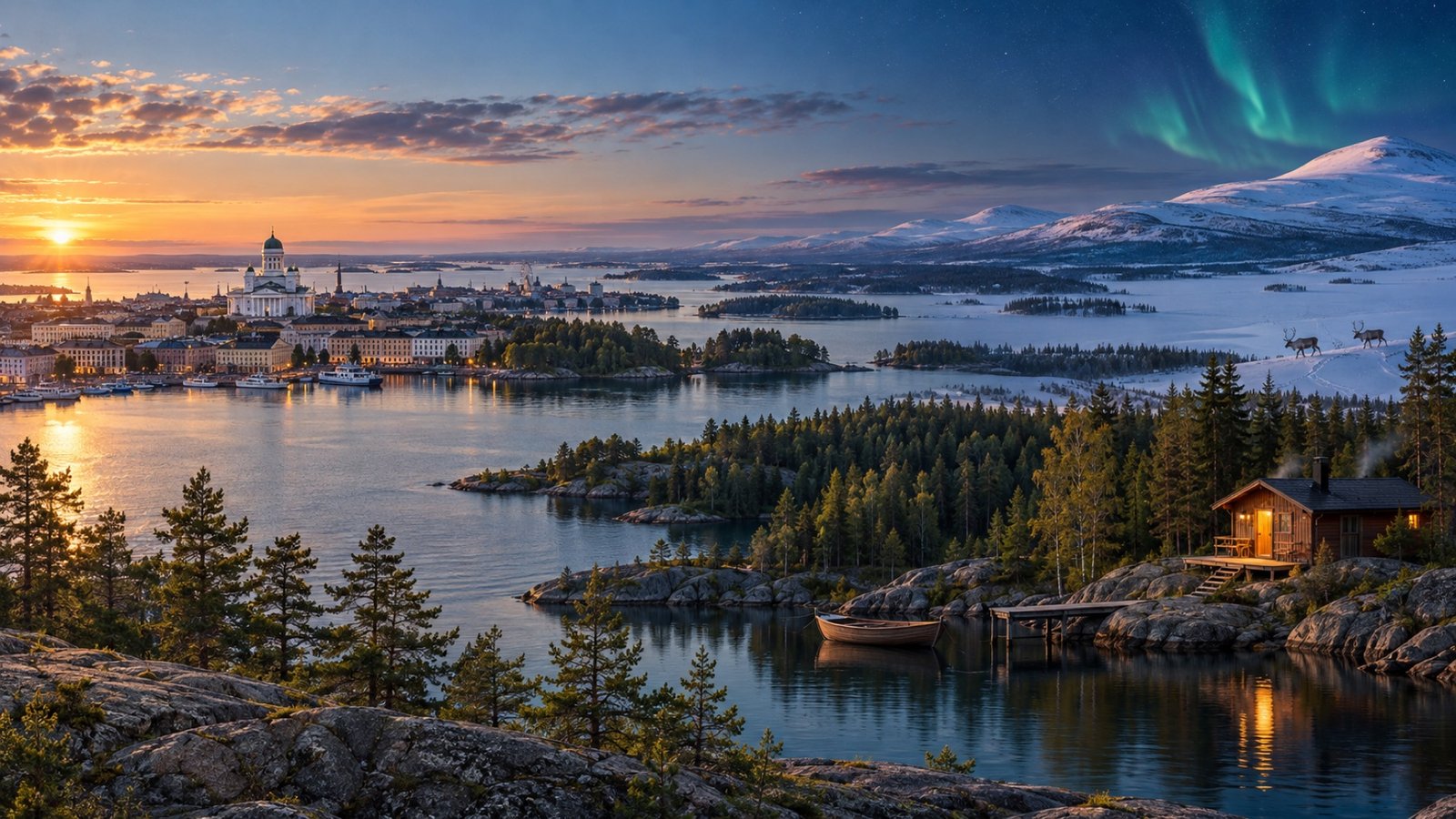
This guide uses official tourism, government and transport sources. Rules and prices can change, so check the linked official pages before booking.
Finland is not one winter package. Helsinki’s island city, the bilingual coast, vast Lakeland, industrial and design heritage, boreal national parks and the living Sámi cultural landscape of the north each require different seasons and decisions. These fifty experiences help first-time visitors plan public transport and ferries, approach sauna and ice safely, respect Everyman’s Rights, and distinguish responsible Arctic interpretation from staged shortcuts.
Finland at a glance
- Ideal first trip: 10–14 days for Helsinki plus Lakeland, the southwest coast or one Lapland base.
- Currency: euro; cards are widely used, while small seasonal services and remote transport should be checked.
- Daily rule: confirm the operating transport company, weather, Fintraffic and the relevant park, ferry or attraction.
- Nature: Everyman’s Rights carry duties; homes, cultivated land, fire restrictions and protected areas remain limits.
- Price check: verify current rail, ferry, cabin, sauna, guide and cancellation totals before purchase.
Entry, visa and arrival planning
Finland participates in the Schengen Area. Check the official Finnish visa service and the authority responsible for your passport and residence for current entry rules.
Helsinki is the principal gateway, while Turku ferries, Tampere and northern airports can reduce backtracking. Åland and Arctic routes require separate timetable checks.
When to go
Summer provides long daylight, archipelago services and broad trail access. Winter creates snow and ice activities but also cold, short southern daylight and possible aurora rather than a guarantee.
Spring and autumn can be quiet and beautiful, while freeze–thaw surfaces, reduced boats and variable snow require live information.
Budget and places to stay
Compare rail, domestic flights and rental cars using full totals: reservations, airport transfers, fuel, parking, winter equipment and one-way fees.
Cabins may price linen, cleaning, heating or meals separately. Confirm lake access, road maintenance, bathrooms and final cost before booking.
Fifty things to do in Finland
1. Helsinki Senate Square and cathedral district
Why go: Helsinki. Neoclassical planning, university buildings and an active cathedral provide a clear introduction to the capital.
Good for: city breaks and first-time visitors
Know before you go: Worship, demonstrations, events and icy steps can alter access.
2. Suomenlinna by public ferry
Why go: Helsinki. The UNESCO sea fortress connects Swedish, Russian and Finnish history across inhabited islands.
Good for: history, archaeology and cultural travellers
Know before you go: Ferries, exposed paths and resident privacy require a realistic island plan.
3. Ateneum for Finnish art in context
Why go: Helsinki. The national collection connects nineteenth-century nation-building, modernism and international exchange.
Good for: culture, families and rainy-day travellers
Know before you go: Works rotate and a major collection rewards a selective route.
4. Kiasma and Helsinki contemporary art
Why go: Helsinki. Contemporary exhibitions and architecture create a useful counterpoint to the historic centre.
Good for: culture, families and rainy-day travellers
Know before you go: Installations change and some spaces may be sensory-intensive.
5. Oodi Central Library as civic architecture
Why go: Helsinki. The public library demonstrates Finnish investment in reading, making, play and accessible shared space.
Good for: design and architecture travellers
Know before you go: It is a working library, so events, quiet zones and equipment rules matter.
6. Temppeliaukio rock church with worship respect
Why go: Helsinki. A church carved into bedrock combines geology, acoustics and post-war design.
Good for: design and architecture travellers
Know before you go: Services, concerts and group arrivals can pause tourist access.
7. Design Museum and Design District walk
Why go: Helsinki. Collections and independent studios connect familiar Finnish brands with labour, materials and changing design values.
How to do it: Check demonstration times, identify the maker and production place and treat the village or studio as a working environment.
Good for: design, makers and responsible shoppers
Know before you go: A design label is not proof of local manufacture.
8. Seurasaari open-air museum in season
Why go: Helsinki. Transferred buildings and guides show regional domestic architecture across a wooded island.
Good for: culture, families and rainy-day travellers
Know before you go: Building access, demonstrations and cafés are highly seasonal.
9. Public sauna with etiquette and safe cooling
Why go: Helsinki. A regulated sauna introduces an everyday social practice when heat, privacy and bathing rules are respected.
How to do it: Choose a regulated public venue, follow washing and swimwear rules, hydrate and ask a clinician if heat or cold exposure may be unsafe.
Good for: wellness travellers who can manage heat safely
Know before you go: Heat exposure, cold water and medical conditions require restraint.
10. Nuuksio National Park by public transport
Why go: Espoo. Forest, lakes and marked trails provide a genuine nature day close to the capital.
Good for: walking, wildlife and landscape travellers
Know before you go: Mud, ice, fire restrictions and infrequent final connections matter.
11. Porvoo old town beyond the red warehouses
Why go: Porvoo. Wooden streets, river trade, cathedral history and independent businesses create a coherent day trip.
Good for: history, archaeology and cultural travellers
Know before you go: Cobbles, residents and fire-sensitive timber areas need care.
12. Fiskars Village and working design studios
Why go: Raasepori. An ironworks village now supports makers, exhibitions and industrial-landscape interpretation.
How to do it: Check demonstration times, identify the maker and production place and treat the village or studio as a working environment.
Good for: design, makers and responsible shoppers
Know before you go: Studios and exhibitions have separate seasonal schedules.
13. Hanko coast and spa-town history
Why go: Hanko. Villas, beaches and migration history reveal Finland’s southern maritime edge.
Good for: city breaks and first-time visitors
Know before you go: Cold water, wind and reduced off-season services change the visit.
14. Turku Castle with Baltic history
Why go: Turku. The castle connects medieval power, Swedish rule and later prison and museum history.
Good for: history, archaeology and cultural travellers
Know before you go: Stairs, restoration and event use can restrict rooms.
15. Turku Cathedral and river walk
Why go: Turku. Religious history and the Aura river urban corridor explain why Turku became Finland’s oldest major city.
Good for: history, archaeology and cultural travellers
Know before you go: Services, bicycles and winter surfaces require attention.
16. Forum Marinum and working harbour
Why go: Turku. Ships, naval history and maritime trade make the southwest coast legible.
Good for: culture, families and rainy-day travellers
Know before you go: Vessel access is seasonal and ladders or gangways may limit mobility.
17. Turku archipelago short route with timetable discipline
Why go: Southwest Finland. Ferries, skerries and inhabited islands show a bilingual maritime landscape.
Good for: islands, lakes and slow-travel visitors
Know before you go: Missed ferries, limited food and strong wind can strand an overambitious route.
18. Åland maritime museum and island cycling
Why go: Åland. Autonomous island history, shipping and gentle roads offer a distinct bilingual region.
Good for: islands, lakes and slow-travel visitors
Know before you go: Ferry reservations, wind and seasonal services need advance planning.
19. Old Rauma on a respectful walking circuit
Why go: Rauma. The UNESCO wooden town preserves a living commercial centre rather than a frozen museum set.
Good for: history, archaeology and cultural travellers
Know before you go: Homes, narrow streets and fire safety make considerate movement essential.
20. Sammallahdenmäki Bronze Age burial site
Why go: Satakunta. Stone cairns within forest connect prehistoric ritual with a changing shoreline.
Good for: history, archaeology and cultural travellers
Know before you go: Protected structures, roots and seasonal path conditions rule out climbing.
21. Tampere Vapriikki museum centre
Why go: Tampere. Multiple collections inside an industrial setting allow history, media and natural science to be tailored to the group.
Good for: culture, families and rainy-day travellers
Know before you go: The range encourages overpacking; select exhibitions in advance.
22. Tampere public sauna and lake culture
Why go: Tampere. A lakeside sauna can connect industrial-city life with an enduring everyday ritual.
How to do it: Choose a regulated public venue, follow washing and swimwear rules, hydrate and ask a clinician if heat or cold exposure may be unsafe.
Good for: wellness travellers who can manage heat safely
Know before you go: Swimming, winter ice and heat exposure require local rules and supervision.
23. Moomin Museum with literary context
Why go: Tampere. Original art and archives reveal Tove Jansson’s craft beyond merchandise.
Good for: culture, families and rainy-day travellers
Know before you go: Family demand and quiet viewing needs should shape the visit.
24. Serlachius museums in Mänttä
Why go: Pirkanmaa. Art collections, forest-industry wealth and contemporary architecture form a destination beyond a single gallery.
Good for: culture, families and rainy-day travellers
Know before you go: Transport, separate sites and seasonal outdoor art require a full-day plan.
25. Hämeenlinna castle and regional history
Why go: Häme. A medieval castle and nearby museums connect inland administration, defence and everyday life.
Good for: history, archaeology and cultural travellers
Know before you go: Stairs, events and winter courtyards affect access.
26. Verla groundwood and board mill
Why go: Kymenlaakso. The UNESCO mill preserves machinery, workers’ history and an industrial settlement in its original landscape.
Good for: history, archaeology and cultural travellers
Know before you go: Guided interiors and opening seasons are limited.
27. Lappeenranta fortress and Lake Saimaa harbour
Why go: South Karelia. Earthworks, museums and the harbour introduce borderland history and Lakeland travel.
Good for: city breaks and first-time visitors
Know before you go: Events, slopes and boating schedules change the route.
28. Olavinlinna Castle in Savonlinna
Why go: South Savo. A lake fortress connects frontier politics, architecture and a modern opera tradition.
Good for: history, archaeology and cultural travellers
Know before you go: Festival periods, boats and steep stone circulation can complicate access.
29. Lake Saimaa cruise with seal-sensitive behaviour
Why go: Lakeland. A licensed cruise reveals labyrinthine waterways and the habitat of the endangered Saimaa ringed seal.
Good for: islands, lakes and slow-travel visitors
Know before you go: Wildlife sightings are uncertain and protected areas require distance.
30. Punkaharju ridge road and forest museum
Why go: South Savo. A narrow glacial ridge, lakes and forest interpretation show why landscape became part of Finnish identity.
Good for: walking, wildlife and landscape travellers
Know before you go: Traffic, steep shores and winter ice limit roadside stops.
31. Koli National Park from official trails
Why go: North Karelia. Famous views over Lake Pielinen gain meaning through geology, art history and managed trails.
Good for: walking, wildlife and landscape travellers
Know before you go: Snow, fog and steep roots require a route below the group’s limit.
32. Joensuu and Karelian cultural context
Why go: North Karelia. Museums, food and river-city life can introduce eastern traditions without romanticising border history.
Good for: responsible cultural travellers
Know before you go: Events and regional distances reward an overnight stay.
33. Jyväskylä Alvar Aalto route
Why go: Central Finland. Buildings and collections trace Aalto’s development across civic, educational and domestic commissions.
Good for: design and architecture travellers
Know before you go: Several sites require separate booking and transport.
34. Petäjävesi Old Church with conservation etiquette
Why go: Central Finland. The UNESCO timber church demonstrates Nordic wooden construction and living parish history.
Good for: history, archaeology and cultural travellers
Know before you go: Worship, fragile interiors and seasonal opening restrict casual access.
35. Kuopio Puijo tower and market hall
Why go: North Savo. Lakeland views, local food and a compact city centre form a practical regional base.
Good for: city breaks and first-time visitors
Know before you go: Fog, lift maintenance and seasonal market hours can alter the day.
36. Repovesi National Park on a marked circuit
Why go: Kymenlaakso. Cliffs, forest and lakes provide a stronger hiking day within reach of southern cities.
Good for: walking, wildlife and landscape travellers
Know before you go: Bridge status, steep steps, ice and limited transport require checks.
37. Archipelago National Park with an authorised operator
Why go: Southwest Finland. Remote islands and Baltic ecology are best reached through licensed boats or a well-planned paddling trip.
Good for: islands, lakes and slow-travel visitors
Know before you go: Cold water, wind and rescue distance make improvisation unsafe.
38. Kvarken Archipelago and land-uplift interpretation
Why go: Ostrobothnia. The UNESCO landscape visibly records post-glacial land uplift across shallow bays and moraine ridges.
Good for: walking, wildlife and landscape travellers
Know before you go: Seasonal boats, nesting areas and changing water depth affect access.
39. Vaasa museums and bilingual coastal culture
Why go: Vaasa. Regional history, art and Swedish-Finnish everyday life add depth before entering the archipelago.
Good for: city breaks and first-time visitors
Know before you go: Separate museum schedules and winter weather reward a compact plan.
40. Oulu market square and science centre
Why go: Oulu. Coastal trade, technology and cycling culture make Oulu more than a Lapland transit point.
Good for: city breaks and first-time visitors
Know before you go: Snow, bicycles and waterfront wind affect walking.
41. Hailuoto ferry island day
Why go: Northern Ostrobothnia. Dunes, villages and Bothnian coast ecology offer a slow day from Oulu.
Good for: islands, lakes and slow-travel visitors
Know before you go: Ferry or ice-road status, wind and limited island services must be checked.
42. Rovaniemi Arktikum before outdoor excursions
Why go: Rovaniemi. Arctic science, regional history and northern livelihoods give context to commercial winter activities.
Good for: culture, families and rainy-day travellers
Know before you go: A large indoor visit and tour departures need deliberate pacing.
43. Rovaniemi Christmas attraction with clear expectations
Why go: Rovaniemi. A commercial festive district can be enjoyable when visitors separate entertainment from regional culture.
How to do it: Check age suitability, queues, food, toilets and quiet spaces, then keep the rest of the day light.
Good for: families and multigenerational groups
Know before you go: Queues, pricing and staged experiences should be understood before arrival.
44. Reindeer experience led by responsible local herders
Why go: Finnish Lapland. A herder-led visit can discuss livelihoods, land use and animal welfare beyond a short sleigh photograph.
Good for: responsible cultural travellers
Know before you go: Photography, feeding and handling must follow the host’s rules.
45. Sámi Museum Siida and Inari cultural landscape
Why go: Inari. Community-led exhibitions connect Sámi history, languages, environment and contemporary life.
Good for: responsible cultural travellers
Know before you go: Sacred or culturally sensitive material requires respectful behaviour.
46. Lake Inari with licensed transport
Why go: Inari. A vast Arctic lake links islands, seasonal light and Sámi homelands.
Good for: islands, lakes and slow-travel visitors
Know before you go: Cold water, rapidly changing weather and winter ice demand professional judgment.
47. Urho Kekkonen National Park on a modest route
Why go: Saariselkä. Fells, boreal forest and hut networks provide accessible Arctic walking near services.
Good for: walking, wildlife and landscape travellers
Know before you go: Snow, darkness, navigation and remoteness increase quickly beyond day routes.
48. Pallas–Yllästunturi fell trail by season
Why go: Western Lapland. Open fells and long-distance paths offer clean horizons without guaranteeing easy conditions.
How to do it: Use current trail and weather information, carry navigation and emergency layers, reserve huts or transport and turn back early when conditions change.
Good for: experienced hikers and hut-to-hut travellers
Know before you go: Wind, snow, river crossings and hut spacing require mountain preparation.
49. Oulanka National Park and Karhunkierros segment
Why go: Kuusamo. Rivers, gorges, forest and suspension bridges support anything from a day walk to a multi-day route.
How to do it: Use current trail and weather information, carry navigation and emergency layers, reserve huts or transport and turn back early when conditions change.
Good for: experienced hikers and hut-to-hut travellers
Know before you go: Flooding, ice, steep stairs and crowded huts require current trail information.
50. Northern lights with a safety-led operator
Why go: Finnish Lapland. A responsible guide can manage cold, road conditions and cloud better than improvised roadside chasing.
Good for: walking, wildlife and landscape travellers
Know before you go: Aurora are never guaranteed and severe cold can become an emergency.
Food and drink worth planning around
Rye bread, fish, berries, mushrooms, dairy, Karelian pies and regional modern cooking reward local context. Ask about origin, season and allergens.
Foraging requires confident identification and compliance with protected-area, private-home and local rules; never consume an uncertain mushroom or berry.
What to buy
For glass, ceramics, textiles, knives, wood, knitwear and Sámi duodji, identify the maker, material and production location. Finnish branding is not proof of Finnish manufacture.
Use established sellers, keep receipts and check antique, wildlife-material and tax rules before export.
Getting around
Use the national rail and regional transport planners, then confirm tickets with the operating company. Night trains and long-distance services can require reservations.
Use Fintraffic for road and rail conditions. Winter tyres do not remove the need to slow down, allow daylight and avoid unmaintained shortcuts.
Easy access and family travel
Accessibility varies across historic ships, cobbles, ferries, saunas, forest trails and snow seasons. Ask for exact boarding, changing, gradients, lifts and toilets.
Families and mixed-ability groups should agree on a short shared route plus optional extension. Heat, cold, darkness and mosquitoes can be more tiring than expected.
Stay safe
Check official weather, ice, fire, road and trail information. Use qualified guides for thin ice, exposed winter travel and unfamiliar paddling or backcountry routes.
Everyman’s Rights do not permit disturbance or damage. Stay away from homes and crops, follow fire rules, protect wildlife and leave no trace.
Mistakes to avoid
- Trying to combine Helsinki, Åland, Lakeland and Lapland in one rushed week.
- Assuming every ferry, island service, hut or museum building runs year-round.
- Walking or driving onto natural ice without current local safety information.
- Treating Everyman’s Rights as permission to enter gardens, crops or protected habitat.
- Expecting northern lights or midnight sun without matching season and latitude.
- Reducing Sámi culture to costumes, reindeer photos or generic “Lapland” branding.
- Booking an extreme sauna–ice routine without health and supervision considerations.
- Making every segment non-refundable with no weather buffer.
Sample seven-day route
Use four Helsinki nights, one Porvoo or Nuuksio day and two Turku or Tampere nights. Do not add Lapland to the same short week.
Sample ten-day route
Use three Helsinki, three Turku and archipelago or Tampere, and four Savonlinna, Koli or another Lakeland base nights.
Sample fourteen-day route
Use four Helsinki and coast, four Lakeland, and six Rovaniemi, Inari or Kuusamo nights. Fly or use the sleeper train for the long northern leg and keep a weather buffer.
Finland travel FAQ
How many days are enough for Finland?
Seven days suits Helsinki and one southern region. Ten to fourteen days supports a strong coast–Lakeland or city–Lapland trip.
Do I need a car?
No for major cities, rail corridors and many organised Lapland activities. A car helps in selected rural areas, but winter roads and long distances require planning.
Can I walk or camp anywhere?
No. Everyman’s Rights have limits near homes, on cultivated land and in protected areas, and fire or camping restrictions still apply.
Are northern lights guaranteed?
No. Darkness, clear sky, solar activity and a safe location all matter; southern Finland is not equivalent to Lapland.
Official planning sources
- Visit Finland official destinations
- Visit Finland official things to do
- Visit Finland practical information
- Finland national parks and outdoor guidance
- Fintraffic road conditions
- Finland official visa information
- Sámi Museum Siida
- UNESCO World Heritage state-party record for Finland
- United Kingdom government travel advice for Finland
- United States government travel advisory for Finland
Disclosure: This independent editorial guide is informational, not a booking guarantee. No price, ranking, safety outcome, entry permission or availability is guaranteed. Recheck all time-sensitive details with the linked official source before purchase.