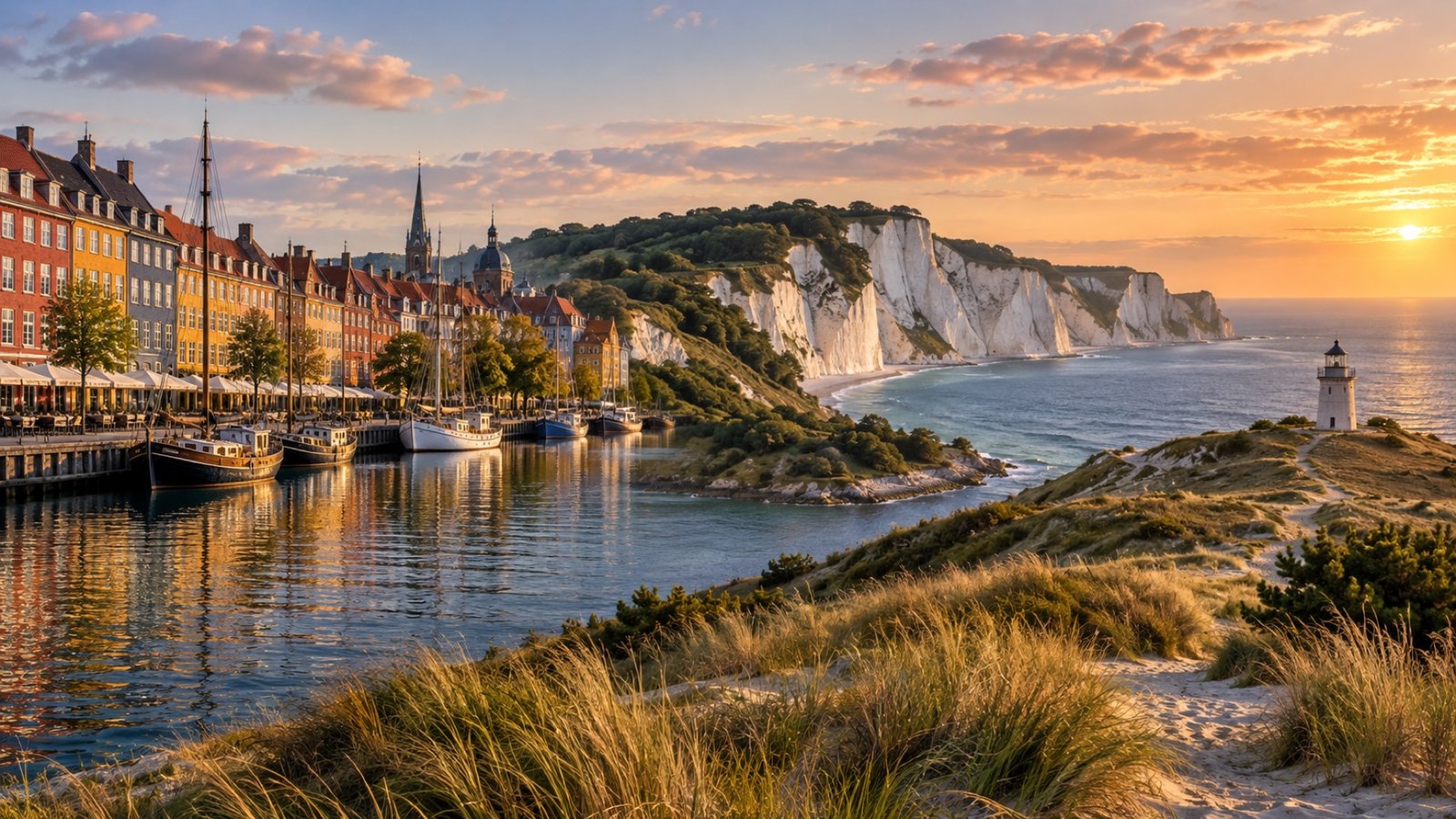
This guide uses official tourism, government and transport sources. Rules and prices can change, so check the linked official pages before booking.
Denmark is compact, but it is not only a Copenhagen checklist. Island cities, royal and Viking landscapes, design, food, Baltic and North Sea coasts, living wooden towns and Jutland’s dunes require different timing and behaviour. These fifty experiences help first-time visitors use trains, ferries and bicycles safely, understand tides and cliff closures, distinguish historical evidence from popular mythology, and build a route that supports working communities.
Denmark at a glance
- Ideal first trip: 7–12 days for Copenhagen plus one or two regions by train or ferry.
- Currency: Danish krone; cards are widespread, though small seasonal services should be checked.
- Daily rule: confirm Rejseplanen or the operating company, weather and the relevant attraction, ferry, park or road authority.
- Cycling: Copenhagen lanes are transport infrastructure, not beginner practice space; learn signals before joining peak flow.
- Price check: verify current rail, ferry, museum, food, accommodation and cancellation totals before purchase.
Entry, visa and arrival planning
Denmark participates in the Schengen Area. Check the official Danish immigration service and the authority responsible for your passport and residence for current entry and visa rules.
Copenhagen is the main air and rail gateway. Billund, Aarhus, Aalborg and ferries can reduce backtracking, while the Faroe Islands and Greenland require separate planning and are outside this mainland guide.
When to go
Late spring through early autumn supports the broadest island boats, gardens, beaches and outdoor museums. Winter offers city culture and seasonal atmosphere with short daylight, wind and reduced rural services.
North Sea conditions, cliff access and ferries can change in any season. Shoulder months reward flexible travellers who verify every connection.
Budget and places to stay
Compare rail and bus tickets with regional or national products using exact journeys. Add airport transport, bicycle rental, ferries, attraction extras and reservation rules.
Holiday homes may price cleaning, utilities and linen separately. Verify the final amount, public-transport access and check-in process.
Fifty things to do in Denmark
1. National Museum of Denmark for a chronological foundation
Why go: Copenhagen. Prehistory, monarchy, trade and modern social history make later castles and Viking sites easier to interpret.
Good for: culture, families and rainy-day travellers
Know before you go: Large collections and changing displays reward a selective route.
2. Nyhavn as a working waterfront, not only a photograph
Why go: Copenhagen. Historic houses, canals and harbour transport show how the waterfront changed from commerce to public life.
Good for: city breaks and first-time visitors
Know before you go: Crowds, restaurant pricing and active quays need attention.
3. Rosenborg Castle and royal collections
Why go: Copenhagen. Compact interiors and regalia connect monarchy, collecting and Renaissance royal life.
Good for: history, archaeology and cultural travellers
Know before you go: Timed entry, stairs and narrow rooms can limit access.
4. Christiansborg Palace across one public section
Why go: Copenhagen. Government, ruins, royal reception rooms and city views overlap in a working political complex.
Good for: history, archaeology and cultural travellers
Know before you go: Parliamentary business, ceremonies and separate entries change availability.
5. SMK National Gallery with a focused collection plan
Why go: Copenhagen. Danish and international art reveal national identity, modernism and wider European exchange.
Good for: culture, families and rainy-day travellers
Know before you go: Collection scale and temporary closures make priorities essential.
6. Ny Carlsberg Glyptotek and winter garden
Why go: Copenhagen. Ancient sculpture, French art and the architecture of collecting create a distinctive indoor day.
Good for: culture, families and rainy-day travellers
Know before you go: Gallery rotations and stairs require advance access checks.
7. Designmuseum Danmark with production context
Why go: Copenhagen. Furniture, craft and industrial design explain Danish modernism beyond famous brand names.
Good for: culture, families and rainy-day travellers
Know before you go: Displays rotate and authenticity requires attention to makers and manufacture.
8. Danish Architecture Center and harbour change
Why go: Copenhagen. Exhibitions and waterfront viewpoints make planning, housing and contemporary architecture legible.
Good for: design and architecture travellers
Know before you go: Construction, events and rooftop conditions can alter access.
9. Copenhagen by bicycle only after learning the rules
Why go: Copenhagen. Protected lanes offer practical mobility when visitors understand signals, turning, parking and rush-hour flow.
How to do it: Rent from an established operator, learn Danish signals and lane etiquette, use lights and avoid stopping in commuter flow.
Good for: confident cyclists and low-car city travellers
Know before you go: Wrong-way riding and sudden stops endanger commuters.
10. Harbour bus and waterfront districts
Why go: Copenhagen. Public boats link major modern buildings and neighbourhoods without a sightseeing surcharge.
Good for: coast, islands and slow-travel visitors
Know before you go: Weather, service changes and slippery pontoons affect boarding.
11. Tivoli Gardens as a cultural park, not a rushed checklist
Why go: Copenhagen. Historic landscaping, rides, performance and seasonal design make the park broader than an amusement stop.
Good for: families and multigenerational groups
Know before you go: Separate ride costs, queues and seasonal events change value.
12. Assistens Cemetery and Nørrebro respectfully
Why go: Copenhagen. Burial history, literature and a lived multicultural district reward a quiet, considerate walk.
Good for: city breaks and first-time visitors
Know before you go: It remains a cemetery and neighbourhood rather than a photo set.
13. Reffen or another regulated food-market session
Why go: Copenhagen. Independent kitchens and harbour space can introduce contemporary street food and small producers.
How to do it: Compare posted prices, origin and allergens, choose one dependable meal and avoid treating a market as unlimited sampling.
Good for: food-focused and regional travellers
Know before you go: Hours, weather, allergens and cashless payment vary.
14. CopenHill architecture and activity choice
Why go: Copenhagen. A waste-to-energy plant combined with recreation makes infrastructure visible and debatable.
Good for: design and architecture travellers
Know before you go: Roof access, sports bookings and weather rules must be checked.
15. Louisiana Museum of Modern Art with the sculpture garden
Why go: North Zealand. Art, landscape architecture and Øresund views form one of Denmark’s strongest museum experiences.
Good for: culture, families and rainy-day travellers
Know before you go: Popular trains, timed exhibitions and outdoor weather affect pacing.
16. Kronborg Castle with history beyond Hamlet
Why go: Helsingør. The UNESCO fortress explains tolls, Baltic power and military architecture alongside its literary association.
Good for: history, archaeology and cultural travellers
Know before you go: Performances, stairs and coastal wind change routes.
17. Maritime Museum of Denmark below the old dock
Why go: Helsingør. Innovative architecture and exhibits connect sailors, shipping, trade and family separation.
Good for: culture, families and rainy-day travellers
Know before you go: Sloping circulation and large exhibits reward time.
18. Frederiksborg Castle and national-history museum
Why go: Hillerød. Royal rooms, portraiture and formal gardens trace Danish power and memory.
Good for: history, archaeology and cultural travellers
Know before you go: Restoration, events and garden seasons affect access.
19. Roskilde Cathedral with royal-burial context
Why go: Roskilde. The UNESCO cathedral reveals changing architecture, worship and royal commemoration across centuries.
Good for: history, archaeology and cultural travellers
Know before you go: Services and funerary spaces require respectful timing.
20. Viking Ship Museum with experimental archaeology
Why go: Roskilde. Original ships, reconstruction and sailing research distinguish evidence from popular Viking imagery.
Good for: culture, families and rainy-day travellers
Know before you go: Sailing and outdoor workshops are seasonal and weather-dependent.
21. Dragør old town and harbour without blocking homes
Why go: Amager. A preserved maritime town provides a low-transfer contrast to central Copenhagen.
Good for: city breaks and first-time visitors
Know before you go: Narrow lanes, residents and coastal wind require considerate walking.
22. Møns Klint from open official paths
Why go: Møn. White chalk cliffs, beech forest and geological interpretation form a major coastal landscape.
Good for: walking, wildlife and landscape travellers
Know before you go: Cliff fall, stairs, mud and edge exposure make closures non-negotiable.
23. Camønoen on one realistic stage
Why go: Møn. A long-distance island trail links villages, fields, coast and protected landscapes.
How to do it: Plan one signed stage with confirmed transport, water and accommodation, carry weather layers and turn back early when conditions change.
Good for: experienced walkers and multi-day travellers
Know before you go: Road sections, accommodation and water points require stage planning.
24. Stevns Klint with geological and Cold War context
Why go: Zealand. The UNESCO cliff records a global extinction boundary while nearby sites add modern defence history.
Good for: walking, wildlife and landscape travellers
Know before you go: Cliff edges, access points and fragile geology require marked routes.
25. Camp Adventure tower and forest route
Why go: South Zealand. A spiralling tower and managed woodland walk create a designed viewpoint over flat agricultural country.
Good for: walking, wildlife and landscape travellers
Know before you go: Height, weather, crowds and paid access should be understood.
26. Odense H.C. Andersen House with literary context
Why go: Odense. Architecture, manuscripts and interpretation place the writer beyond simplified fairy-tale branding.
Good for: culture, families and rainy-day travellers
Know before you go: Timed entry and interactive galleries may need sensory breaks.
27. Funen Village open-air museum
Why go: Odense. Historic farm buildings and seasonal demonstrations explain rural life on the island.
Good for: culture, families and rainy-day travellers
Know before you go: Outdoor scale and limited winter programming affect the visit.
28. Egeskov Castle and gardens by season
Why go: Funen. A moated castle, designed landscape and varied collections make a full-day heritage site.
Good for: history, archaeology and cultural travellers
Know before you go: Separate attractions, stairs and seasonal grounds can overwhelm short visits.
29. Ærøskøbing with ferry-day realism
Why go: Ærø. Painted houses, harbour life and island landscapes reward an overnight rather than a rushed connection.
Good for: coast, islands and slow-travel visitors
Know before you go: Ferry reservations, wind and limited off-season services matter.
30. Aarhus ARoS and city-roofline art
Why go: Aarhus. Major modern collections and immersive installations anchor Denmark’s second-city art scene.
Good for: culture, families and rainy-day travellers
Know before you go: Special exhibitions, sensory works and queues need planning.
31. Den Gamle By across one historical era
Why go: Aarhus. Reconstructed streets and living interpretation span several periods of Danish urban life.
Good for: culture, families and rainy-day travellers
Know before you go: Large grounds and seasonal staffing make selection essential.
32. Moesgaard Museum for archaeology and human history
Why go: Aarhus. Prehistory, bog finds and global ethnography are presented in a landscape-led building.
Good for: culture, families and rainy-day travellers
Know before you go: Dense displays and transport from the centre require a half day.
33. Aarhus harbour architecture and Dokk1
Why go: Aarhus. Library, public space and residential development show contemporary city-making on a former industrial edge.
Good for: design and architecture travellers
Know before you go: Construction and working-harbour boundaries can shift.
34. Jelling monuments and visitor centre
Why go: South Jutland. Runic stones, burial mounds and a church connect conversion, kingship and Danish state formation.
Good for: history, archaeology and cultural travellers
Know before you go: Protected monuments and worship require marked, respectful access.
35. LEGOLAND Billund with an age-based plan
Why go: Billund. The original park can be meaningful family play when rides and expectations match the group.
Good for: families and multigenerational groups
Know before you go: Queues, weather, height restrictions and extras alter value.
36. LEGO House as design and creative play
Why go: Billund. Hands-on zones and exhibitions connect a global toy with Danish systems thinking and company history.
Good for: families and multigenerational groups
Know before you go: Timed admission, overstimulation and popular dates need advance planning.
37. Koldinghus with adaptive architecture
Why go: Kolding. A ruined royal castle transformed by modern conservation demonstrates layers rather than a fake restoration.
Good for: history, archaeology and cultural travellers
Know before you go: Ramps, stairs and events affect circulation.
38. Ribe medieval streets and cathedral
Why go: Southwest Jutland. Denmark’s oldest town links ecclesiastical, trading and Viking-era history in a compact centre.
Good for: history, archaeology and cultural travellers
Know before you go: Cobbles, worship and tidal-coast excursions require separate timing.
39. Wadden Sea Centre and tide-led nature trip
Why go: Southwest Jutland. The UNESCO tidal landscape supports bird migration, mudflats and coastal livelihoods.
Good for: walking, wildlife and landscape travellers
Know before you go: Tides, soft ground and weather make licensed guidance essential off safe paths.
40. Black Sun murmuration with a responsible guide
Why go: Wadden Sea. Seasonal starling flocks can be spectacular when observed without disturbing roosts or farms.
Good for: walking, wildlife and landscape travellers
Know before you go: Timing and sightings are uncertain; private fields remain private.
41. FÆNGSLET museum in the former Horsens prison
Why go: Horsens. Cells, labour and penal history are interpreted within an authentic institution.
Good for: culture, families and rainy-day travellers
Know before you go: Confinement themes and narrow historic spaces may be difficult for some visitors.
42. Silkeborg lakes and Museum Jorn
Why go: Central Jutland. Modern art and lake landscapes combine culture with a slower inland base.
Good for: culture, families and rainy-day travellers
Know before you go: Boat seasons and changing exhibitions affect the day.
43. Thy National Park on a signed dune-and-heath route
Why go: Northwest Jutland. Dunes, heath, forest and fishing settlements form Denmark’s wildest large coastal park.
Good for: walking, wildlife and landscape travellers
Know before you go: Wind, shifting sand, fire risk and surf demand conservative routes.
44. Klitmøller surf culture with a qualified school
Why go: Thy. A North Sea community illustrates contemporary outdoor culture beyond a beach photograph.
Good for: coast, islands and slow-travel visitors
Know before you go: Cold water, rip currents and wind require professional instruction.
45. Aalborg waterfront and Utzon Center
Why go: Aalborg. Industrial conversion, design exhibitions and a walkable fjord edge show northern urban change.
Good for: design and architecture travellers
Know before you go: Events and waterfront weather affect access.
46. Lindholm Høje burial site and museum
Why go: North Jutland. Iron Age and Viking graves, settlement evidence and landscape context counter simplified warrior stories.
Good for: history, archaeology and cultural travellers
Know before you go: Protected stones, wind and winter surfaces require care.
47. Skagen Museum and artists’ colony
Why go: Skagen. Paintings and local history explain why artists were drawn to the region’s light, workers and social life.
Good for: culture, families and rainy-day travellers
Know before you go: Exhibition capacity and high-season crowds need planning.
48. Grenen at the legal, safe shoreline limit
Why go: Skagen. The meeting waters and shifting sandspit provide a dramatic northern endpoint.
Good for: walking, wildlife and landscape travellers
Know before you go: Strong currents make swimming dangerous and the point moves with conditions.
49. Rubjerg Knude Lighthouse and migrating dune
Why go: North Jutland. The relocated lighthouse and erosion landscape make coastal change visible.
Good for: walking, wildlife and landscape travellers
Know before you go: Wind, sand, unstable edges and changing paths require current advice.
50. Bornholm Hammershus and island geology
Why go: Bornholm. Castle ruins, cliffs and Baltic history reward a multi-day island route.
Good for: history, archaeology and cultural travellers
Know before you go: Ferry capacity, exposed ruins and long island transfers need planning.
Food and drink worth planning around
Smørrebrød, bakery traditions, seafood, dairy, pork, seasonal produce and modern Nordic cooking vary widely in price. Check menus, origin and allergens before ordering.
Markets and food halls are useful when treated as one meal. Reservations matter at celebrated restaurants, while a famous old price should never be assumed current.
What to buy
For ceramics, glass, furniture, textiles, jewellery and food products, identify the maker, materials and production location. Danish design branding is not proof of manufacture in Denmark.
Use established sellers, keep receipts and check antique, wildlife-material, food and tax rules before export.
Getting around
Use Rejseplanen for national trip planning and confirm tickets with the operator. InterCity trains, buses and ferries are practical, while bicycles need separate reservation or carriage rules.
Use official road information for congestion and bridge conditions. Coastal wind, darkness and bicycle traffic require more caution than the flat landscape suggests.
Easy access and family travel
Accessibility varies across castles, ships, cobbles, ferries, cliffs and open-air museums. Ask for exact gradients, gangways, lifts, toilets and assistance.
Families and mixed-ability groups should agree on a short shared route plus optional extension. Wind, rain and large museum campuses can be more tiring than distance.
Stay safe
Check official weather, water, tide, cliff and road information. Use qualified guides on mudflats and unfamiliar cold-water activities.
Never swim at Grenen or ignore cliff barriers. Stay out of dunes or nesting zones marked closed and keep farm tracks, homes and bicycle lanes clear.
Mistakes to avoid
- Spending the entire trip in central Copenhagen and calling it a Denmark tour.
- Standing or turning unpredictably in busy cycle lanes.
- Entering Wadden Sea mudflats or strong North Sea water without local safety knowledge.
- Ignoring cliff, erosion or dune closures for a photograph.
- Treating Viking sites as proof of every popular legend.
- Assuming island ferries, museums and cafés run year-round.
- Booking celebrated restaurants without checking menu, price and cancellation terms.
- Making every rail, ferry and room booking non-refundable.
Sample seven-day route
Use four Copenhagen nights, one North Zealand day, one Roskilde day and one Møn or South Zealand night.
Sample ten-day route
Use four Copenhagen, two Odense and Funen, three Aarhus and one Jelling or Billund night, travelling mainly by train.
Sample fourteen-day route
Use four Copenhagen and North Zealand, three Funen and islands, three Aarhus and central Jutland, and four Ribe, Wadden Sea, Thy or Skagen nights.
Denmark travel FAQ
How many days are enough for Denmark?
Seven days covers Copenhagen and two nearby regions. Ten to fourteen days gives Aarhus, Funen or Jutland proper time.
Do I need a car?
No for Copenhagen, major cities and many heritage sites. A car helps in selected coastal areas, but trains, buses and ferries cover strong first routes.
Is cycling easy for visitors?
The terrain is flat, but urban lanes are busy. Learn hand signals and rules, practise away from rush hour and never stop in the lane.
Can I swim anywhere on the coast?
No. Cold water, currents, wind and local restrictions vary; Grenen is particularly dangerous for swimming.
Official planning sources
- VisitDenmark official things to do
- VisitDenmark official travel FAQ
- VisitDenmark official nature highlights
- Rejseplanen national journey planner
- Danish Road Directorate traffic information
- New to Denmark official short-stay visa information
- Danish national parks
- UNESCO World Heritage state-party record for Denmark
- United Kingdom government travel advice for Denmark
- United States government travel advisory for Denmark
Disclosure: This independent editorial guide is informational, not a booking guarantee. No price, ranking, safety outcome, entry permission or availability is guaranteed. Recheck all time-sensitive details with the linked official source before purchase.