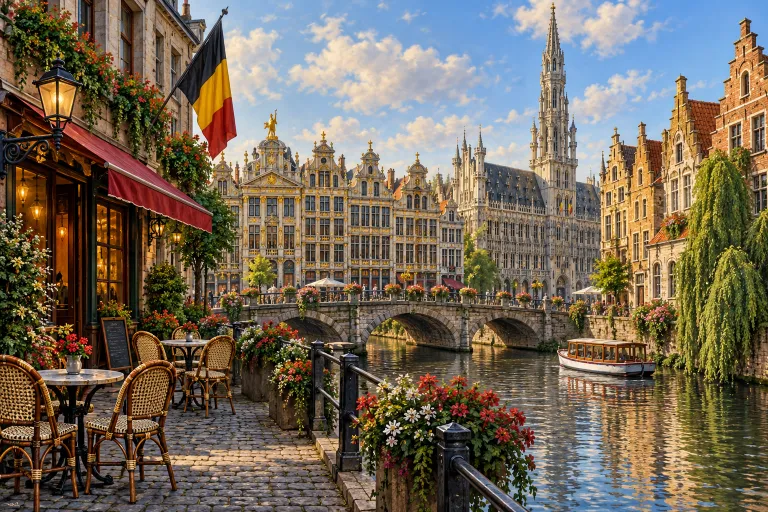
Fact-checked on 13 October 2026 against Belgian government, official tourism and UNESCO pages. Heritage status and visitor arrangements can change, so use the linked source before a trip.
Facts about Belgium go far beyond waffles and a weekend in Brussels. Its languages, landscapes and old trading towns make much more sense when you know a few simple facts first. Here are 50 useful starting points, with an official source beside every claim. Try the Belgium quiz, then explore our Belgium travel guide for trip routes and practical stops.
Belgium mini quiz
Five quick questions. Pick an answer, see why it is right, then try again for a better score.
How Belgium works
- Belgium became independent in 1830. Its break from the Northern Netherlands began in Brussels, then a provisional government declared independence. Belgium.be
- Its first constitution dates to 1831. The National Congress adopted it on 7 February of that year. Belgium.be
- Belgium is a federal state. The constitutional change that formally created the federal state came in 1993, after decades of reform. Belgium.be
- There are three regions. They are the Flemish Region, the Walloon Region and the Brussels-Capital Region. A region is not the same thing as a language community. Belgium.be
- There are also three communities. The Flemish, French and German-speaking Communities reflect language and culture, not simply three equal pieces of a map. Belgium.be
- Belgium has three official languages. They are Dutch, French and German. Do not assume every part of the country uses all three in everyday life. Belgium.be
- Brussels has its own region. The Brussels-Capital Region is distinct from both the Flemish and Walloon Regions. Belgium.be
- Flanders is a region, not a separate country. It is Belgium's northern region and includes several major art cities. VISITFLANDERS
- Wallonia is a region, not a separate country. It is one of the three parts of Belgium's federal regional structure. Belgium.be
- Belgium has ten provinces. Provinces are another administrative level; Brussels-Capital is a region rather than an eleventh province. Belgium.be
The map is more varied than it looks
- Belgium lies in western Europe. Its position between several countries has long mattered to trade and travel. Belgium.be geography
- The Netherlands is to the north. The border is one reason a cross-border rail trip can look short on a map, though you should still check the actual timetable. Belgium.be geography
- Germany is to the east. Belgium's eastern border does not mean the whole country is German-speaking; language geography is more complex. Belgium.be geography
- Luxembourg also borders Belgium to the east. The official geographic description names both Luxembourg and Germany on that side. Belgium.be geography
- France borders Belgium to the south and west. That is why a Belgium trip can include very different French-border landscapes, not just city centres. Belgium.be geography
- The country's area is 30,688 square kilometres. Small on a European map does not mean every attraction works as a quick day trip. Belgium.be geography
- The Belgian coast runs for about 65 kilometres. The government's geographic description mentions beaches and dunes along that straight coastal stretch. Belgium.be geography
- Belgium describes three broad elevation zones. Its official geography groups the landscape as lower, central and upper Belgium. Belgium.be geography
- Polders sit inland from the coast. These low, fertile areas have a history of protection from sea flooding. Belgium.be geography
- The Ardennes are in the south. The region combines wooded areas, plateaus and deep valleys, a striking contrast with the low coast. Belgium.be geography
Brussels beyond the postcard
- Grand-Place survived a major bombardment. Brussels rebuilt the square after the 1695 attack, which helps explain the late-17th-century appearance visitors see today. UNESCO
- Grand-Place joined the World Heritage List in 1998. UNESCO recognises the square as a historic civic and mercantile ensemble. UNESCO Belgium list
- Grand-Place is still a working civic space. Brussels City Hall remains a workplace for the mayor and aldermen, not merely a backdrop for photos. visit.brussels
- The familiar Manneken-Pis outdoors is not the original. The original statue is kept in the Brussels City Museum. visit.brussels
- The famous Manneken-Pis figure was made in 1619. City tourism identifies Jérôme Duquesnoy the Elder as its maker. visit.brussels
- Manneken-Pis has a costume museum. The GardeRobe MannekenPis displays the sculpture's changing wardrobe, rather than asking visitors to judge the landmark by its tiny size. visit.brussels
- The Atomium was built for the 1958 World's Fair. A temporary fair emblem became one of Brussels' lasting landmarks. visit.brussels
- The Atomium depicts an iron crystal unit cell. Its shape is about a scientific structure, not a literal picture of one isolated atom. visit.brussels
- The Atomium has nine spheres. Their arrangement represents the atoms in that enlarged iron structure. visit.brussels
- Brussels has a street-level comic-strip trail. Murals celebrating comic characters have appeared on city walls since 1991, so the art is not limited to a museum. visit.brussels
Art cities and the stories they preserve
- Bruges' historic centre is World Heritage. UNESCO inscribed it in 2000 for its urban fabric and role in medieval trade and culture. UNESCO
- Bruges was an important medieval trading centre. Its preserved streets and canals are evidence of a working commercial city, not a town built for modern tourism. UNESCO
- Flemish beguinages joined the World Heritage List in 1998. These historic communities form a UNESCO serial property, with the Bruges beguinage among the places visitors encounter. UNESCO Belgium list
- The Belfries of Belgium and France form a shared World Heritage property. The group began with Belgian belfries in 1999 and expanded in 2005. UNESCO
- Ghent stands where the Leie and Scheldt meet. The rivers help explain its old commercial landscape and waterside streets. VISITFLANDERS
- Ghent has a Castle of the Counts. It is one of the features the official regional tourism board singles out in the city. VISITFLANDERS
- The Ghent Altarpiece is a city landmark. The work is also called the Adoration of the Lamb of God in official tourism material. VISITFLANDERS
- Jan van Eyck is one of the Flemish Masters. Learning that name makes a museum visit in Bruges or Ghent more rewarding. VISITFLANDERS
- Pieter Bruegel is another Flemish Master. Flemish art is not one painter or one city; regional tourism places him in a much wider artistic tradition. VISITFLANDERS
- Peter Paul Rubens is part of that same heritage. Antwerp is an especially useful stop for understanding his legacy. VISITFLANDERS
Heritage that reaches beyond the headline cities
- Belfries told medieval towns who held civic power. UNESCO describes them as symbols of municipal liberties, distinct from a lord's keep or a church tower. UNESCO
- Victor Horta's Brussels town houses are World Heritage. UNESCO inscribed the group in 2000; they are a way into Belgium's Art Nouveau story. UNESCO Belgium list
- The Plantin-Moretus complex in Antwerp is World Heritage. Its house, workshops and museum preserve a chapter of printing history. UNESCO Belgium list
- Spiennes has Neolithic flint mines. The mines near Mons are on UNESCO's list, taking Belgium's heritage story far earlier than its medieval towns. UNESCO Belgium list
- Tournai's Notre-Dame Cathedral is World Heritage. It is one of Belgium's listed sites outside Brussels and Flanders' better-known art cities. UNESCO Belgium list
- Four historic lifts on the Canal du Centre are World Heritage. The UNESCO property is in the La Louvière and Le Roeulx area of Hainaut. UNESCO Belgium list
- Wallonia's major mining sites are World Heritage. UNESCO lists the industrial landscape, so Belgium's protected heritage is not only palaces and cathedrals. UNESCO Belgium list
- Western Front remembrance sites include Belgian places. The transnational World Heritage listing was added in 2023; approach these sites as memorials, not photo props. UNESCO Belgium list
- Spa is part of a European World Heritage group. The Great Spa Towns of Europe property includes Belgium's Spa, linking the town to the history of therapeutic travel. UNESCO Belgium list
- Belgium also has natural World Heritage. Its ancient and primeval beech forests are part of a wider European UNESCO property; not every listed place is a building. UNESCO Belgium list
Belgium travel questions people ask
What language do people speak in Belgium?
Belgium has three official languages: Dutch, French and German. The language you see most depends on the area, so check both a city's local name and the station name when planning a journey. Source: Belgian government.
Are Brussels, Flanders and Wallonia separate countries?
No. Belgium is one federal country with three regions: Brussels-Capital, the Flemish Region and the Walloon Region. Its three language communities are a different part of the federal structure. Source: Belgian government.
Is Bruges' historic centre a UNESCO World Heritage site?
Yes. UNESCO lists the historic centre of Bruges, inscribed in 2000. That status does not mean every building is free or open, so check the individual attraction before travelling. Source: UNESCO.
What can I see in Belgium beyond Brussels?
Ghent and Bruges offer historic city centres, while the coast and southern Ardennes show very different landscapes. Choose a region that fits your time rather than trying to cover them all in one day. Source: VISITFLANDERS; Belgian geography.
Can I use trains to explore Belgium?
SNCB/NMBS runs the national rail network. Check your exact route, station and latest timetable before buying a ticket. Our Europe train booking guide explains how to compare rail options, while SNCB/NMBS has the current Belgian schedule.
Planning note: A World Heritage label describes cultural or natural significance; it does not promise that a site is open, free, accessible or available without booking. Before visiting, check the site operator and the relevant official tourism or transport page.