Pack for the first 24 hours
What to keep with you, what to check, and which travel extras are actually useful.
The quick carry-on checklist
| Keep accessible | Pack inside the bag | Check before you leave |
|---|---|---|
| Passport, visa or entry papers, boarding pass, payment card | Spare shirt, underwear, socks, light layer | Passport validity and entry rules for your nationality |
| Prescription medicines and any medical instructions | Travel-size toiletries in a leak-resistant pouch | Airport liquid and medication screening rules |
| Phone, charging cable, power bank | Glasses, contact-lens supplies, earplugs | Airline size, weight and battery limits |
| One small snack and an empty water bottle | Items needed for the first night | Food import rules at the destination |
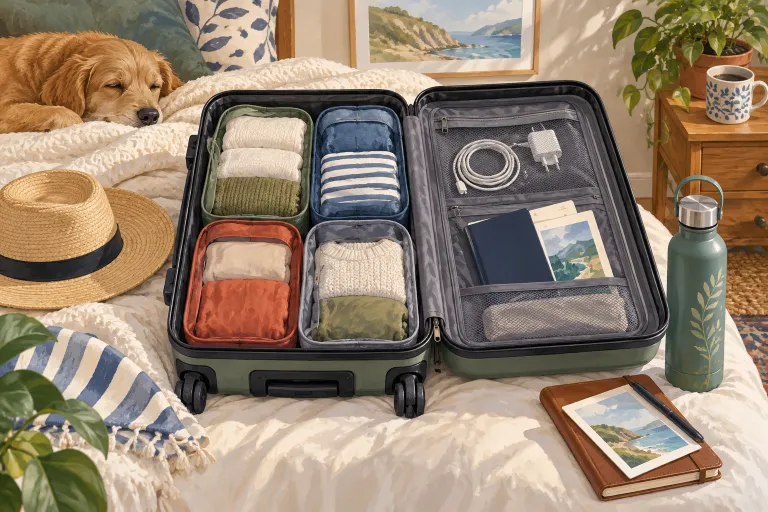
Compression packing cubes can separate a spare outfit from toiletries. A small luggage scale can help you check the bag after packing. Neither changes your airline’s allowance; measure and weigh the finished bag yourself.
Affiliate disclosure: These are Amazon.com shopping links. As an Amazon Associate I earn from qualifying purchases. Check the seller, final price, delivery country and return terms before buying.
Compare packing cubes on Amazon.com ↗Compare luggage scales on Amazon.com ↗
Think of your carry-on as a 24-hour backup. If a checked bag is delayed, you should still be able to reach your accommodation, take your medicine, charge your phone and get dressed the next morning. The exact list changes for a child, a cold-weather trip or medical needs.
Check the airline before buying a bag
There is no single worldwide carry-on size. Your ticket may include a small under-seat item but charge extra for an overhead bag. A connecting flight can have a different operating airline, aircraft and weight limit. Open each carrier’s baggage page and check the fare you actually bought. Look at the allowed dimensions including wheels and handles, the weight limit, the number of items and any gate-check conditions.
Measure the filled bag, not only the empty case. Soft backpacks can grow beyond their advertised size when the front pocket is packed. A rigid case can fit the height limit but fail on wheel depth. Leave a little room so you do not have to open a bursting zipper in the security line. If the overhead bag might be checked at the gate, keep a small pouch with medicine, documents, batteries and valuables that you can remove quickly.
Liquids: the departure airport matters
For U.S. screening, use the TSA’s current liquids guidance and its item-by-item search before departure. For the UK, the government says liquid rules depend on the airport; many still use 100 ml containers, while some allow larger containers. You may pass through another airport on the return trip with different rules. A container that is half empty can still fail if the container itself is above that airport’s limit.
To keep things simple, decant only products you truly need on the flight or first night. Put creams, gels and toothpaste together in a clear, easy-to-remove pouch. Keep liquids that might spill away from paper documents and electronics. Medical liquids, baby food and special dietary products may have exceptions, but screening and airline requirements can differ. Check the exact airport page and carry supporting details when needed.
Power banks and batteries: keep them in the cabin
The FAA says spare lithium batteries and power banks belong in carry-on baggage, not checked baggage. Protect exposed terminals from short circuit. A standard lithium-ion battery is generally limited to 100 watt-hours under FAA rules; larger batteries need airline approval or may be prohibited. Airlines and countries may set stricter limits, so read your operating carrier’s current rule, especially if you carry several power banks.
If staff gate-check your carry-on, remove your power bank and spare batteries and keep them with you. Do the same for any item the carrier tells you to keep in the cabin. Do not travel with a swollen, damaged or recalled battery. If a device heats up, smokes or smells unusual during the flight, tell the crew immediately. A cheap power bank with no visible capacity rating can create uncertainty at check-in, so check the watt-hour label before you travel.
Documents, money and medication
Put your passport and one payment method in a spot you can reach without unpacking. Keep a second payment method separately in case a wallet is lost or one card fails. Download the address of your first stay, transport instructions and booking references for offline use. Do not rely only on a screenshot in a phone that might run out of battery.
Carry enough essential medicine for the trip and possible delays, subject to local law and airline rules. Keep it clearly identified and easy to show at security. Some medicines that are routine at home are controlled abroad; check the destination’s official customs or health authority before departure. If you need refrigeration, needles or medical equipment, speak to the airline and airport in advance. This is a practical packing reminder, not medical or legal clearance.
Choose clothes by the first 24 hours
Pack one complete change you would be comfortable wearing if the checked bag arrives a day late. For most trips that means underwear, socks and a versatile top. Add a light layer if the aircraft or arrival city may be cold. Wear bulky shoes and the coat rather than using most of the cabin allowance for them. If your destination is hot but the flight is cold, layers work better than one heavy garment.
For a longer trip, do not try to fit every outfit into the cabin unless you are truly travelling with carry-on only. Build a small repeatable set: a few tops that match the same bottoms, quick-drying basics and one outfit for your main activities. Leave space for food or medicine bought after security. Packing cubes help with organization, but they do not remove weight; weigh the packed bag after using them.
Families and accessibility needs
For a child, split diapers, wipes, a spare outfit and comfort items between two adults’ bags if possible. Keep a small kit under the seat so you do not need to open the overhead bin whenever something is needed. Check the carrier’s child-bag policy and the airport’s rules for milk, formula and baby food. Do not assume every airport uses the same exemption.
If you use mobility equipment, hearing devices, a CPAP machine or other medical support, ask the airline exactly how it must be carried and whether it counts toward the cabin allowance. Save the answer. Put essential accessories and backup supplies where you can reach them during a delay. The safest plan is the one that still works if your overhead bag has to be checked at the gate.
A five-minute check the night before
- Open the operating airline’s baggage page and confirm your fare’s size, weight and item count.
- Open the departure and connection airports’ security pages for liquids and special items.
- Check the FAA or relevant national aviation authority and your airline for batteries.
- Weigh and measure the packed bag, including wheels, handles and outer pockets.
- Move passport, medicines, power bank and one payment method into an easy-access pouch.
- Download bookings and first-night directions for offline use.
If a rule is unclear, ask the airline or airport directly rather than buying a product advertised as “airport approved.” Shopping pages cannot authorize an item for your route.
Common questions
Can I bring a power bank on an international flight?
Often yes, but it should be in the cabin and within the carrier’s stated capacity limit. Confirm the watt-hour rating and airline policy; remove it if your bag is gate-checked.
Should medicines go in checked luggage?
Keep essential medicines in the cabin so a delayed checked bag does not interrupt your trip. Check the destination’s legal rules for the exact medicine and bring supporting documents when required.
Is a bag marked “carry-on approved” guaranteed to fit?
No. Airline limits vary by fare, route and aircraft. Measure the filled bag, including wheels and handles, against your operating airline’s rule.
Next, use our family travel budget planner to include baggage fees in the real trip cost.
Leave a Reply