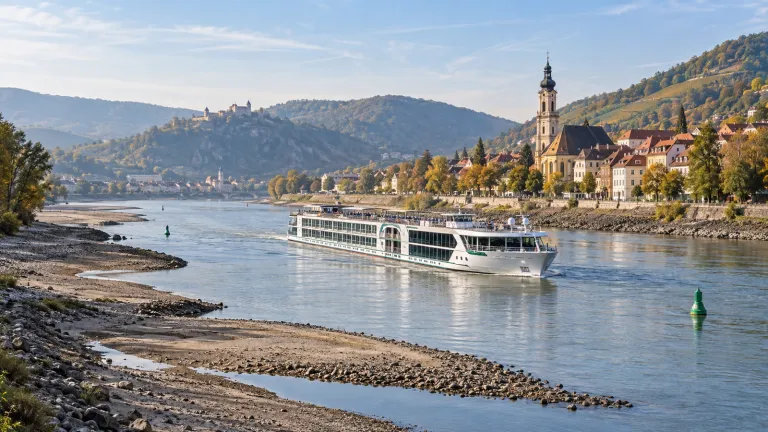
Danube river cruise and low water: what to ask first
A buyer’s guide to route changes, ships, buses and contract terms. Updated 14 October 2026.
Quick answer: Low water can change a Danube cruise, but one river gauge cannot tell you whether your specific ship will sail its full route. Vessel depth, river section, weather and the operator’s plan matter. Before paying, ask the cruise line in writing how it handles an impassable section: a ship swap, bus transfer, changed port, shorter cruise or cancellation. Read the contract’s change and refund terms. Do not rely on a promise that “the river will be fine” months ahead.
| Possible change | What it means for you | Question to ask before booking |
|---|---|---|
| Different docking place | Extra bus or walk to the advertised town | Who provides the transfer, and how long is it? |
| Ship swap | Move bags to another vessel around a blocked section | Is the cabin and accessibility comparable? |
| Bus section | Part of the river journey becomes a road trip | What sights and meals remain included? |
| Major itinerary change | Ports, days or even the cruise may change | What do the contract and applicable rights allow? |
Compare packing cubes ↗Compare travel adapters ↗
Why river level matters
A river ship needs sufficient navigable depth for its draft along the route. The Danube has different sections, each with its own conditions. An official gauge reading at one town is not the same thing as a ship-specific clearance decision throughout an itinerary. River authorities issue navigation and shallow-water information, while the cruise operator decides how to run its voyage within safety limits.
Austria’s waterway organisation viadonau publishes navigation information, and the Danube Commission has discussed prolonged low-water challenges. In 2026, official Austrian statements described unusually low levels in parts of the river. Those facts show that low water is a real operating issue. They do not predict your future sailing, guarantee disruption or prove that every cruise on the river will be affected.
High water can also cause problems, such as bridge-clearance or port access limits. A buyer should ask about water-related changes generally, not only one type. The most useful preparation is understanding the operator’s response and your options if the route changes.
Ship swap: ask what stays the same
Some operators use two ships on opposite sides of an affected stretch. Guests travel by road between them. Viking’s own current-sailings update describes this as one possible response to low water, not a guarantee for every voyage. A ship swap may preserve much of the route but still involve packing and a transfer day.
Ask whether your cabin category, bed setup and accessibility will be comparable. If you need a lift, step-free transfer or space for medical equipment, get the details in writing. “Same cabin type” may not answer how you will board the second ship or handle a bus. The operator should explain the plan for luggage and meals.
Do not assume that a ship swap is automatically unacceptable or automatically equivalent. Different travellers value different parts of a cruise. If the overnight river experience is the reason you booked, a long bus section may matter a lot. If the main goal is visiting cities, the change may be less disruptive. Decide before booking what would be a deal-breaker for you.
Ports and excursions can change too
A ship might dock farther from a city even when it can continue sailing. An included walking tour may then involve a longer coach transfer. Ask whether the transfer is provided, how long it takes and whether there is a suitable alternative for passengers who cannot walk far. A brochure’s “in the heart of town” description may not be the docking reality on a changed day.
Read which excursions are included and which are optional. If a port is missed, ask what happens to an optional excursion you bought from the cruise line. A tour booked from an unrelated third party may have separate terms. Keep confirmations and cancellation deadlines for both.
Look at the itinerary as a set of experiences, not just port names. A replaced stop can still be interesting, but you should understand what is being exchanged. Ask for a written revised plan if the operator changes the route before departure.
Questions to send the cruise line
- Which river sections are on my exact sailing, and are any currently restricted?
- How do you notify passengers if an itinerary may change?
- What are the possible alternatives for this route: ship swap, bus, different port or cancellation?
- Will cabin class, included meals and excursions remain comparable?
- How are mobility, medication and baggage needs handled during a transfer?
- What refund or price-reduction terms apply to a significant change?
- Who pays for extra hotel nights or transport if the cruise cannot operate?
Ask these questions by email or another written channel and save the response. A sales conversation can be helpful, but written terms are easier to review later. If the answer is “we decide on the day,” ask what the contract says you can do if you dislike a major change.
Read the booking contract, not only the brochure
Find the exact company selling your trip, the organiser if it is a package, and the terms incorporated into your booking. A river cruise alone, a cruise with flights, and a package sold by a travel agent may not have identical legal treatment. EU package-travel rules can provide rights for qualifying packages, including information about major changes, but whether they apply depends on the contract and seller. Do not treat a blog paragraph as a legal ruling on your booking.
Read what the operator can change, when it must notify you, and what happens if a large part of the advertised trip cannot be delivered. Ask whether a voucher is optional or required under the applicable terms and law. The European Commission’s consumer guidance explains package-travel rights, but you should also check your own country’s consumer authority for the contract you sign.
Insurance can cover certain disruptions, but the policy’s wording controls. Many policies exclude a foreseeable event or a change that does not meet a named trigger. Do not buy a policy because a seller casually says it “covers low water.” Ask the insurer which clause covers the specific situation and keep the answer.
Compare cruises on more than price
Write down the base fare, flights, transfers, gratuities, drinks, excursions, port fees if separately charged, and cancellation conditions. Compare the final cost per person. A low headline fare with many optional excursions may cost more than a higher fare with the activities you actually want included.
Consider the ship’s design and accessibility. Cabin size, stairs, lift availability, boarding access and meal options may matter more to your enjoyment than a tiny difference in the route. Ask for the deck plan and the precise cabin category. Do not assume two ships in the same brand are identical in every practical detail.
Choose a route based on cities you care about. If one famous stop is the only reason to book, ask how likely it is to be replaced and what your rights would be. A flexible mindset helps, but it should not replace informed consent.
Check current information close to sailing
Official river information is useful background. viadonau and DoRIS publish waterway and navigation details, while operator updates tell passengers what will happen to their sailing. The operator’s message is the relevant operational decision for your booking. A social post about a different ship or date is not proof of your situation.
Check your email and booking portal in the weeks before departure. Make sure the operator has the right contact details. If a change is announced, request the revised itinerary and the options in writing. Keep a copy of the original brochure and contract for comparison.
If already travelling, follow crew safety instructions. Do not demand that a captain pass a shallow section because your hotel was paid. Ask the passenger-services team to explain the alternative and assistance available.
A practical plan for a changed cruise
First, identify exactly what changed: one port, one transfer or the whole cruise. Second, ask the operator for the written revised schedule and contract options. Third, check whether you have independent costs such as flights or hotels. Fourth, keep receipts and correspondence. If there is a dispute, use the operator’s complaints process and the relevant consumer authority; the correct route depends on where and how you bought the trip.
For a traveller with a mobility or medical need, raise it immediately so the operator can assess transport and accommodation. For a family, ask how long a bus transfer will be and where meals or rest stops are planned. Do not wait until boarding to disclose a critical access requirement.
It is reasonable to accept a change if it still offers the trip you value. It is also reasonable to ask about alternatives if a central feature is lost. The key is knowing the facts and terms, not assuming the river or company will behave exactly as an old article predicts.
Quick questions
Can one water-level website predict my cruise?
No. It shows conditions at particular sections and times. The ship’s draft and operator’s route decision are separate.
Will I always get the same cabin in a ship swap?
Do not assume so. Ask your operator what cabin and accessibility it will provide on your specific sailing.
Does low water always cancel the trip?
No. Operators may change ports, use buses, swap ships or alter the itinerary. The response depends on conditions and the operator.
Does travel insurance automatically cover a changed port?
No. Read the policy’s exact trigger, exclusions and claim evidence rules.