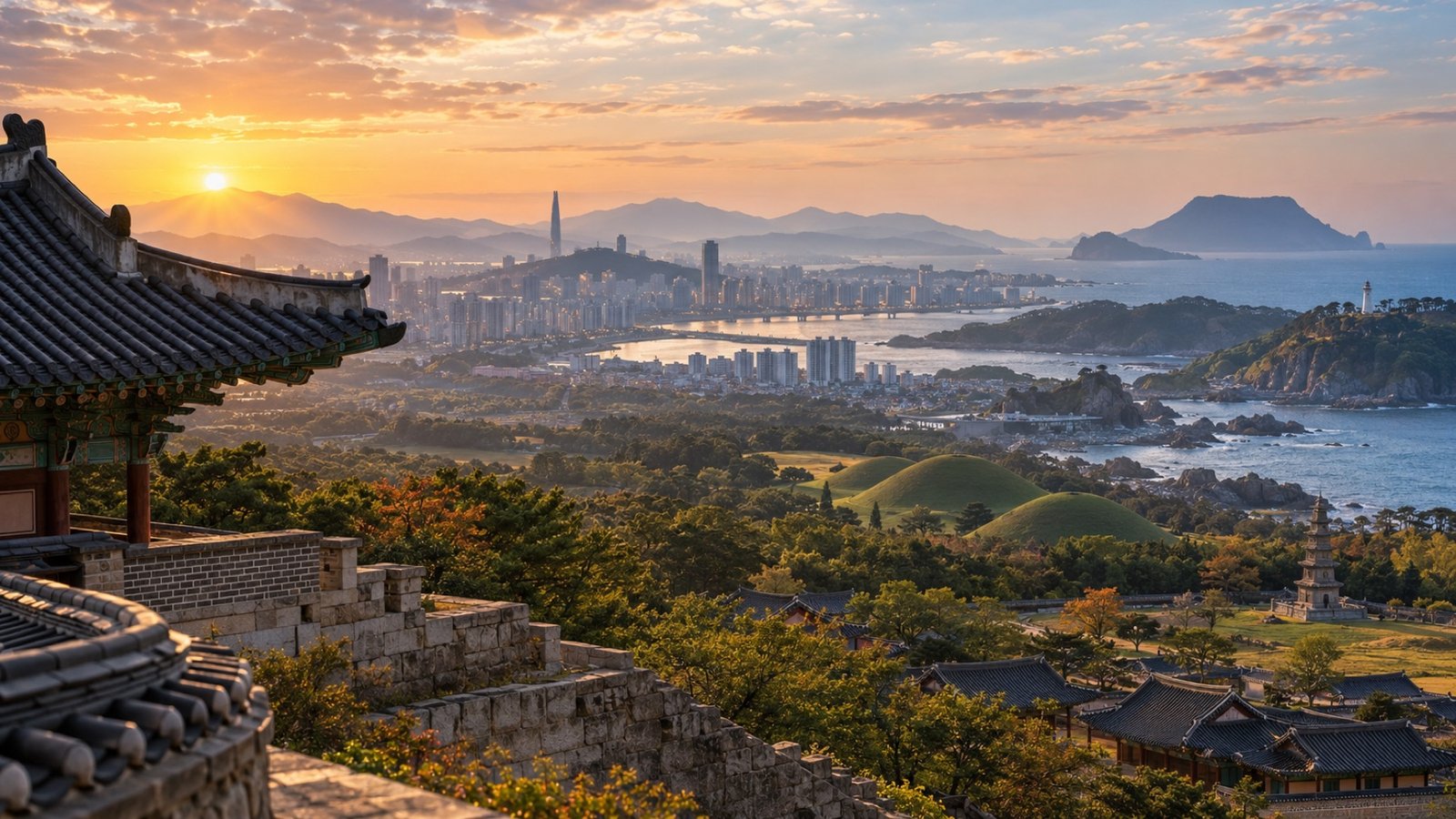
This guide uses official tourism, government and transport sources. Rules and prices can change, so check the linked official pages before booking.
South Korea cannot be understood through Seoul alone. Royal and ritual landscapes, working markets, protected villages, Silla and Baekje archaeology, Busan’s coast and Jeju’s volcanic terrain require different transport, weather and behaviour decisions. These fifty experiences use official visitor routes, treat worship and memorial sites seriously, and keep mountain, ferry and visa information conditional on the current authority rather than repeating an old checklist.
South Korea at a glance
- Ideal first trip: 12–16 days for Seoul, one central heritage region, Gyeongju, Busan and either Jeju or a slower mainland chapter.
- Currency: South Korean won; cards are common, but markets, rural buses and small businesses need a backup payment method.
- Entry: visa and K-ETA requirements depend on passport and status; a 2026 temporary exemption is not a permanent rule.
- Transport: intercity rail, local metro, buses, ferries and Jeju transport use separate reservations and last-return logic.
- Safety rule: typhoon, heat, wildfire, snow, ice, trail, ferry and heritage closures outrank the saved itinerary.
Entry, visa and arrival planning
Use the Korea Visa Portal for the passport and purpose actually used, then check the official K-ETA site if travelling visa-free. The current notice extends a temporary exemption for covered countries through 31 December 2026; eligibility is not universal and can change.
Use only k-eta.go.kr and visa.go.kr. A visa or K-ETA does not guarantee admission, and border officers can determine the stay granted. Keep accommodation, onward plans and required documents available.
When to go
Spring and autumn can support cities and lower trails, but blossoms and foliage are never guaranteed. Summer brings heat, humidity, heavy rain and typhoon risk; winter adds snow, ice and short daylight.
Use the Korea Meteorological Administration, national-park notices and the exact ferry, cable-car or attraction page. A clear city forecast does not prove safe mountain or island conditions.
Budget and places to stay
Compare bases by final refundable accommodation cost plus station access, transfers and luggage handling. A cheaper room far from an early train or last metro can cost more overall.
Use official live ticket and pass totals. Rail passes, palace combinations and city cards save money only when they cover the exact dated route and reservations.
Fifty things to do in South Korea
1. Gyeongbokgung through one palace-history route
Why go: Seoul. A focused route can explain Joseon state space, reconstruction and landscape without treating the largest palace as a costume backdrop.
Good for: history, architecture and first-time Seoul visitors
Know before you go: Closed days, ceremonies, conservation, weather and commercial photography require current confirmation.
2. Changdeokgung palace and reserved rear garden
Why go: Seoul. The UNESCO complex can show how buildings respond to topography when the palace and restricted garden products are planned separately.
Good for: history, architecture and first-time Seoul visitors
Know before you go: Rear-garden access can require a timed guided reservation; seasonal routes, closed days and weather change the visit.
3. Jongmyo Shrine with ritual context
Why go: Seoul. Official interpretation can connect royal ancestral ritual, architecture and music while the shrine remains a protected ceremonial place.
Good for: cultural travellers who can respect active faith
Know before you go: Guided-access systems, ritual dates, conservation and quiet behaviour take priority.
4. National Museum of Korea by one collection story
Why go: Yongsan, Seoul. A selected archaeology, art or Buddhist-culture route can establish evidence before palace and regional travel.
Good for: culture, families and weather-safe learning
Know before you go: Gallery rotations, loans, bags, photography and long walking distances require a current floor plan.
5. National Museum of Korean Contemporary History
Why go: Gwanghwamun, Seoul. A careful visit can examine modern political, economic and social change without treating one exhibition as the only narrative.
Good for: culture, families and weather-safe learning
Know before you go: Content may be complex or contested; use current galleries and distinguish evidence, interpretation and personal memory.
6. Bukchon on the official quiet-route guidance
Why go: Jongno, Seoul. A short public-street route can connect urban form and conserved hanok while recognising that Bukchon is a residential neighbourhood.
Good for: slow urban travel and community history
Know before you go: Noise, restricted hours or streets, resident privacy and steep lanes outrank photographs.
7. Seochon public lanes and local institutions
Why go: Jongno, Seoul. A modest circuit can connect ordinary urban history, workshops and food without inventing access to private hanok.
Good for: slow urban travel and community history
Know before you go: Keep homes and narrow lanes clear, use current businesses and avoid crowd spillover from palace areas.
8. Insa-dong through craft and gallery evidence
Why go: Jongno, Seoul. One current exhibition and one documented craft business can create a stronger visit than generic souvenir shopping.
How to do it: Plan from the dated official programme, verify the exact venue and content guidance, and distinguish current exhibitions from older listings.
Good for: art, design and current programming
Know before you go: Verify authorship, production place, gallery hours and export rules for antiques or cultural material.
9. Seoul City Wall on one open daylight segment
Why go: Seoul. A selected signed segment can connect topography, gates and defensive history without turning the full wall into a single-day race.
How to do it: Choose one currently open signed segment below the group’s limit, check weather and fire notices, carry water and finish before dark.
Good for: prepared walkers and urban-history travellers
Know before you go: Use current trail and access notices; heat, snow, ice, darkness, works and military sensitivity affect routes.
10. Namsan Park without an assumed cable-car ride
Why go: Central Seoul. A public park route can explain the city’s terrain and changing skyline while paid transport remains optional.
How to do it: Use the official park map, keep transport products separate and retain a lower-effort plan for haze, heat, snow or rain.
Good for: families and lower-complexity outdoor days
Know before you go: Cable-car, tower, road and trail operations are separate; haze, ice, heat and crowds can remove the view.
11. War Memorial of Korea as a critical history visit
Why go: Yongsan, Seoul. Collections can support evidence-led learning about conflict and military history when visitors avoid spectacle and allow room for multiple civilian experiences.
Good for: history students and reflective travellers
Know before you go: Treat memorial areas quietly, verify gallery status and do not photograph security-sensitive activity.
12. Dongdaemun Design Plaza through the dated programme
Why go: Jung-gu, Seoul. A current design exhibition and the public urban space can reveal contemporary architecture without assuming every room is always open.
How to do it: Plan from the dated official programme, verify the exact venue and content guidance, and distinguish current exhibitions from older listings.
Good for: art, design and current programming
Know before you go: Events, installations, commercial shoots and crowd controls change access.
13. Cheonggyecheon as an urban-water restoration walk
Why go: Central Seoul. A short public segment can introduce infrastructure, public space and ecological restoration without claiming the stream is natural wilderness.
How to do it: Use official public transport and public paths, group nearby stops, start outside peak heat and protect the last practical return.
Good for: first-time visitors and public-transport users
Know before you go: Flood warnings, slippery steps, maintenance, heat and event crowds require surface-street exits.
14. Gwangjang Market by one food craft
Why go: Jongno, Seoul. A meal focused on one stall tradition can reveal labour and market etiquette when the market is treated as a workplace, not a tasting obstacle course.
Good for: food learners and market travellers
Know before you go: Verify allergens, price before ordering, keep aisles clear and avoid filming workers or diners without consent.
15. Bukhansan on one currently open KNPS trail
Why go: Seoul. A route below the group’s limit can introduce granite terrain and temple landscapes while national-park rules control the day.
Good for: prepared hikers and landscape travellers
Know before you go: Check KNPS closures, reservation or fire rules, weather, daylight and ability; do not improvise rock routes.
16. Suwon Hwaseong Fortress on a measured circuit
Why go: Suwon. The UNESCO walls and gates can explain late-Joseon defence and planning when visitors choose a realistic segment rather than rushing the entire circuit.
Good for: history, architecture and careful walkers
Know before you go: Steep surfaces, weather, events and restoration require an accessible ground-level alternative.
17. Hwaseong Haenggung with fortress context
Why go: Suwon. The reconstructed temporary palace can add governance and ceremony context when original fabric and later reconstruction are distinguished.
Good for: history, architecture and first-time Seoul visitors
Know before you go: Performances, events, room access and photography conditions change.
18. Incheon Open Port heritage route
Why go: Incheon. A documented public route can examine treaty-port urban change and multiple communities without turning difficult imperial histories into decoration.
Good for: history, architecture and careful walkers
Know before you go: Use official interpretation, respect worship and residents, and check museum opening separately.
19. Ganghwa dolmen and local museum context
Why go: Ganghwa Island, Incheon. A museum-first route can explain UNESCO-listed megalithic burial evidence before a lawful outdoor site visit.
Good for: archaeology and evidence-led history
Know before you go: Do not climb or touch stones; weather, rural buses, excavations and protected boundaries require planning.
20. Jeonju Hanok Village beyond rental-costume photos
Why go: Jeonju. A slow route can connect housing, craft, food and institutions while distinguishing living buildings from visitor businesses.
Good for: slow urban travel and community history
Know before you go: Homes, worship, traffic, crowding and commercial photography require restraint.
21. Jeonju food culture through one market and one meal
Why go: Jeonju. Comparing ingredients, preparation and regional context can make bibimbap or a shared table meaningful without declaring one restaurant definitive.
Good for: food learners and market travellers
Know before you go: Verify allergens, alcohol, portion style, price and closing days directly.
22. Gongsanseong Fortress on the current public route
Why go: Gongju. The Baekje Historic Areas component can connect river landscape and defence when official interpretation replaces romantic reconstruction.
Good for: history, architecture and careful walkers
Know before you go: Steep walls, heat, snow, restoration and event closures affect the route.
23. Tomb of King Muryeong and Gongju museum evidence
Why go: Gongju. Museum collections and a protected tomb-complex route can explain exchange and burial practice without implying entry into conserved chambers.
Good for: culture, families and weather-safe learning
Know before you go: Use replica or exhibition access as directed; never cross barriers or touch burial structures.
24. Buyeo Baekje chapter at Busosanseong and museum
Why go: Buyeo. A paired official route can connect the final Baekje capital, river and archaeology without compressing the region into one legend.
Good for: history, architecture and careful walkers
Know before you go: Trail gradients, boat operations, heat and museum schedules require separate checks.
25. Hahoe Village with resident privacy
Why go: Andong. The UNESCO village can reveal clan landscape, housing and ritual when travellers use public routes and let residents control private access.
How to do it: Use the official public route, keep homes and ceremonies private, support resident businesses and avoid treating the community as a set.
Good for: slow travellers and vernacular-architecture learners
Know before you go: Homes, services, performances, shuttle operations and fire risk limit visitor movement.
26. Dosan Seowon with scholarly context
Why go: Andong. A quiet visit can introduce Neo-Confucian education and landscape design without treating the academy as an empty photo set.
Good for: history, architecture and careful walkers
Know before you go: Ceremonies, conservation, rural transport and uneven surfaces require current information.
27. Gyeongju National Museum before the open sites
Why go: Gyeongju. A focused Silla collection route can make tombs, temples and palace remains intelligible before outdoor touring.
Good for: culture, families and weather-safe learning
Know before you go: Gallery rotations, loans, bags and holiday schedules need checking.
28. Daereungwon tomb complex on public paths
Why go: Gyeongju. The mounds and authorised exhibition space can introduce Silla burial archaeology while protected tombs remain closed.
Good for: archaeology and evidence-led history
Know before you go: Use only marked paths and currently open interiors; heat, works and fragile grass control access.
29. Donggung Palace and Wolji Pond with archaeology first
Why go: Gyeongju. An evening or daylight visit can connect excavated palace landscape and reconstruction when lighting is not substituted for historical evidence.
Good for: archaeology and evidence-led history
Know before you go: Crowds, surfaces, weather, events and conservation can alter the loop.
30. Cheomseongdae and Wolseong public archaeology circuit
Why go: Gyeongju. A compact route can connect scientific history, royal landscape and active research without entering excavation areas.
Good for: archaeology and evidence-led history
Know before you go: Follow barriers, respect fieldwork and check heat, night lighting and event changes.
31. Bulguksa Temple as active sacred heritage
Why go: Gyeongju. A respectful official route can connect Buddhist architecture, landscape and conservation while worship remains primary.
Good for: cultural travellers who can respect active faith
Know before you go: Dress, prayer, stairs, photography, fire safety and conservation restrict the visit.
32. Seokguram Grotto with conservation limits
Why go: Gyeongju. The protected grotto can be understood through its official approach and interpretation without promising unrestricted views or photography.
Good for: cultural travellers who can respect active faith
Know before you go: Mountain road, shuttle or walking conditions, barriers, glass and conservation rules control access.
33. Gyeongju Namsan on one marked heritage trail
Why go: Gyeongju. A signed route can combine landscape and Buddhist remains when the mountain is not treated as an open-air object hunt.
Good for: prepared hikers and landscape travellers
Know before you go: Use current park guidance, do not touch carvings, and check weather, fire risk, daylight and fitness.
34. Yangdong Village from public lanes
Why go: Gyeongju area. The UNESCO clan village can add rural social and architectural context when private homes and resident life remain protected.
How to do it: Use the official public route, keep homes and ceremonies private, support resident businesses and avoid treating the community as a set.
Good for: slow travellers and vernacular-architecture learners
Know before you go: Rural transport, gradients, services, weather and private property constrain the route.
35. Gamcheon Culture Village through resident rules
Why go: Busan. A public route can examine hillside urban history and community-led art without treating every stairway and home as public.
Good for: slow urban travel and community history
Know before you go: Follow quiet zones, keep doorways clear, use official paths and avoid intrusive portraits.
36. Jagalchi Market as a working seafood market
Why go: Busan. One purchase or meal can connect port labour and seafood knowledge when visitors agree price, preparation and sustainability before ordering.
Good for: food learners and market travellers
Know before you go: Wet floors, allergens, live-animal ethics, filming and market work require care.
37. Haeundae Beach with current safety guidance
Why go: Busan. A supervised shore visit can connect Busan’s urban coast when swimming is separated from a promenade walk.
How to do it: Use a designated supervised shore where available, follow current flags and weather, and keep a non-swimming alternative.
Good for: families and cautious coastal visitors
Know before you go: Seasonal lifeguards, flags, currents, typhoon conditions, jellyfish and water quality control swimming.
38. Gwangalli waterfront by public transit
Why go: Busan. A public evening or daytime route can frame urban waterfront life without promising bridge lights or an event every night.
How to do it: Use official public transport and public paths, group nearby stops, start outside peak heat and protect the last practical return.
Good for: first-time visitors and public-transport users
Know before you go: Crowds, cycling, weather, events and late transport require a planned return.
39. Taejongdae on the current park route
Why go: Busan. A lawful cliff-and-forest circuit can reveal coastal geology when visitors stay behind barriers and verify internal transport.
Good for: geology, wildlife and conservation-minded travellers
Know before you go: Wind, rain, heat, cliff edges, road works and shuttle status affect suitability.
40. United Nations Memorial Cemetery with respect
Why go: Busan. The cemetery can support quiet reflection on the Korean War and international service when names and national stories are treated with care.
Good for: history students and reflective travellers
Know before you go: Ceremonies, dress, silence, restricted areas and photography etiquette take priority.
41. Haedong Yonggungsa Temple as active worship
Why go: Busan. A respectful visit can connect Buddhist practice and a coastal setting without using the temple as an unrestricted sunrise backdrop.
Good for: cultural travellers who can respect active faith
Know before you go: Prayer, steep stairs, crowds, weather, photography and commercial activity require restraint.
42. Hallasan on one reserved or open official trail
Why go: Jeju Island. A trail matched to ability can introduce volcanic ecology without assuming every route reaches Baengnokdam summit.
Good for: prepared hikers and landscape travellers
Know before you go: Reservation, entry cut-offs, snow, ice, wind, heat, closures and turnaround times govern the hike.
43. Seongsan Ilchulbong on the official route
Why go: Eastern Jeju. The UNESCO tuff cone can be understood through geology and designated paths rather than a sunrise guarantee.
Good for: geology, wildlife and conservation-minded travellers
Know before you go: Wind, rain, heat, stairs, crowd controls and conservation can close or shorten access.
44. Geomun Oreum on a reserved guided route
Why go: Jeju Island. A reserved official route can connect volcanic formation and forest ecology while sensitive cave and research areas remain protected.
Good for: geology, wildlife and conservation-minded travellers
Know before you go: Advance reservation, guide rules, weather, clothing and biosecurity control participation.
45. Jeju Olle on one current marked section
Why go: Jeju Island. One ability-matched coastal or village section can support slow travel without treating the full network as one continuous safe route.
How to do it: Choose one currently open signed segment below the group’s limit, check weather and fire notices, carry water and finish before dark.
Good for: prepared walkers and urban-history travellers
Know before you go: Check diversions, weather, tides, daylight and transport; never enter private land or an unmarked coast.
46. Jeju Haenyeo Museum and lawful shore context
Why go: Jeju Island. Museum evidence can introduce women divers’ labour and community history without chasing or filming working divers.
Good for: culture, families and weather-safe learning
Know before you go: Demonstrations are not guaranteed; weather, work, consent and seasonal conditions determine what can be observed.
47. Bijarim Forest on designated paths
Why go: Jeju Island. A quiet forest route can examine old nutmeg trees and volcanic soils while protecting roots and understory.
Good for: geology, wildlife and conservation-minded travellers
Know before you go: Stay on paths and check wind, rain, closures, insects and accessibility.
48. Udo as a ferry-dependent island day
Why go: Udo, Jeju. A public bus, bicycle or walking plan can connect village and volcanic coast when the last ferry is fixed before exploration.
How to do it: Confirm ferry, vehicle rules and last return before departure, carry essentials and keep a same-day mainland fallback.
Good for: prepared travellers with flexible schedules
Know before you go: Ferries, vehicle rules, wind, seas, rentals and road traffic can cancel or reshape the day.
49. Jeju 4·3 Peace Park and memorial hall
Why go: Jeju City. A careful visit can support evidence-led learning about the Jeju 4·3 period and its victims without converting trauma into tourism spectacle.
Good for: history students and reflective travellers
Know before you go: Allow time, behave quietly and verify current exhibitions or ceremonies.
50. Jeju Stone Park through geology and folklore
Why go: Jeju Island. A measured route can connect volcanic stone, island life and documented folklore while distinguishing interpretation from literal history.
Good for: culture, families and weather-safe learning
Know before you go: Large outdoor distances, weather, maintenance and gallery access require a current map.
Food and drink worth planning around
Korean food changes by region, season, technique and community. Ask what a market or restaurant specialises in instead of using one dish as a national shorthand.
Verify allergens and dietary restrictions directly; stocks, sauces, fermentation, seafood and shared grills can contain ingredients not obvious from the English name. Alcohol is optional and never belongs before driving, swimming or hiking.
What to buy
For ceramics, textiles, paper, tea, food, cosmetics and craft, identify the maker and production place. Heritage packaging is not proof that an item was handmade locally.
Use established sellers, retain receipts and check customs, tax, food, medicine, antique, plant and wildlife-material rules before departure.
Getting around
Use KORAIL and the responsible local authority for current train, metro and bus schedules. Confirm the station, train type, reservation, luggage and last connection rather than relying on a saved timetable.
Jeju, Udo and coastal routes add flight or ferry weather risk. Rental cars require a valid licence arrangement, insurance, parking and sober driving; never assume a mountain road remains open.
Easy access and family travel
Accessibility varies across palace thresholds, tomb paths, temple stairs, village lanes, mountain trails, ferries and markets. Ask for the precise route, surface, toilets, seating and assistance.
A shuttle, lift or accessible station does not prove the full experience is step-free. Snow, rain, heat, crowds and last-mile gradients are separate questions.
Stay safe
Follow official weather, national-park, wildfire, typhoon, road, ferry and beach guidance. Turn back early for heat, snow, ice, lightning, poor visibility or a missed transport margin.
Do not enter military or controlled areas, photograph sensitive infrastructure, feed wildlife, cross heritage barriers or hike an unmarked social-media route. Use licensed activity operators.
Mistakes to avoid
- Treating the 2026 K-ETA temporary exemption as permanent or universal.
- Trying to cover Seoul, Gyeongju, Busan and Jeju in a few rushed days.
- Assuming every palace or museum closes on the same weekday.
- Entering Bukchon residential lanes loudly or outside current access guidance.
- Expecting the Hallasan summit from a trail that does not reach it.
- Booking island or coastal plans without protecting the last ferry or weather fallback.
- Treating temples, shrines, tombs and memorials as unrestricted photo sets.
- Following an old mountain route after a closure or fire warning.
Sample seven-day route
Use four Seoul days, one Suwon or Jeonju chapter and two Gyeongju days. Do not add both Busan and Jeju unless the trip is extended; protect one weather-flexible museum day.
Sample ten-day route
Use four Seoul, one Suwon or Andong, two Gyeongju and three Busan days. Replace Busan with Jeju only when flight, trail and weather margins are realistic.
Sample fourteen-day route
Use four Seoul, two central heritage, three Gyeongju and Busan, and four Jeju or slower southern-coast days. Preserve two flexible weather days and avoid changing hotels every night.
South Korea travel FAQ
Do I need K-ETA?
It depends on passport and status. The official K-ETA notice extends a temporary exemption for currently covered countries through 31 December 2026, but other travellers may still require K-ETA or a visa. Check the official system immediately before travel.
Can every Hallasan trail reach the summit?
No. Only specified summit routes do so under normal operations, and reservations, entry cut-offs or closures can apply. Choose from the current Hallasan National Park information.
Can I tour Bukchon at any hour?
Do not assume so. It is a residential area with quiet and access controls that can change. Follow the current Seoul guidance and leave restricted lanes alone.
Is one week enough for Seoul, Busan and Jeju?
It is technically possible but usually produces excessive transfers. Seven days works better with Seoul plus one regional chapter; add time for Busan and Jeju.
Do I need a rail pass?
Not automatically. Compare the live price and reservation rules for the exact trains and dates against point-to-point tickets.
Official planning sources
- Official K-ETA portal
- K-ETA 2026 temporary exemption notice
- Korea Visa Portal
- VISITKOREA official portal
- VISITKOREA guides and maps
- VISITKOREA 2025–26 must-visit guide
- VISITKOREA transportation
- VISITKOREA Busan regional guide
- VISITKOREA Jeju regional guide
- UNESCO Republic of Korea properties
- UNESCO Changdeokgung
- UNESCO Gyeongju Historic Areas
- UNESCO Seokguram and Bulguksa
- UNESCO Historic Villages Hahoe and Yangdong
- UNESCO Jeju Volcanic Island and Lava Tubes
- UNESCO Baekje Historic Areas
- Korea Heritage Service royal palaces
- Korea National Park Service English
- Seoul official tourism
- Busan official tourism
- Visit Jeju official portal
- Visit Jeju Hallasan reservation guidance
- KORAIL official
- Korea Meteorological Administration English
Disclosure: This independent editorial guide is informational, not a booking guarantee. No price, ranking, safety outcome, entry permission or availability is guaranteed. Recheck all time-sensitive details with the linked official source before purchase.