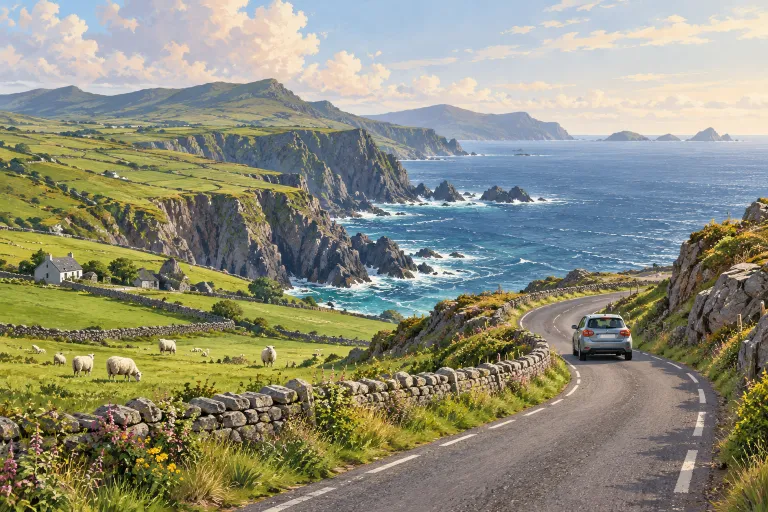
Ireland road trip: a manageable 7-night first route
Dublin, Galway, Clare and Kerry give you city time and Atlantic scenery without trying to circle the whole island in one week.
Quick answer: Spend the first and last nights near Dublin, two nights in Galway, one in Clare and two in the Killarney area. Use a car for the west and southwest, not for your central Dublin day. Check every drive and accommodation before booking; this is a route shape, not a fixed timetable.
| Day | Sleep near | Main idea | Keep flexible |
|---|---|---|---|
| 1 | Dublin | Arrive, settle in and walk locally. | No long drive after an overnight flight. |
| 2 | Galway | Collect the car and head west, with one planned stop. | Allow pickup and traffic time. |
| 3 | Galway | Choose Connemara or a slow city and coast day. | Weather decides the outdoor route. |
| 4 | Clare | Move south; choose one coastal or Burren stop. | Do not chase every viewpoint. |
| 5 | Killarney area | Travel to Kerry and enjoy a local walk. | Leave evening free. |
| 6 | Killarney area | Pick one Kerry loop or park day. | Skip a long detour in bad weather. |
| 7 | Dublin area | Return east and position for departure. | Keep a final-night flight buffer. |
Browse rain jackets ↗Browse packing organisers ↗
Why this route skips most of the island
Ireland’s Wild Atlantic Way is an extensive coastal route. A week is enough for a taste, not every headland. The route above chooses a few bases so you can take a walk, eat in a town and pause when the weather is good. Driving from viewpoint to viewpoint all day can make the trip feel like a delivery schedule.
The table is for seven nights with departure after the final night. If your flight leaves on Day 7, remove a west-coast day and return earlier. If you have ten nights, add time to Galway or Kerry before adding a third region. If you want Northern Ireland too, plan it as a separate section and check the car rental’s cross-border conditions.
Day 1: Dublin without the rental car
Arrive, reach your accommodation and learn the nearby streets. Central Dublin can be easier on foot or public transport than with a parked rental car. The first day is not the time for a long drive if you are tired, jet-lagged or learning to drive on the left. Have a simple meal, charge your phone and save tomorrow’s pickup address offline.
If you arrive early and feel fresh, choose one short activity rather than booking a rigid sequence. If you land late, go directly to the hotel. This small decision can protect the rest of the trip: an overtired driver on unfamiliar roads is a poor start to a holiday.
Days 2 and 3: Galway as the first western base
Collect the car on Day 2. Before leaving the desk, inspect the vehicle, note existing damage, understand the fuel return rule and check what is covered by insurance. Know the excess, deposit and whether any card benefit applies to this exact rental. Do not assume the cheapest online quote is the final cost. Ask how tolls are billed and whether you may drive across the border if that is part of your plan.
Drive toward Galway with just one chosen stop. On the first western evening, park and walk. For Day 3, decide between a Connemara outing and a gentle Galway day based on weather and energy. A scenic drive is not only wheel time: narrow roads, viewpoints and lunch can stretch the day. Plan where you will turn back before you leave, so you are not forced to drive unfamiliar roads late at night.
Day 4: Clare, with time for the landscape
Move south at a comfortable pace. The Burren, coastline and towns offer different experiences, so pick one focus. Check the local operator or official tourism page for current access before travelling to a specific site. Wind and rain can change how pleasant a cliff or coastal stop feels. Follow barriers and marked paths; a photograph is never worth moving into an unsafe position.
Staying in Clare breaks the journey to Kerry. It also gives you an afternoon to stop when something genuinely interests you. If the weather is poor, choose a town, indoor attraction or early check-in. Do not treat the overnight as a failure because you drove fewer kilometres than planned.
Days 5 and 6: Kerry without an all-day race
Move to the Killarney area on Day 5, then keep the rest of the day local. On Day 6 choose one main option: a Killarney National Park day, a Dingle Peninsula trip, or another Kerry route you care about. Trying to do several loops in one day leaves little time outside the car. Check road, parking and seasonal visitor information before committing to a route.
For a family, a shorter nature walk and one scenic stop may be ideal. For a keen walker, choose a route that matches the group’s ability and the day’s conditions. If you need step-free access, check the exact trail, attraction entrance and toilet availability rather than relying on a broad destination description. Pack a dry layer and allow time to change plans.
Day 7: return toward Dublin
Plan the eastbound drive as a travel day, not one more full sightseeing day. Return the vehicle according to the rental agreement or stay close enough for a calm morning drop-off. Photograph the vehicle and fuel gauge when returning it, and keep the receipt. A final night near your departure point reduces the risk that traffic, a closure or a late start causes a missed flight.
Check where the rental company’s airport return actually is and how long the shuttle or walk takes. A published driving estimate does not include breakfast, packing, fuel, drop-off checks or airport security. Give yourself a real buffer. If you are leaving from another airport, reverse or adapt the route instead of making an unnecessary loop back to Dublin.
Driving rules a visitor must understand
Tourism Ireland’s driving guide says traffic drives on the left. It also explains a key cross-border difference: road distances and speed signs use kilometres in the Republic of Ireland and miles in Northern Ireland. Read the current local rules, carry the correct licence and confirm that your insurance is valid for the trip. Follow posted limits rather than copying another driver.
Choose a car you are comfortable placing on a narrow road. Some country lanes have little margin, and a large vehicle can be stressful to park or pass. Give cyclists and pedestrians room, stop only in safe legal places, and do not hold a phone while driving. The passenger can handle navigation. If you miss a turn, continue to a safe place rather than making a sudden manoeuvre.
Ask the rental desk about automatic versus manual transmission before paying. Drivers used to the right side may find an automatic easier to adjust to, but only the available car and total price can settle the choice. Practice in a quiet area before joining faster roads. If you are tired, let another authorised driver take over or stop.
Budget for the whole trip, not just car hire
Compare accommodation, rental, insurance excess or added cover, fuel, tolls, parking, paid attractions and meals. Add airport transfers for days without the car. A low rental headline can rise after taxes, one-way fees, extra driver, young-driver fee or optional equipment. Read what is included before checkout. Do not buy duplicated cover without understanding your existing policy, and do not assume a credit card covers every rental condition.
For lodging, check parking details before booking: on-site versus nearby, height limits, overnight cost and whether a space is guaranteed. A charming town-centre room with no parking may be wonderful on a car-free day and inconvenient during a road trip. Consider a few two-night bases rather than paying with time to move luggage every morning.
Rain, daylight and shorter-trip changes
Build your route around daylight and the season you actually travel, not a summer photo. Check a forecast and road information close to each drive. In rain, a café, museum or short town walk can be more pleasant than an exposed viewpoint. In dry weather, take the scenic pause. The best itinerary is one you can adjust without losing a large prepaid booking.
With five nights, choose Dublin plus Galway and one nearby region, or Dublin plus Kerry, rather than forcing both coasts into every day. With a child, an older traveller or someone with limited mobility, cut the number of moves. That makes time for meals, toilets and rest. A shorter route can feel richer than an impressive map with no time to stop.
Common questions
Do I need a car in Dublin?
Not for this route’s central Dublin day. Compare public transport and walking with hotel parking and rental cost before collecting a car.
Can I drive the entire Wild Atlantic Way in seven nights?
You can cover only a portion comfortably. Choose a region and enjoy it rather than treating the full route as a checklist.
Can I take a rental car into Northern Ireland?
Ask the exact rental company before booking and check insurance, fees and conditions. Do not assume every contract allows the same trip.
Should I sleep near the airport before flying home?
It is often useful when you have an early flight or a long return drive. Compare your actual departure time with the route and car-return process.
Need a broader planning checklist? See our family trip budget and carry-on packing guides.
Leave a Reply