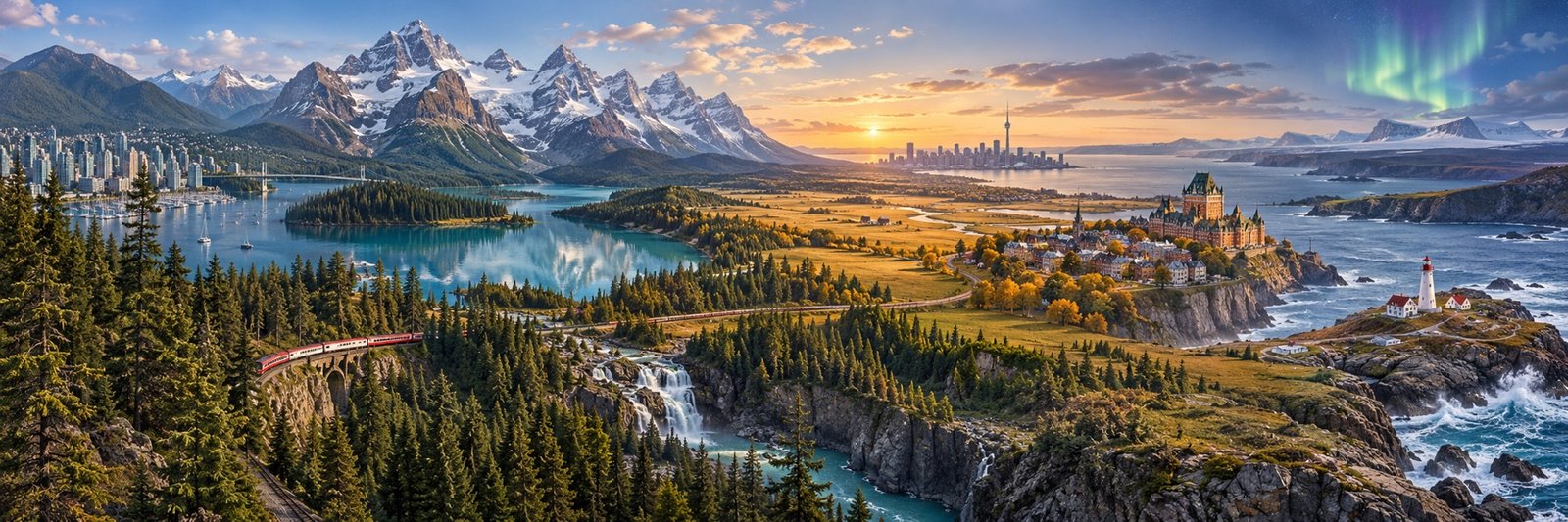
This guide uses official tourism, government and transport sources. Rules and prices can change, so check the linked official pages before booking.
Canada is too large for one coast-to-coast checklist. Vancouver and the Pacific coast, the Rocky Mountains, Prairie cities, Ontario and Québec, Atlantic communities and the northern territories require different seasons, budgets and transport plans. These fifty experiences help first-time visitors build a coherent route, understand distance and weather, and spend more time learning from the places they actually reach.
Canada at a glance
- Ideal first trip: 10–14 days in one or two connected regions; a genuine coast-to-coast journey normally needs substantially longer.
- Currency: Canadian dollar. Cards are common, but remote communities and seasonal operators need backup planning.
- Best planning principle: choose a geographic corridor, then add one nature chapter rather than linking distant icons with repeated flights.
- Transport: major cities have transit and selected corridors have intercity rail; rural parks, islands and the North require separate reservations and contingency time.
- Price check: compare the final total including federal and provincial taxes, baggage, parking, resort fees, transfers, gratuities and cancellation terms.
Entry, visa and arrival planning
Use the Government of Canada entry and immigration pages for the rules attached to your passport, residence, travel purpose and route. An eTA, visa, permit or border decision cannot be inferred from a travel blog, airline snippet or another traveller’s experience.
Open-jaw itineraries can reduce backtracking through Vancouver, Calgary, Toronto, Montréal or Halifax. Compare the whole arrival chain, including customs, baggage, airport transport, winter disruption and the cost of reaching a park or island after the international flight.
When to go
Canada spans Pacific rainforest, mountains, Prairies, Great Lakes, Atlantic coast, boreal forest, tundra and Arctic environments. Summer is not universally mild and winter is not one uniform season. Check the exact province, park and elevation for heat, smoke, snow, storms, daylight and road conditions.
Peak foliage, wildlife, northern lights, skiing and coastal seasons vary by latitude and ecosystem. Build the trip around what is reliably open, not a viral photograph tied to one short weather window.
Budget and places to stay
Build value, mid-range and premium scenarios using live, refundable prices. Domestic flights, one-way car fees, park shuttles, ferries, remote tours and seasonal accommodation can dominate the budget even when a city hotel looks affordable.
Compare the property’s official final total with a reputable booking platform and read the exact room description. Check taxes, parking, air conditioning, lift access, breakfast, resort fees and distance to the transport you will actually use.
Fifty things to do in Canada
1. Stanley Park seawall and rainforest with cultural context
Why go: Vancouver, British Columbia. The seawall, coastal forest and harbour views introduce Vancouver’s geography while Indigenous place names and public art deepen the route.
How to do it: Check park and seawall notices, begin early and pair one loop section with an Indigenous-led or museum-based account of the land.
Good for: Walkers, cyclists and first-time city visitors
Know before you go: Separate walking and cycling lanes, storms, fallen trees and busy viewpoints require attention.
2. Granville Island as a working arts and food district
Why go: Vancouver, British Columbia. Studios, food businesses, performance spaces and waterfront transport work best when treated as a neighbourhood rather than one market hall.
How to do it: Arrive by transit or ferry, choose a small number of local producers and visit working studios only during posted hours.
Good for: Food, craft and family travellers
Know before you go: Crowds, delivery activity and narrow shared paths make quiet weekday hours more comfortable.
3. Museum of Anthropology and Indigenous-led learning
Why go: Vancouver, British Columbia. Collections and contemporary work can introduce the distinct Nations of the Pacific Northwest when the museum’s own interpretation leads the visit.
How to do it: Check current galleries and programs, read community labels carefully and support named Indigenous artists or businesses.
Good for: Culture, design and learning travellers
Know before you go: Cultural belongings are not decorative props; follow photography and respectful-behaviour rules.
4. Sea-to-Sky corridor with one responsible base
Why go: British Columbia. Howe Sound, mountain communities and coastal rainforest create a coherent landscape journey between Vancouver and Whistler.
How to do it: Choose Squamish or Whistler as a base, confirm highway and attraction status and avoid stacking every viewpoint into one drive.
Good for: Road-trip, mountain and outdoor travellers
Know before you go: Weather, smoke, wildlife and unsafe roadside stopping can change the route quickly.
5. Victoria’s harbour, museums and neighbourhoods
Why go: Victoria, British Columbia. The provincial capital combines Coast Salish context, political history, gardens and a walkable inner harbour.
How to do it: Use the ferry or flight schedule as the day’s anchor, select one major museum and add a quieter neighbourhood or shoreline walk.
Good for: History, gardens and car-free travellers
Know before you go: Ferry queues and wind can disrupt timing; active government and harbour spaces have access rules.
6. Pacific Rim National Park Reserve with tidal awareness
Why go: Vancouver Island, British Columbia. Rainforest, surf and long beaches reveal a powerful Pacific ecosystem alongside Nuu-chah-nulth homelands.
How to do it: Check Parks Canada notices, tides and local road conditions, stay several nights and follow community guidance.
Good for: Coastal walkers, surfers and nature travellers
Know before you go: Cold water, logs, waves, wildlife and limited services make casual beach assumptions dangerous.
7. Haida Gwaii through Haida-led interpretation
Why go: Haida Gwaii, British Columbia. Haida art, governance, living culture and island ecosystems make this a learning journey rather than a remote-photo checklist.
How to do it: Reserve transport and accommodation early, choose Haida-owned or Haida-led experiences and follow community access requests.
Good for: Culture, ecology and slow-travel visitors
Know before you go: Weather, ferries, flights and protected cultural sites require flexibility and permission.
8. Banff town and Bow Valley without chasing every lake
Why go: Banff National Park, Alberta. A single base can connect mountain interpretation, valley walks and public transport while reducing repeated parking searches.
How to do it: Use Parks Canada and local transit, reserve required shuttles and build one major landscape experience per day.
Good for: First-time Rockies, families and hikers
Know before you go: Wildlife, smoke, snow and overcrowded parking require official same-day checks.
9. Lake Louise and Moraine Lake by official shuttle
Why go: Banff National Park, Alberta. Glacial lakes and mountain terrain are extraordinary but access is regulated and should not be improvised.
How to do it: Book the official transport that matches the date, choose one trail within the group’s ability and carry layers even in summer.
Good for: Landscape, hiking and photography travellers
Know before you go: Private vehicle restrictions, altitude, cold water and rapid weather changes are significant.
10. Icefields Parkway as a slow mountain journey
Why go: Alberta. The road between Lake Louise and Jasper crosses glaciers, valleys and wildlife habitat that deserve a full day or more.
How to do it: Check road, fuel and park notices, select a few legal stops and keep a substantial daylight and weather margin.
Good for: Road-trip and geology travellers
Know before you go: No mobile signal, wildlife, ice, smoke and limited fuel turn overpacked itineraries into safety risks.
11. Jasper National Park after wildfire and restoration changes
Why go: Jasper, Alberta. The park’s landscapes and community require current, respectful planning as access and services evolve.
How to do it: Use Parks Canada and municipal recovery information, book only operating services and spend locally without entering closed areas.
Good for: Rockies, rail and resilient-community travellers
Know before you go: Closures, rebuilding, smoke and wildlife can alter routes; old guides may be wrong.
12. Calgary river paths, museums and contemporary city
Why go: Calgary, Alberta. The city offers Indigenous history, immigration stories, design and food beyond its festival image.
How to do it: Choose one museum, use the river pathway or transit and check major-event dates before setting hotel expectations.
Good for: Urban, museum and food travellers
Know before you go: Stampede and event periods transform prices, transport and crowd levels.
13. Drumheller badlands and dinosaur interpretation
Why go: Alberta. Eroded landscapes and palaeontology become meaningful through museum science and protected-site rules.
How to do it: Reserve the museum if needed, start early, combine one indoor and one signed outdoor stop and carry water.
Good for: Families, geology and science travellers
Know before you go: Heat, storms, fragile formations and long rural drives require preparation.
14. Waterton Lakes with international-peace-park context
Why go: Southern Alberta. Prairie and mountain ecosystems meet in a smaller park with distinctive weather and wildlife.
How to do it: Check Parks Canada conditions, choose one shoreline or signed trail and allow for strong wind or closure alternatives.
Good for: Hikers, wildlife and quiet-park travellers
Know before you go: Wind, bears, fire conditions and seasonal services can change plans rapidly.
15. Saskatoon river valley and Prairie food culture
Why go: Saskatchewan. River paths, Indigenous cultural learning and regional food show a creative Prairie city beyond a stopover label.
How to do it: Use transit or a central base, choose an Indigenous-led cultural experience and one local producer or restaurant.
Good for: Food, culture and urban-walking travellers
Know before you go: Winter cold and summer heat require a weather-specific route.
16. Wanuskewin Heritage Park with living-culture perspective
Why go: Near Saskatoon, Saskatchewan. The landscape carries thousands of years of Northern Plains Indigenous history, archaeology and contemporary cultural work.
How to do it: Use the park’s official programming, allow time for indoor interpretation and respect all trail and ceremony guidance.
Good for: Indigenous culture, archaeology and families
Know before you go: Events and access vary; cultural practice must not be treated as staged entertainment.
17. Grasslands National Park and dark-sky planning
Why go: Saskatchewan. Prairie ecology, bison habitat, badlands and exceptional night skies reward visitors who slow down.
How to do it: Reserve camping or accommodation, download park information, carry fuel and water and plan a daylight arrival.
Good for: Dark-sky, wildlife and road-trip travellers
Know before you go: Heat, storms, rattlesnakes, limited signal and long distances require self-sufficiency.
18. Winnipeg’s Forks and human-rights museums
Why go: Winnipeg, Manitoba. A historic meeting place, river geography and national museums create a compact route into migration, treaties and civic life.
How to do it: Allow substantial time for the Canadian Museum for Human Rights and connect it with an Indigenous-led or local-history experience.
Good for: History, architecture and learning travellers
Know before you go: Museum material can be emotionally demanding; winter conditions change walking routes.
19. Churchill wildlife with an ethical specialist operator
Why go: Northern Manitoba. Polar bears, beluga whales, tundra and northern community life can be experienced responsibly only with seasonal expertise.
How to do it: Choose an established operator, verify season and transport, learn wildlife distance rules and keep several weather-buffer days.
Good for: Wildlife, photography and northern travellers
Know before you go: Flights, trains, cold and wildlife create high cost and real disruption risk; sightings are never guaranteed.
20. Toronto neighbourhoods, waterfront and skyline in balance
Why go: Toronto, Ontario. Canada’s largest city rewards neighbourhood food, lakefront public space and cultural institutions more than a skyline-only visit.
How to do it: Choose one museum or tower reservation, one neighbourhood and one waterfront section connected by transit.
Good for: Urban, food and first-time visitors
Know before you go: Traffic, major events and long cross-city distances make an overfilled map inefficient.
21. Toronto Islands as a car-free lake day
Why go: Toronto, Ontario. Ferries, beaches and skyline views provide a low-intensity counterpoint to downtown.
How to do it: Check ferry schedules and water advisories, travel outside the busiest departure and bring what is needed for the return queue.
Good for: Families, cycling and relaxed-city travellers
Know before you go: Weather, flooding, cold water and ferry demand can close or crowd parts of the islands.
22. Niagara Falls with gorge and regional context
Why go: Niagara, Ontario. The falls are more meaningful when paired with river geology, hydro history or a responsibly paced regional stay.
How to do it: Stay overnight or use a realistic rail and bus plan, reserve only official attractions and view from lawful public areas.
Good for: Families, geology and first-time visitors
Know before you go: Mist, ice, crowds and commercial upselling require suitable clothing and clear spending limits.
23. Thousand Islands and Kingston’s historic waterfront
Why go: Eastern Ontario. Waterways, island landscapes and Kingston’s civic history form a coherent stop on the Toronto–Ottawa–Montréal corridor.
How to do it: Base in Kingston, choose a licensed cruise or shoreline route and verify border implications for any boat itinerary.
Good for: History, boating and rail-corridor travellers
Know before you go: Weather, water safety and international-route details can change departures.
24. Ottawa’s Parliament, museums and Rideau Canal
Why go: Ottawa, Ontario. The capital brings political institutions, national collections and a UNESCO-listed waterway into one walkable core.
How to do it: Check official Parliament and museum reservations, select two institutions maximum and use both Ottawa and Gatineau sides.
Good for: Civics, museum and family travellers
Know before you go: Security, state events, construction and winter ice conditions change access.
25. Algonquin Provincial Park with a realistic wilderness plan
Why go: Ontario. Forests, lakes and wildlife offer a major nature chapter within reach of southern Ontario, but not a casual city park.
How to do it: Use the provincial park’s official map and permit system, choose a day route or properly equipped overnight plan and carry navigation.
Good for: Paddlers, hikers and autumn travellers
Know before you go: Cold water, blackflies, bears, fire bans and no-signal areas require experience and preparation.
26. Bruce Peninsula and Fathom Five without illegal parking
Why go: Ontario. Cliffs, clear water and protected shorelines are beautiful but demand reservations and conservation-minded access.
How to do it: Use Parks Canada booking and shuttle information, select one area and keep a weather-safe alternative.
Good for: Coastal hikers, divers and nature travellers
Know before you go: Cold water, cliffs, storms and parking controls make spontaneous arrival unreliable.
27. Montréal old city, neighbourhoods and food markets
Why go: Montréal, Québec. French-language culture, architecture, creative neighbourhoods and diverse food reward several days rather than one old-town loop.
How to do it: Use the metro, choose one museum or heritage interior and spend a second day in neighbourhood markets and public spaces.
Good for: Food, design and urban travellers
Know before you go: Festivals, winter weather and construction alter hotel prices and walking routes.
28. Mount Royal through the seasons
Why go: Montréal, Québec. The mountain gives city orientation, designed landscape and everyday recreation within the urban core.
How to do it: Check trail and weather conditions, use marked paths and combine the viewpoint with one nearby neighbourhood rather than crossing the city repeatedly.
Good for: Walkers, families and city-view travellers
Know before you go: Ice, heat and cycling conflicts require season-specific footwear and awareness.
29. Québec City’s fortified core and lower town
Why go: Québec City, Québec. Fortifications, French colonial history and contemporary public life create a dense but physically demanding heritage route.
How to do it: Stay overnight, begin before day-trip crowds and use the funicular or a shorter route if steep streets are unsuitable.
Good for: History, architecture and winter-city travellers
Know before you go: Cobbles, hills, snow and cruise days change accessibility and crowd levels.
30. Charlevoix landscape and food route
Why go: Québec. River settlements, mountain scenery, farms and art communities create a strong regional extension from Québec City.
How to do it: Choose one base, verify seasonal opening and driving conditions and limit the route to a few producers with clear provenance.
Good for: Food, landscape and road-trip travellers
Know before you go: Winter roads, ferry timing and limited evening services need planning.
31. Saguenay Fjord with land and water perspectives
Why go: Québec. A dramatic fjord, villages and protected ecosystems reward a multi-night nature route.
How to do it: Choose a signed trail, authorised cruise or kayak operator, check marine weather and keep wildlife distance.
Good for: Hiking, paddling and geology travellers
Know before you go: Cold water, wind, fog and steep terrain are serious even in summer.
32. Gaspé Peninsula as a complete coastal circuit
Why go: Québec. Cliffs, fishing communities, parks and long coastal roads form a journey that cannot be compressed into a weekend.
How to do it: Allow at least several nights, check road and park conditions and choose one direction with realistic daily distances.
Good for: Road-trip, coast and wildlife travellers
Know before you go: Fog, storms, wildlife and limited fuel or accommodation make improvisation costly.
33. Fredericton and Wolastoq river culture
Why go: New Brunswick. The provincial capital combines galleries, river paths and regional history in a manageable slow-travel base.
How to do it: Use local cultural institutions, learn the river’s Indigenous name and connect one city day with a nearby community experience.
Good for: Art, history and relaxed-city travellers
Know before you go: Seasonal opening and flood or winter conditions can affect riverside routes.
34. Bay of Fundy tides with official timing
Why go: New Brunswick and Nova Scotia. Extreme tidal change reshapes shorelines and reveals powerful coastal geology.
How to do it: Use park or local official tide tables, visit a regulated site and understand exactly when to leave the exposed seabed.
Good for: Geology, families and coastal travellers
Know before you go: Fast-rising water, slippery rock and fog make unofficial timing dangerous.
35. Halifax waterfront and Africville or immigration history
Why go: Halifax, Nova Scotia. The harbour, museums and communities reveal naval, migration, Black Canadian and Atlantic histories beyond seafood imagery.
How to do it: Choose one major history institution, include community-informed interpretation and explore the waterfront on foot.
Good for: History, food and urban-coast travellers
Know before you go: Cruise days and storms increase crowds; memorial and community histories require respect.
36. Peggy’s Cove with safe granite and community respect
Why go: Nova Scotia. A working coastal community and lighthouse landscape can be visited meaningfully without treating dangerous rocks as a photo set.
How to do it: Arrive outside peak coach hours, stay on safe dry surfaces and use local businesses without blocking homes or working access.
Good for: Coastal photography and short-trip visitors
Know before you go: Black rocks, waves and wind can be fatal; obey every warning.
37. Cape Breton’s Cabot Trail with cultural depth
Why go: Nova Scotia. Highlands, coast, Mi’kmaq and Gaelic cultures make the route stronger as a multi-night circuit.
How to do it: Choose two bases, check road and park notices and include an Indigenous-led or cultural institution rather than only viewpoints.
Good for: Road-trip, hiking and music travellers
Know before you go: Fog, wildlife, steep roads and autumn demand require daylight margins and reservations.
38. Prince Edward Island coast, farms and literary heritage
Why go: Prince Edward Island. Beaches, farmland, small communities and literary sites work best as a slow island chapter.
How to do it: Stay several nights, check park access and bridge or ferry conditions and balance famous sites with local food and trails.
Good for: Families, cycling and literary travellers
Know before you go: Dune protection, rip currents, seasonal services and limited transport require care.
39. St. John’s harbour, Signal Hill and local culture
Why go: Newfoundland and Labrador. A steep colourful city, Atlantic weather and layered harbour history create a distinct eastern gateway.
How to do it: Use a central base, check trail conditions and combine Signal Hill with a museum, music venue or neighbourhood meal.
Good for: Culture, walking and coast travellers
Know before you go: Fog, wind, ice and steep streets can transform a simple route.
40. Gros Morne National Park with geological interpretation
Why go: Newfoundland. Fjords, tablelands and coastal communities reveal exceptional geology across a large park.
How to do it: Stay multiple nights, use Parks Canada interpretation, reserve boat or guided activities and match hikes to conditions.
Good for: Geology, hiking and road-trip travellers
Know before you go: Weather, long drives, steep trails and seasonal closures require buffers.
41. L’Anse aux Meadows and northern Newfoundland
Why go: Newfoundland. Archaeology and Norse history gain meaning through the protected site and the long landscape journey required to reach it.
How to do it: Use Parks Canada information, allow several days for the peninsula and combine the site with local community experiences.
Good for: Archaeology, history and slow-road travellers
Know before you go: Distance, fog, wind and short operating seasons make tight schedules fragile.
42. Fogo Island through community-based travel
Why go: Newfoundland. Outport culture, contemporary design and coastal landscapes reward visitors who spend locally and listen carefully.
How to do it: Reserve ferry, lodging and activities with buffers, use local guides and respect private stages, boats and homes.
Good for: Design, culture and remote-island travellers
Know before you go: Weather and ferry disruption can extend the stay; premium lodging is not the only valid way to visit.
43. Whitehorse, Yukon River and Kwanlin Dün cultural learning
Why go: Yukon. The territorial capital offers northern history, trails and Indigenous cultural interpretation with practical services.
How to do it: Choose a local cultural centre or Indigenous-led experience, use the riverfront and leave room for weather changes.
Good for: Northern first-timers, culture and outdoor travellers
Know before you go: Cold, smoke, wildlife and large road distances require serious preparation.
44. Kluane National Park and Reserve with guided scale
Why go: Yukon. Icefields, high mountains and Southern Tutchone homelands require humility and route-specific knowledge.
How to do it: Use Parks Canada and local First Nations information, choose a viewpoint, signed trail or qualified flight or hiking operator.
Good for: Mountain, geology and wilderness travellers
Know before you go: Remote terrain, bears, wind and flight cancellations make improvisation risky.
45. Dawson City and Tr’ondëk Hwëch’in context
Why go: Yukon. Gold-rush buildings sit within a much older and living Indigenous landscape that changes how the history should be understood.
How to do it: Use heritage and Indigenous cultural interpretation, stay multiple nights and check seasonal road or air access.
Good for: History, culture and northern-road travellers
Know before you go: Permafrost, smoke, long roads and seasonal businesses require a flexible itinerary.
46. Yellowknife with a daytime plan beyond aurora
Why go: Northwest Territories. Dene culture, Great Slave Lake and a compact northern capital make the trip worthwhile even when the sky is cloudy.
How to do it: Allow several nights, choose a responsible aurora operator and include a cultural centre, gallery or lake-based daytime experience.
Good for: Aurora, culture and winter travellers
Know before you go: Extreme cold, cloud and flight disruption require specialist clothing and buffers.
47. Inuvik and the Western Arctic with local guidance
Why go: Northwest Territories. Mackenzie Delta communities, northern roads and Gwich’in and Inuvialuit cultures make this a relationship-based journey.
How to do it: Plan with local tourism and community operators, check road or flight season and never assume access to cultural or private places.
Good for: Arctic, culture and expedition-minded travellers
Know before you go: Remoteness, insects, cold, smoke and transport disruption can be substantial.
48. Iqaluit through Inuit-led cultural experiences
Why go: Nunavut. Inuit art, language, community life and tundra landscapes should be encountered through local leadership, not an outsider checklist.
How to do it: Arrange accommodation and local guiding before flying, learn local protocols and build weather days into the trip.
Good for: Inuit culture, art and northern travellers
Know before you go: There are no road links to southern Canada; costs, weather and limited capacity require advance planning.
49. Auyuittuq or another Nunavut park with expedition support
Why go: Nunavut. Arctic parks offer immense landscapes and cultural connections but demand permits, local transport and advanced skills.
How to do it: Work with Parks Canada and qualified local outfitters, complete all registration and emergency planning and choose a trip within proven ability.
Good for: Experienced wilderness and expedition travellers
Know before you go: Cold, river crossings, polar-bear risk, evacuation limits and weather make this unsuitable for casual improvisation.
50. The Canadian or Ocean train as the journey itself
Why go: Cross-country or Atlantic Canada. Long-distance VIA Rail routes reveal scale, landscapes and communities when treated as a multi-day experience rather than fast transport.
How to do it: Choose the route and class for comfort needs, verify baggage and meal details and leave a full buffer before any critical onward connection.
Good for: Rail, slow-travel and landscape travellers
Know before you go: Freight traffic, weather and long delays mean same-day flights or cruises after arrival are unsafe planning.
Food and drink worth planning around
Treat Canadian food as regional and multicultural: Pacific seafood, Prairie grain and beef, Québec traditions, Ontario produce, Atlantic fisheries, northern ingredients and immigrant neighbourhoods all tell different stories. Seek businesses that identify producers and communities rather than selling one generic national menu.
For Indigenous food experiences, choose Indigenous-owned or Indigenous-led businesses and follow the language they use for their own work. Ask clearly about allergies, cross-contact, alcohol and wildlife or seafood sourcing.
What to buy
Buy art and craft directly from the artist, an Indigenous-owned gallery or a seller that identifies the maker, Nation and community. Generic symbols and vague authenticity claims are not evidence of origin.
For food, outdoor equipment, jewellery and high-value goods, keep receipts and check airline, customs and wildlife-product rules. Never remove stones, plants, antlers, cultural material or fossils from protected land.
Getting around
Use VIA Rail and each municipal, provincial, ferry, park or airline operator for current schedules. Passenger rail is useful in selected corridors but is not a dense national network; long-distance trains can be experiences in themselves and need generous connection buffers.
A car can unlock rural regions, but winter tyres, wildlife, smoke, mountain conditions, ferries, restricted park parking and very long distances change the calculation. Avoid driving tired, keep fuel margins and download official route information before losing signal.
Easy access and family travel
Accessibility varies by station, trail, season and equipment. Ask for the exact route, gradients, surfaces, washrooms, seating, lift dimensions and transfer assistance. Parks Canada, VIA Rail, museums and local operators provide useful starting information, but the specific visit still needs confirmation.
Families should treat cold, heat, smoke, wildlife, ferry waits and long transfers as real activities. One major experience plus flexible neighbourhood or waterfront time is often stronger than a day of repeated timed entries.
Stay safe
Use official weather, wildfire, avalanche, park, marine and road information. Wildlife needs distance, food must be secured and remote routes need communications and turnaround plans. A popular map pin is not proof that a trail, ice surface or shoreline is safe.
In cities, use normal precautions around valuables, nightlife and unfamiliar transport. In wilderness, the larger risks are often weather, water, exposure, distance and overconfidence. Travel insurance should match the actual activities and any remote evacuation limits.
Mistakes to avoid
- Trying to combine Vancouver, Banff, Toronto, Montréal and Halifax in one short trip.
- Assuming summer removes wildfire, heat, cold-water or mountain-weather risk.
- Booking a park hotel without understanding shuttle, parking and reservation systems.
- Treating Indigenous culture as a generic attraction instead of choosing Indigenous-led interpretation.
- Using a tight same-day connection after a long-distance train, ferry or northern flight.
- Approaching wildlife or stopping unsafely on a road for photographs.
- Relying on old prices, seasonal schedules or a saved map in a low-signal area.
- Underestimating taxes, gratuities, one-way transport fees and distances between regions.
Sample seven-day route
Choose one corridor. Use four nights in Vancouver and three in Victoria or Whistler; or four nights in Toronto and three in Montréal with one carefully chosen day trip. Do not add the Rockies or Atlantic Canada to the same week.
Sample ten-day route
Use three nights Vancouver, four nights in one Rocky Mountain base and three nights Calgary; or three Toronto, two Ottawa, three Montréal and two Québec City. Both versions minimise repeated flights.
Sample fourteen-day route
Combine Vancouver, the Rockies and Calgary; or Toronto, Ottawa, Montréal and Québec City with a slower nature chapter. Atlantic Canada also works as a separate Halifax–Cape Breton–Prince Edward Island route.
Canada travel FAQ
How many days are enough for Canada?
Ten to fourteen days is useful for one or two connected regions. Canada is continent-scale, so a shorter trip improves when it gives up the idea of seeing both coasts.
Do I need a car?
Not for central Vancouver, Toronto, Ottawa, Montréal or Québec City, and not for a rail-corridor itinerary. A car helps in many rural regions, but some famous parks also require or strongly favour shuttles.
When should I visit the Rockies?
The answer depends on hiking, lakes, skiing or quiet-season priorities. Check Parks Canada, road and operator information because snow, smoke, parking controls and seasonal services change access.
Can I see the northern lights?
Possibly, but never as a guarantee. Choose a destination with a meaningful daytime plan, allow several nights and check cloud, daylight, transport and cold-weather logistics.
Official planning sources
- Destination Canada official travel guide
- Official places to go in Canada
- Parks Canada national parks
- Government of Canada travel and immigration
- VIA Rail official routes
- VIA Rail official schedules
- Canada official weather information
- Canada wildfire information system
- UNESCO World Heritage state-party record for Canada
- United Kingdom government travel advice for Canada
- United States government travel advisory for Canada
Disclosure: This independent editorial guide is informational, not a booking guarantee. No price, ranking, safety outcome, entry permission or availability is guaranteed. Recheck all time-sensitive details with the linked official source before purchase.