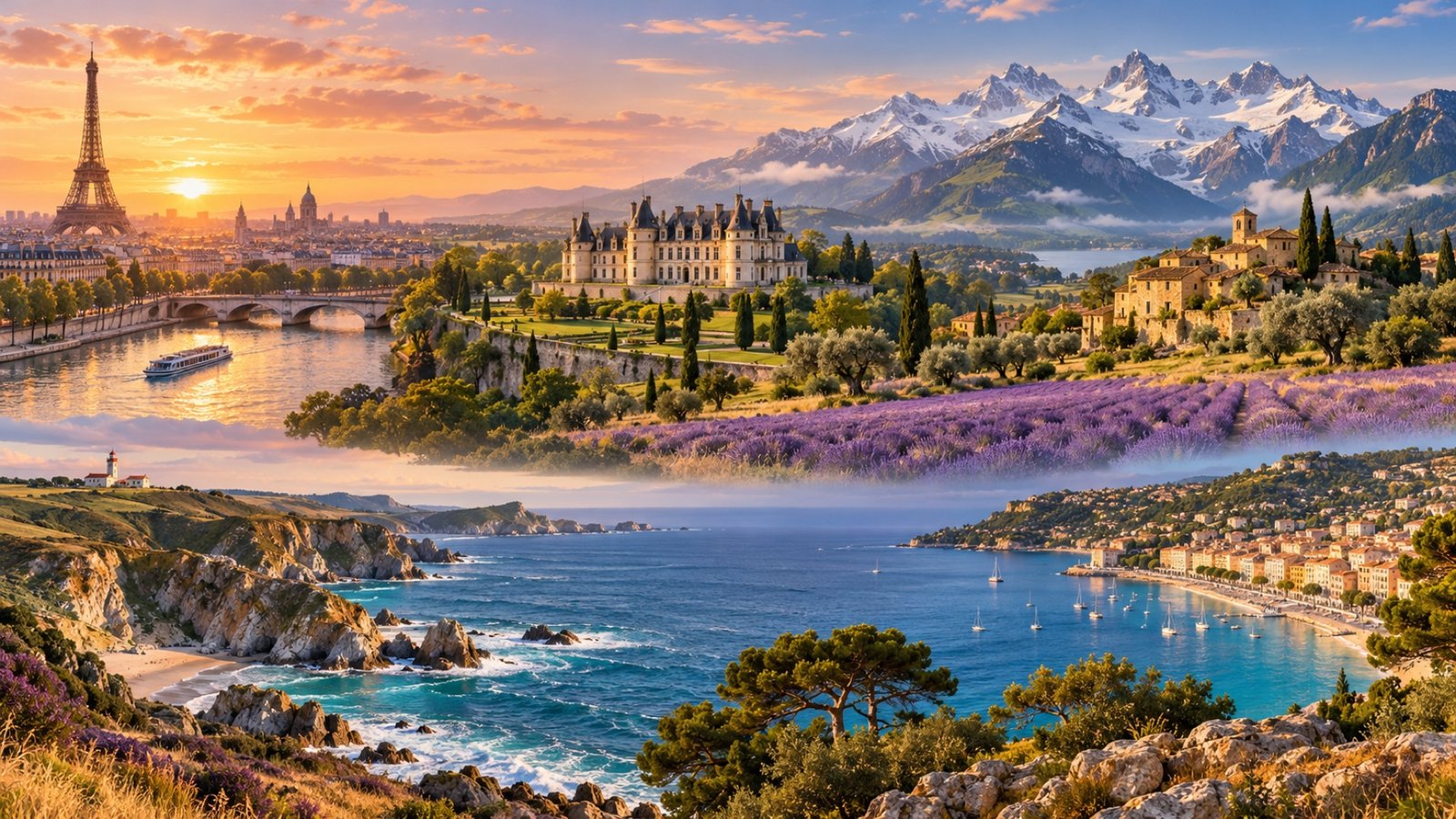
This guide uses official tourism, government and transport sources. Rules and prices can change, so check the linked official pages before booking.
France is not one Paris itinerary enlarged to national scale. The Atlantic, Alps, Mediterranean, Pyrenees, northern memorial landscapes, wine regions and regional cities have distinct climates, identities and transport realities. This guide is for a first visit that includes famous places without turning the country into a race. It explains fifty experiences, how to connect them, common planning failures and which official source should settle a time-sensitive decision.
France at a glance
- Ideal first trip: 10–14 days for Paris plus two regions; three weeks for a slower north-to-south route.
- Currency: euro. Cards are common, but keep a backup method for small businesses and machine failures.
- Best planning principle: reserve high-demand anchors, then preserve flexibility for weather, strikes and regional transport.
- Transport: high-speed rail is excellent between major cities; rural coasts, villages and mountains need separate local planning.
- Price check: compare final official totals including cancellation terms, city tax, breakfast, parking and mandatory fees.
Entry and arrival planning
Use France-Visas and the relevant official border source to determine what applies to your passport. Short Schengen stays are generally limited to 90 days in any 180-day period, but nationality, residence status and trip purpose matter. Do not rely on a blog, airline advertisement or AI summary for permission to travel. France’s overseas territories can have separate entry rules.
Paris Charles de Gaulle and Orly are major gateways, while Nice, Lyon, Marseille, Toulouse, Bordeaux and regional airports can support an open-jaw route. Compare the complete journey: airport transport, baggage, arrival time, hotel check-in and the cost of returning to the first airport. A slightly higher multi-city fare can save a hotel night and a full day of backtracking.
When to go
Late spring and early autumn often balance daylight and comfort, but France spans several climate zones. Summer brings strong demand, heat and wildfire restrictions in Mediterranean regions and high use of coasts and mountains. Winter supports cities and snow sports but short daylight and alpine conditions need buffers. Check French school holidays, national holidays, major festivals, harvest periods and sporting events before booking.
Budget and places to stay
Build three live scenarios instead of trusting a national average. A value trip uses advance rail, simple central rooms, bakeries, markets and free streetscapes. A mid-range trip adds well-located hotels, reserved monuments and occasional taxis. A premium trip pays for historic properties, flexible rail, private interpretation and remote transfers. Paris, Riviera resorts and festival dates can cost far more than regional cities on the same day.
For every hotel, compare the final cancellable total on the official property site with a reputable platform, then read the exact room description. “Centre” does not guarantee an easy station transfer. Check air conditioning, lift access, bed configuration, breakfast, city tax, parking and luggage storage. Recent recurring comments about noise, cleanliness and access matter more than a headline score.
Fifty things to do in France
1. Eiffel Tower and Champ de Mars
Why go: Paris. Use the Eiffel Tower as a lesson in engineering and city geography rather than a rushed photograph, then continue through the Champ de Mars and nearby residential streets. This experience earns its place because it contributes a distinct part of France’s story rather than repeating a view found elsewhere.
How to do it: Reserve only through the official tower channel, select a level that suits the group, arrive before the security time and keep the rest of the half day nearby.
Good for: First-time visitors, architecture travellers and families
Know before you go: Summit access can close because of wind, weather or operations; unofficial ticket sellers and petition scams are common around the approach.
2. Louvre with a focused collection route
Why go: Paris. The Louvre is a former palace and a vast global collection; a three-theme route creates a more meaningful visit than trying to see every famous room. This experience earns its place because it contributes a distinct part of France’s story rather than repeating a view found elsewhere.
How to do it: Check the official floor plan and gallery closures, reserve a timed entry, choose one major department plus two priorities and stop before museum fatigue erases the detail.
Good for: Art, archaeology and palace-history travellers
Know before you go: Entrances, bag checks and room access change; protect valuables in crowds and research the provenance context of objects rather than treating the museum as a trophy list.
3. Notre-Dame and Sainte-Chapelle
Why go: Paris. Notre-Dame’s restored cathedral and Sainte-Chapelle’s stained glass explain the political, religious and artistic importance of the Île de la Cité. This experience earns its place because it contributes a distinct part of France’s story rather than repeating a view found elsewhere.
How to do it: Check worship and visitor times separately, begin early, allow security queues and add the island and Left Bank on foot instead of another distant timed attraction.
Good for: Gothic architecture, history and photography visitors
Know before you go: Both are active sacred sites with controlled access; dress and behave respectfully, and verify step-free routes before arrival.
4. Seine banks and a licensed river cruise
Why go: Paris. Walking the UNESCO-listed riverbanks reveals the relationship between bridges, monuments and neighbourhoods, while a scheduled cruise offers a second perspective without another metro transfer. This experience earns its place because it contributes a distinct part of France’s story rather than repeating a view found elsewhere.
How to do it: Walk one bank in daylight, compare licensed operators and exact piers, then schedule the cruise near sunset only when the seasonal timetable supports the return journey.
Good for: Couples, multigenerational groups and low-impact sightseeing
Know before you go: Water levels, security restrictions and weather can change routes; keep phones secure near crowded bridges and never buy from an unverified street seller.
5. Montmartre beyond Sacré-Cœur
Why go: Paris. Montmartre works best as a living hill neighbourhood with working streets, cemetery, small museums and art history, not only a staircase and souvenir square. This experience earns its place because it contributes a distinct part of France’s story rather than repeating a view found elsewhere.
How to do it: Arrive by a less congested route, use the funicular when helpful, walk downhill through quieter streets and choose one museum or guided history theme.
Good for: Walkers, art-history visitors and photographers
Know before you go: Steep gradients and cobbles affect mobility; residents need clear doorways and quiet streets, and artists should be asked before being photographed.
6. Musée d’Orsay and the Left Bank
Why go: Paris. The converted railway station provides a strong chronological route through nineteenth-century art and connects naturally to the Seine, Saint-Germain and the Luxembourg area. This experience earns its place because it contributes a distinct part of France’s story rather than repeating a view found elsewhere.
How to do it: Reserve a practical entry, check which galleries are open, study a small number of movements and leave time for the architecture instead of racing to individual paintings.
Good for: Impressionism, design and indoor-weather planners
Know before you go: Popular rooms become dense and lifts may queue; confirm accessibility, temporary exhibitions and bag rules on the museum site.
7. Le Marais history and Jewish heritage
Why go: Paris. Le Marais layers medieval streets, hôtels particuliers, Jewish history, LGBTQ+ culture, museums and contemporary commerce in one walkable district. This experience earns its place because it contributes a distinct part of France’s story rather than repeating a view found elsewhere.
How to do it: Start before the shopping peak, include a museum or documented heritage stop, buy food from established businesses and leave residential courtyards private.
Good for: Cultural travellers, food explorers and repeat Paris visitors
Know before you go: Opening days differ by religious and museum calendars; avoid photographing worshippers or memorials intrusively and watch belongings in crowded lanes.
8. Canal Saint-Martin and eastern Paris
Why go: Paris. The canal, République, Belleville and nearby districts show a creative and residential Paris that balances the monumental centre. This experience earns its place because it contributes a distinct part of France’s story rather than repeating a view found elsewhere.
How to do it: Walk in daylight, choose one market or park, use a documented street-art or food route and return by metro before an overfull late itinerary.
Good for: Neighbourhood travellers, design visitors and relaxed walkers
Know before you go: Canal edges and road crossings require attention; nightlife noise, temporary works and market days change the atmosphere.
9. Père Lachaise with respectful interpretation
Why go: Paris. Père Lachaise is a landscape of architecture, memory, politics and social history rather than a celebrity scavenger hunt. This experience earns its place because it contributes a distinct part of France’s story rather than repeating a view found elsewhere.
How to do it: Download the official map, select a few themes, allow hills and uneven paths, and pair the visit with nearby streets rather than crossing the city for another major ticket.
Good for: History, garden and literary travellers
Know before you go: It remains a working cemetery; keep voices low, never climb monuments and verify accessible routes and opening times.
10. Versailles palace, gardens and town
Why go: Île-de-France. Versailles becomes more understandable when the palace, designed landscape, political history and ordinary town are treated as one full-day destination. This experience earns its place because it contributes a distinct part of France’s story rather than repeating a view found elsewhere.
How to do it: Reserve through the official estate, arrive from the correct station, prioritise either interiors or estate grounds and eat away from the busiest palace corridor.
Good for: Royal history, garden and architecture travellers
Know before you go: Fountains and estate transport are seasonal, distances are large and state or maintenance closures can alter rooms; confirm accessibility before buying extras.
11. Giverny and the Seine valley
Why go: Normandy. Monet’s house and garden connect artistic practice to a real landscape, while the village and Seine valley prevent the day becoming a single crowded photo stop. This experience earns its place because it contributes a distinct part of France’s story rather than repeating a view found elsewhere.
How to do it: Travel by the official rail-and-shuttle combination or a planned car route, reserve entry, arrive early and add only one nearby cultural stop.
Good for: Garden, painting and slow-travel visitors
Know before you go: The garden is seasonal and narrow paths become busy; never enter planted beds and verify the final shuttle or train before lingering.
12. Rouen and Honfleur as separate chapters
Why go: Normandy. Rouen offers cathedral, medieval streets and Joan of Arc history, while Honfleur adds harbour, maritime trade and artistic heritage. This experience earns its place because it contributes a distinct part of France’s story rather than repeating a view found elsewhere.
How to do it: Base overnight or choose one place for a day trip; if combining them, use a realistic bus or car plan and protect time for museums and ordinary streets.
Good for: Architecture, history and coastal-city travellers
Know before you go: Road congestion and limited evening connections can break a tight pair; cobbles and old buildings require individual accessibility checks.
13. Étretat and the Alabaster Coast
Why go: Normandy. Étretat’s chalk arches are spectacular, but the wider Alabaster Coast provides a more responsible landscape experience than a single cliff-edge photograph. This experience earns its place because it contributes a distinct part of France’s story rather than repeating a view found elsewhere.
How to do it: Check weather and official path status, arrive by public transport or legal parking, walk only a signed section and use the town as a real base.
Good for: Coastal walkers and geology travellers
Know before you go: Cliff falls, wind and unprotected edges are serious hazards; stay behind barriers, avoid cliff bases and never follow an informal social-media path.
14. D-Day beaches and Bayeux
Why go: Normandy. Bayeux, the landing beaches, museums and cemeteries require context, quiet and enough time to understand military events and civilian consequences. This experience earns its place because it contributes a distinct part of France’s story rather than repeating a view found elsewhere.
How to do it: Choose one sector, use an accredited guide or a carefully mapped car route, include a museum and memorial, and stay overnight rather than rushing from Paris.
Good for: Modern-history travellers and multigenerational families
Know before you go: Cemeteries and memorials are not performance spaces; verify opening rules, keep respectful photography and do not attempt every beach in one day.
15. Mont-Saint-Michel and its bay
Why go: Normandy. The tidal island combines pilgrimage, engineering, village life and a powerful bay landscape when visited beyond the midday coach peak. This experience earns its place because it contributes a distinct part of France’s story rather than repeating a view found elsewhere.
How to do it: Check official tides, shuttle operations and abbey entry, stay nearby or arrive early, and use a certified bay guide for any walk on tidal flats.
Good for: Heritage, landscape and photography travellers
Know before you go: Tides and quicksand make independent bay crossings dangerous; steep lanes and stairs require an accessible alternative plan.
16. Lille and Louvre-Lens
Why go: Hauts-de-France. Lille’s Flemish-influenced centre, markets and museums pair with the Louvre-Lens to create a strong northern cultural break. This experience earns its place because it contributes a distinct part of France’s story rather than repeating a view found elsewhere.
How to do it: Use Lille as a rail base, reserve a half day for the city and a separate rail segment to Lens, checking museum closing days and football or event demand.
Good for: Art, food and short-break travellers
Know before you go: Large events change room prices and trains; museum access and regional connections should be checked live rather than assumed from Paris timetables.
17. Baie de Somme by bike or foot
Why go: Hauts-de-France. The Somme estuary combines wetlands, coastal villages, birdlife and cycling routes that reward a quiet multi-day approach. This experience earns its place because it contributes a distinct part of France’s story rather than repeating a view found elsewhere.
How to do it: Select one marked route, use a local base, check tides and seasonal wildlife guidance, and rent equipment from an established operator.
Good for: Birders, cyclists and families
Know before you go: Mudflats, fast tides and protected nesting areas require strict path discipline; do not approach seals or wildlife for photographs.
18. Reims and responsible Champagne visits
Why go: Grand Est. Reims combines cathedral history and major Champagne houses, while the surrounding region reveals vineyards, villages and smaller producers. This experience earns its place because it contributes a distinct part of France’s story rather than repeating a view found elsewhere.
How to do it: Reserve cellar tours through official channels, choose a designated driver or rail-based route, eat before tastings and compare one large house with one independent producer.
Good for: Food-and-wine travellers and heritage visitors
Know before you go: Alcohol service is discretionary and driving limits are strict; cellar stairs, cool temperatures and harvest periods change access.
19. Strasbourg and European institutions
Why go: Alsace. Strasbourg connects a Gothic cathedral and canal-lined old city with contemporary European institutions and Franco-German history. This experience earns its place because it contributes a distinct part of France’s story rather than repeating a view found elsewhere.
How to do it: Explore the centre early, reserve institutional visits when available, use trams and add a neighbourhood meal rather than treating Petite France as the entire city.
Good for: Architecture, politics and Christmas-market travellers
Know before you go: Peak market periods require early lodging and crowd planning; security rules can close institutional areas and cobbles affect mobility.
20. Colmar and Alsace villages without overpacking
Why go: Alsace. Colmar and the wine-route villages present preserved urban form, vineyards and regional food, but each is a living community rather than a themed set. This experience earns its place because it contributes a distinct part of France’s story rather than repeating a view found elsewhere.
How to do it: Stay in a transport hub, visit only two villages in one day, use trains, buses or a sober driver and spend beyond the most photographed lanes.
Good for: Couples, food travellers and small-town photographers
Know before you go: Seasonal buses and restaurant days vary; avoid blocking homes, fly no drones without permission and never combine tastings with driving.
21. Loire Valley châteaux with a two-site limit
Why go: Centre-Val de Loire. Chambord, Chenonceau and the wider Loire estates tell different stories of power, design, gardens and landscape management. This experience earns its place because it contributes a distinct part of France’s story rather than repeating a view found elsewhere.
How to do it: Choose two contrasting estates, reserve official entries, base in Tours or another connected town and count transfers, lunch and garden walking honestly.
Good for: Architecture, garden and family travellers
Know before you go: Trying three or four estates produces shallow visits; accessibility differs between historic floors and gardens, and flood or event conditions can change routes.
22. Loire à Vélo slow travel
Why go: Centre-Val de Loire and Pays de la Loire. The Loire cycling network links towns, châteaux, river landscapes and local food with a pace that makes the region coherent. This experience earns its place because it contributes a distinct part of France’s story rather than repeating a view found elsewhere.
How to do it: Select a signed section matched to the group, reserve a reliable bike, confirm luggage transfers and train bicycle rules, and keep a weather alternative.
Good for: Cyclists, families with experience and low-carbon travellers
Know before you go: Heat, road crossings and mechanical failure need planning; helmets, lights, water and a shorter bailout route should be agreed before departure.
23. Dijon and Beaune Burgundy route
Why go: Bourgogne-Franche-Comté. Dijon’s ducal heritage and Beaune’s wine and hospital history offer a compact introduction to Burgundy beyond a tasting checklist. This experience earns its place because it contributes a distinct part of France’s story rather than repeating a view found elsewhere.
How to do it: Use rail between cities, walk a documented heritage route, reserve one cellar or vineyard visit and include regional food with clear pricing.
Good for: History, gastronomy and wine travellers
Know before you go: Vineyards are private workplaces, alcohol and driving do not mix, and harvest access or opening hours change seasonally.
24. Lyon neighbourhoods and gastronomy
Why go: Auvergne-Rhône-Alpes. Lyon’s Roman sites, Renaissance streets, silk history, contemporary districts and food culture reward at least two nights. This experience earns its place because it contributes a distinct part of France’s story rather than repeating a view found elsewhere.
How to do it: Group Vieux Lyon and Fourvière, use funicular and metro, reserve only one major meal, and explore a market or neighbourhood with room for ordinary café time.
Good for: Food, architecture and urban-history travellers
Know before you go: Traditional menus can be rich and allergen information varies; steep old streets and traboules require respectful access and mobility planning.
25. Annecy lake and old town
Why go: Auvergne-Rhône-Alpes. Annecy combines an attractive old town with lake travel, cycling and mountain views, working best when the waterfront is not compressed into a Geneva day trip. This experience earns its place because it contributes a distinct part of France’s story rather than repeating a view found elsewhere.
How to do it: Stay overnight, walk early, reserve a licensed boat or bicycle, and choose one shore rather than attempting the full lake in peak traffic.
Good for: Families, couples and active travellers
Know before you go: Water temperatures, storms and crowded cycle paths require caution; use official beaches and never assume a rental includes safety equipment.
26. Chamonix and Mont Blanc safety choices
Why go: French Alps. Chamonix offers glaciers, high-mountain history and cable-assisted viewpoints, but altitude and alpine conditions turn sightseeing into a serious planning decision. This experience earns its place because it contributes a distinct part of France’s story rather than repeating a view found elsewhere.
How to do it: Check official lift and weather status, acclimatise, choose a valley or mid-level backup and hire certified professionals for technical terrain.
Good for: Mountain enthusiasts and landscape visitors
Know before you go: Altitude illness, crevasses, rockfall and sudden weather are real; a lift ticket is not permission or preparation for mountaineering.
27. Auvergne volcanoes and Clermont-Ferrand
Why go: Auvergne. Clermont-Ferrand and the Chaîne des Puys combine volcanic science, Romanesque architecture, food and marked outdoor routes. This experience earns its place because it contributes a distinct part of France’s story rather than repeating a view found elsewhere.
How to do it: Use the city as a base, check seasonal access to Puy de Dôme, select one signed trail and include a weather-proof museum or food option.
Good for: Geology, hiking and family travellers
Know before you go: Exposed summits change quickly and protected volcanic ground should not be shortcut; rural buses and final departures need advance checking.
28. Bordeaux city and riverfront
Why go: Nouvelle-Aquitaine. Bordeaux’s UNESCO-listed centre, riverfront, markets and wine culture form a complete city break even without a vineyard tour. This experience earns its place because it contributes a distinct part of France’s story rather than repeating a view found elsewhere.
How to do it: Use trams, walk one heritage district at a time, reserve the Cité du Vin or one museum, and include ordinary neighbourhood food beyond prestige labels.
Good for: Architecture, food and short-break travellers
Know before you go: Heat, large events and tasting alcohol affect plans; check riverfront works, tram disruptions and accessibility live.
29. Saint-Émilion with a sober transport plan
Why go: Nouvelle-Aquitaine. Saint-Émilion layers medieval architecture, underground heritage and working vineyards, and deserves context beyond a branded tasting. This experience earns its place because it contributes a distinct part of France’s story rather than repeating a view found elsewhere.
How to do it: Travel by rail plus the confirmed local connection or use a sober driver, reserve one verified estate, and allow time for the town’s slopes and monuments.
Good for: Wine, heritage and landscape visitors
Know before you go: Cellar sales pressure is not quality proof; underground access involves steps, harvest changes visits and driving after tasting is unsafe.
30. Arcachon Bay and Dune du Pilat
Why go: Nouvelle-Aquitaine. Arcachon Bay combines oyster villages, tidal landscapes and Europe’s great dune system within reach of Bordeaux. This experience earns its place because it contributes a distinct part of France’s story rather than repeating a view found elsewhere.
How to do it: Check rail and local bus times, visit the dune in safe weather, choose one bay town and use a licensed boat only when conditions suit.
Good for: Coastal families, walkers and food travellers
Know before you go: Dune edges shift, sand becomes hot and steep, and oysters carry individual health risks; follow marked access and current local advisories.
31. Dordogne, Sarlat and cave heritage
Why go: Nouvelle-Aquitaine. The Dordogne links prehistoric interpretation, river landscapes, bastide towns, castles and regional food across a rural area. This experience earns its place because it contributes a distinct part of France’s story rather than repeating a view found elsewhere.
How to do it: Base several nights, reserve official cave or replica-centre visits, choose one river activity and reduce driving by grouping one valley each day.
Good for: Prehistory, countryside and family travellers
Know before you go: Many caves restrict photography and access; roads are slow, rivers depend on water conditions and unverified food claims should be avoided.
32. La Rochelle and Île de Ré
Why go: Atlantic coast. La Rochelle’s harbour, maritime museums and markets connect naturally to the flat cycling landscapes and villages of Île de Ré. This experience earns its place because it contributes a distinct part of France’s story rather than repeating a view found elsewhere.
How to do it: Stay near transport, take a bus or bicycle to the island, use marked routes and limit the day to one side rather than racing the full coast.
Good for: Cyclists, families and maritime-history travellers
Know before you go: Summer traffic and wind are significant; salt marshes and dunes are working or protected landscapes, not open shortcuts.
33. Nantes and the Loire estuary
Why go: Pays de la Loire. Nantes combines château history, contemporary art, industrial imagination and an estuary landscape extending toward Saint-Nazaire. This experience earns its place because it contributes a distinct part of France’s story rather than repeating a view found elsewhere.
How to do it: Spend one day in the walkable centre and island, reserve major mechanical attractions, then make the estuary a separate rail or guided day.
Good for: Creative-city travellers and families
Know before you go: Large installations have operating rules and queues; estuary art may be seasonal, remote or accessible only by a safe planned route.
34. Saint-Malo and Dinan
Why go: Brittany. Saint-Malo’s walled maritime city and Dinan’s river and medieval streets provide complementary Breton histories when paced across two days. This experience earns its place because it contributes a distinct part of France’s story rather than repeating a view found elsewhere.
How to do it: Check tides and rail or bus connections, walk the ramparts only when conditions permit, and stay overnight to experience streets outside day-trip hours.
Good for: Maritime, history and family travellers
Know before you go: Ramparts, cobbles and steep lanes affect mobility; the intertidal zone can cut off walkers quickly, so obey local tide guidance.
35. Brittany’s Pink Granite and western coast
Why go: Brittany. The Pink Granite Coast, lighthouses and western headlands show Brittany’s geology, maritime weather and living communities beyond resort imagery. This experience earns its place because it contributes a distinct part of France’s story rather than repeating a view found elsewhere.
How to do it: Choose one coastal base, walk a signed customs-path section, check wind and tide forecasts and buy from local producers without blocking village access.
Good for: Coastal walkers, photographers and road trippers
Know before you go: Cliffs, waves and rapidly changing weather are serious; paths cross sensitive habitats and parking outside marked areas harms residents.
36. Toulouse and aerospace culture
Why go: Occitanie. Toulouse combines brick architecture, Canal du Midi heritage, markets and major aerospace institutions in a lively southern city. This experience earns its place because it contributes a distinct part of France’s story rather than repeating a view found elsewhere.
How to do it: Use metro and walking routes, reserve aerospace visits, explore the river and one market, and check rugby or event dates before choosing lodging.
Good for: Science, food and urban travellers
Know before you go: Large sites have security and timed-entry rules; summer heat and event crowds call for early starts and water.
37. Carcassonne beyond the ramparts
Why go: Occitanie. Carcassonne’s restored fortified city becomes more meaningful when paired with the lower town, local history and surrounding landscape. This experience earns its place because it contributes a distinct part of France’s story rather than repeating a view found elsewhere.
How to do it: Arrive early or stay overnight, walk both towns, choose one museum or guided interpretation and avoid building the day around souvenir lanes.
Good for: Medieval-history visitors and families
Know before you go: Walls and towers involve steps and exposed sections; summer heat and peak crowds require an accessibility and rest plan.
38. Canal du Midi slow route
Why go: Occitanie. The Canal du Midi links engineering history, shaded towpaths, towns and wine landscapes and is best experienced slowly by bike, boat or short walks. This experience earns its place because it contributes a distinct part of France’s story rather than repeating a view found elsewhere.
How to do it: Choose one section, verify path surface and boat credentials, carry water, and plan station or transfer logistics before starting.
Good for: Cyclists, boat travellers and multigenerational groups
Know before you go: Tree works, heat and mixed-use paths change conditions; lock bicycles securely and do not swim outside authorised areas.
39. French Pyrenees with a valley base
Why go: Pyrenees. The French Pyrenees offer national-park landscapes, pilgrimage towns, thermal heritage and cross-border culture without requiring a summit objective. This experience earns its place because it contributes a distinct part of France’s story rather than repeating a view found elsewhere.
How to do it: Select one valley, check mountain and road status, plan a low-level route and use a certified guide for snow, climbing or remote terrain.
Good for: Hikers, wildlife visitors and wellness travellers
Know before you go: Storms, snowfields, heat and livestock are genuine risks; rescue is not a substitute for conservative route choice.
40. Nîmes and Pont du Gard
Why go: Occitanie. Nîmes and the Pont du Gard connect Roman urban life, engineering and Mediterranean landscape in a manageable two-day route. This experience earns its place because it contributes a distinct part of France’s story rather than repeating a view found elsewhere.
How to do it: See the city monuments early, travel to the aqueduct with a confirmed bus or car plan and leave time for the museum and riverside.
Good for: Roman-history, architecture and family travellers
Know before you go: Stone surfaces become hot and slippery, events alter access and river conditions require official swimming guidance.
41. Avignon and the Rhône
Why go: Provence. Avignon’s papal palace, walls, bridge and theatre culture explain a major European political and artistic centre. This experience earns its place because it contributes a distinct part of France’s story rather than repeating a view found elsewhere.
How to do it: Stay inside or near the walls, reserve the palace, walk early and use the city as a rail base rather than combining distant villages every day.
Good for: History, festival and performing-arts travellers
Know before you go: Festival periods transform prices, streets and noise; palace stairs and summer heat require a slower accessible route.
42. Arles and the Camargue
Why go: Provence. Arles combines Roman monuments and art history while the Camargue adds wetlands, horses, rice and birdlife when visited responsibly. This experience earns its place because it contributes a distinct part of France’s story rather than repeating a view found elsewhere.
How to do it: Give Arles a full day, then use a separate official nature reserve or small guided Camargue trip with a licensed operator.
Good for: Archaeology, art and nature travellers
Know before you go: Wetlands are sensitive and mosquitoes, heat and flood conditions vary; never approach horses, bulls or nesting birds.
43. Aix-en-Provence, Luberon and Sainte-Victoire
Why go: Provence. Aix’s markets and Cézanne landscape can anchor a slower Provence stay, with one carefully selected village or signed Sainte-Victoire route. This experience earns its place because it contributes a distinct part of France’s story rather than repeating a view found elsewhere.
How to do it: Walk Aix early, choose either a Luberon circuit or mountain day, verify fire-risk closures and use a sober driver around wine visits.
Good for: Art, food, village and hiking travellers
Know before you go: Wildfire controls can close whole areas, parking is restricted and heat makes exposed walks dangerous; do not chase every village.
44. Marseille harbour, Mucem and neighbourhoods
Why go: Provence. Marseille’s port history, migration, food, hills and contemporary museums form a complex city that should not be reduced to one waterfront photograph. This experience earns its place because it contributes a distinct part of France’s story rather than repeating a view found elsewhere.
How to do it: Use metro and walking routes, connect the Old Port with Mucem and one neighbourhood, reserve bouillabaisse only at a transparent established restaurant.
Good for: Urban-culture, food and maritime travellers
Know before you go: Summer heat, steep streets and petty theft require normal city precautions; avoid unlicensed boats and simplified stereotypes about neighbourhoods.
45. Calanques National Park
Why go: Provence. The Calanques between Marseille and Cassis combine limestone cliffs and Mediterranean water within a protected national park. This experience earns its place because it contributes a distinct part of France’s story rather than repeating a view found elsewhere.
How to do it: Check the park’s official fire-risk access status on the day, use public transport where possible, carry all water and choose a route below the group’s maximum.
Good for: Hikers, kayakers and coastal landscape visitors
Know before you go: Heat, falling rock, fire closures and limited shade are serious; swimming and boating conditions change and rescue access can be slow.
46. Nice old town, museums and coast
Why go: French Riviera. Nice pairs Mediterranean urban life, hill views, markets and major art museums with easy rail access along the Riviera. This experience earns its place because it contributes a distinct part of France’s story rather than repeating a view found elsewhere.
How to do it: Base near a tram or rail stop, walk Vieux Nice early, choose one museum and use Castle Hill or the promenade according to heat and mobility.
Good for: Art, food and first-time Riviera travellers
Know before you go: Pebble beaches, intense sun and crowded trams require footwear, hydration and secure belongings; private beach pricing must be checked live.
47. French Riviera by rail
Why go: Côte d’Azur. Regional trains connect Antibes, Cannes, Monaco, Menton and smaller coastal stops, allowing a car-free route when destinations are limited. This experience earns its place because it contributes a distinct part of France’s story rather than repeating a view found elsewhere.
How to do it: Choose at most two towns in one day, validate the correct ticket, check works and last trains, and walk beyond the station before moving on.
Good for: Car-free travellers, couples and photographers
Know before you go: Trains become extremely crowded during events and beach peaks; Monaco has separate practical rules, and cliff paths need weather checks.
48. Gorges du Verdon and Lake Sainte-Croix
Why go: Provence-Alpes. The Verdon canyon and lake provide dramatic geology, hiking and water activities, but distances and seasonal crowds demand a single-base strategy. This experience earns its place because it contributes a distinct part of France’s story rather than repeating a view found elsewhere.
How to do it: Choose either a rim drive, marked hike or licensed water activity, start early and verify road, fire and water conditions.
Good for: Active travellers, families and road trippers
Know before you go: Cliff roads, heat, storms and cold water are hazards; never mix an exhausting hike with a long unfamiliar drive.
49. Corsica with one-region planning
Why go: Corsica. Corsica combines mountain culture, Genoese towns, beaches, food and protected landscapes, and cannot be covered well in a rushed island loop. This experience earns its place because it contributes a distinct part of France’s story rather than repeating a view found elsewhere.
How to do it: Choose north or south for a first week, reserve ferries or flights and lodging, use realistic mountain-road times and build non-beach cultural days.
Good for: Road trippers, hikers and coastal travellers
Know before you go: Roads are slow, wildfire and storm conditions change access, and the GR20 is a serious trek requiring separate experience and logistics.
50. Écrins, Queyras and the southern Alps
Why go: French Alps. Beyond Chamonix, the Écrins and Queyras offer high valleys, villages, cycling and national-park landscapes with both summer and winter routes. This experience earns its place because it contributes a distinct part of France’s story rather than repeating a view found elsewhere.
How to do it: Base in one valley, check seasonal roads and avalanche or storm forecasts, and use certified guides for glaciers, ski touring or technical routes.
Good for: Mountain, cycling and slow-village travellers
Know before you go: Altitude, avalanche, rockfall and weather require current professional information; resort branding does not make off-piste terrain safe.
Food worth planning around
Build meals into geography instead of crossing a city for every recommendation. Try a market, bakery, neighbourhood restaurant and one regional speciality with clear provenance. France’s food identity changes sharply between Normandy, Brittany, Alsace, Burgundy, Lyon, the Atlantic, southwest, Alps, Provence and Corsica. Ask directly about allergens; familiar names do not guarantee identical ingredients or cross-contamination controls.
Reserve destination restaurants when necessary but keep one flexible meal each day. Read the current menu and final price rather than an old listicle. Wine, cider and spirits are optional cultural products, not required experiences; alcohol and driving never belong in the same plan.
What to buy
Useful souvenirs have a traceable maker, material and place connection: ceramics, textiles, books, regional food that can legally cross your home border, or work bought from an artist. French branding does not prove French manufacture. Ask where an item was made, retain receipts and check customs rules before buying plants, animal products, alcohol or high-value goods.
Getting around
Use SNCF Connect for live rail planning and each local operator for disruptions and accessibility. A ticket can be restricted to a booked train, while flexibility costs more. Rail passes are not automatically cheaper: calculate the journeys you will actually take and understand reservation requirements and missed-connection protection.
In cities, transit apps and contactless or reloadable systems vary. In rural areas, inspect the return journey before leaving, especially on Sundays. A rental car adds value for some villages, coasts and valleys but also adds tolls, fuel, parking, insurance and narrow roads. Do not collect a car immediately after an overnight flight if the driver is tired.
Easy access and family travel
France’s Tourism & Handicap label and Destination for All programme identify many verified services, but details still need checking at the exact attraction and station. Historic buildings combine accessible sections with stairs, cobbles or unavailable floors. Families should count transfers, queues and meals as activities; one anchor plus outdoor flexibility is often better than four timed tickets.
Stay safe
Secure valuables in dense transport and tourist crowds, use licensed transport and plan the route home after late events. Outdoor risks require current official information: wildfire, heat, avalanche, rockfall, tide, cliff, storm, altitude and river conditions can change quickly. Downloading a route is not a substitute for navigation or appropriate skill. Understand travel-insurance exclusions and emergency assistance before departure.
Mistakes to avoid
- Treating Paris as the whole country or deleting it just to appear unconventional.
- Changing hotels every night and losing mornings to checkout and transfers.
- Assuming a TGV arrival means the final village connection is easy.
- Planning Mediterranean hikes without checking heat and wildfire closures.
- Combining wine tasting and driving.
- Quoting old hotel or attraction prices as guarantees.
- Buying unofficial monument, event or rail tickets.
- Ignoring accessibility details in old buildings and hill towns.
Sample seven-day route
Spend four nights in Paris with two central sightseeing days, one museum-and-neighbourhood day and one Versailles or Giverny day. Take the train to Lyon for two nights and finish with one additional city day. This route is deliberately narrow and avoids losing the week to transfers.
Sample ten-day route
Use four nights in Paris, two in the Loire Valley, two in Bordeaux and two in Lyon. Reserve only two Loire estates, use rail between the major bases and keep one flexible day for weather or a neighbourhood that deserves more time.
Sample fourteen-day route
Use four nights Paris, two Normandy, two Loire Valley, two Lyon and four Provence or Riviera. An open-jaw flight can remove a full return to Paris. Travellers who prioritise hiking, wine, food or coast should remove a region and add those nights to one base.
France travel FAQ
How many days are enough?
Seven days supports Paris and one additional city. Ten to fourteen days creates a better first trip. Regional depth needs more time than a highlights list suggests.
Do I need a car?
No for Paris, major cities and many intercity routes. A car can help in selected rural areas only when parking, sober driving and one-way routing justify it.
Should I buy a rail pass?
Compare the pass with exact routes, reservations and flexibility. Advance point-to-point fares may be cheaper; a pass can win when plans are frequent and flexible.
Can I visit overseas France on the same visa?
Not necessarily. France-Visas notes that non-European territories can require separate permissions. Check the official rule for the exact territory and passport.
Official planning sources
- France-Visas short-stay guidance
- Explore France official tourism
- Explore France regional overview
- Paris official tourism essentials
- SNCF Connect timetables
- Official sustainable travel guidance
- Official accessibility planning
- UNESCO World Heritage state-party record for France
- United Kingdom government travel advice for France
- United States government travel advisory for France
Disclosure: This independent editorial guide is informational, not a booking guarantee. No ranking or price is guaranteed. Recheck all time-sensitive details before purchase.