This guide uses official tourism, government and transport sources. Rules and prices can change, so check the linked official pages before booking.
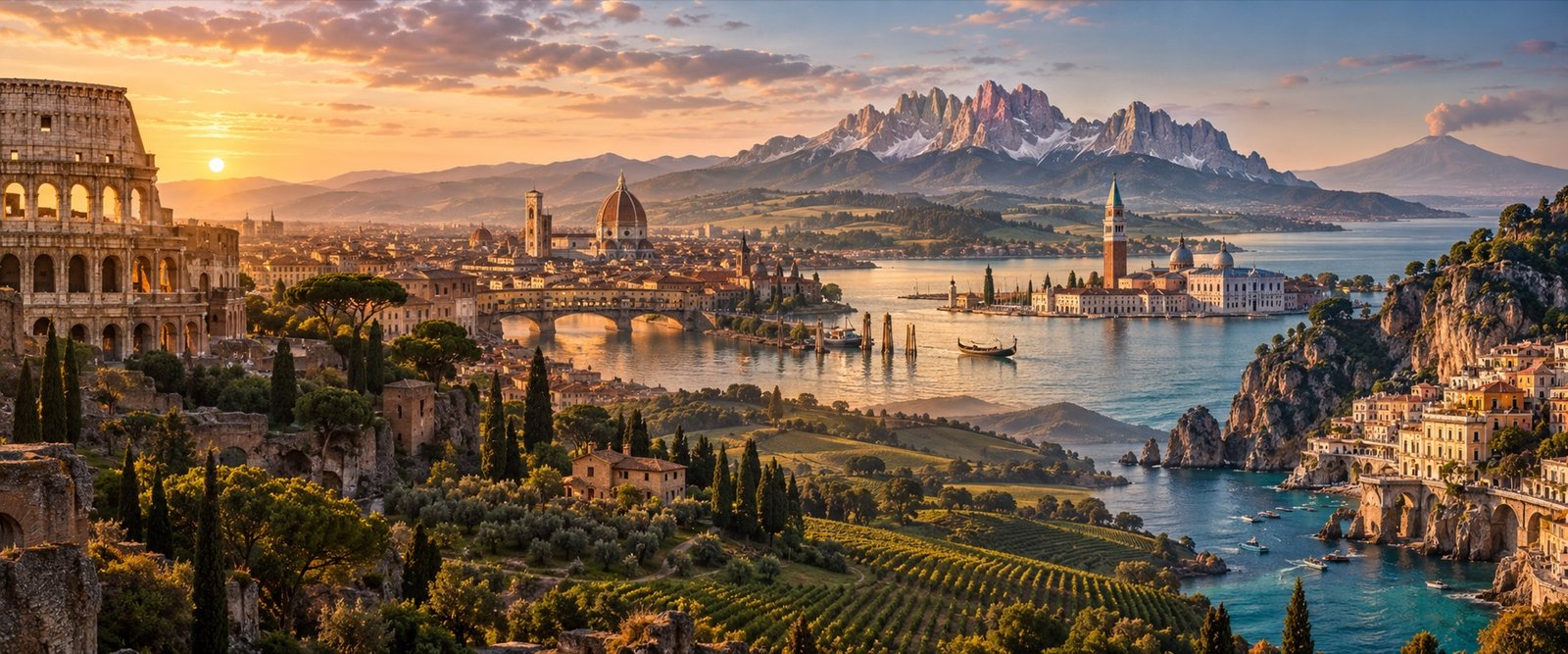
Italy cannot be planned as a single chain of famous monuments. Alpine valleys, industrial northern cities, medieval hill towns, volcanic landscapes, islands and southern coasts have different seasons, transport systems and visitor pressures. This guide uses fifty geographically distinct experiences to help a first-time visitor choose a coherent route instead of collecting rushed photographs.
Italy at a glance
- Ideal first trip: 10–14 days for Rome plus two regions; three weeks for a slower north-to-south route.
- Currency: euro. Cards are common, but keep a backup for small businesses, markets and machine failures.
- Best planning principle: reserve scarce anchors, then protect flexible time for weather, strikes and regional transport.
- Transport: high-speed rail links major cities; islands, villages, coasts and mountains require separate local planning.
- Price check: compare the final official total including city tax, breakfast, parking, beach services and mandatory fees.
Entry, visa and arrival planning
Use the Italian Ministry of Foreign Affairs visa portal and the authority responsible for your passport and residence. Short Schengen stays are commonly limited to 90 days in any 180-day period, but nationality, residence, purpose and previous travel matter. Never treat a travel article, airline advertisement or AI answer as permission to enter.
Rome Fiumicino, Milan Malpensa, Venice, Bologna, Naples and other airports support open-jaw routes. Compare the complete arrival: baggage, rail or bus connection, late check-in, strikes and the cost of returning to the original airport. A higher multi-city airfare can save a hotel night and a full day of backtracking.
When to go
Late spring and early autumn often balance daylight and comfort, but Italy spans Alpine, continental, Mediterranean and island climates. Summer can bring heat, wildfire restrictions, intense demand and crowded coastlines. Winter supports cities, skiing and quieter cultural travel, while snow, storms and short daylight change mountain and ferry plans.
Check national and regional holidays, school breaks, major religious dates, football fixtures, trade fairs, fashion weeks, festivals and cruise schedules. Venice, Florence, Rome, the lakes and coastal villages can feel completely different outside the busiest hours and months.
Budget and places to stay
Build three live scenarios rather than trusting one national daily average. A value route uses advance rail, simple rooms near transport, markets and free public space. A mid-range route adds central hotels, reserved museums and occasional taxis. A premium route pays for historic properties, flexible tickets, private interpretation and remote transfers.
Compare each hotel’s final cancellable total on the official property site with a reputable platform. Read the exact room description and recent recurring comments about noise, lifts, climate control, cleanliness and access. ‘Historic centre’ can mean pedestrian restrictions, stairs, cobbles and a difficult luggage transfer; ‘sea view’ does not guarantee beach access.
Fifty things to do in Italy
1. Colosseum, Forum and Palatine as one archaeological story
Why go: Rome, Lazio. These connected sites explain imperial spectacle, civic power, religion and the changing city more clearly when treated as one landscape.
How to do it: Reserve the official ticket, choose a realistic entrance time, carry water and leave a separate day for other Rome districts.
Good for: Ancient-history travellers and first-time visitors
Know before you go: Security, heat, uneven ground and temporary closures affect the route; unofficial sellers often misrepresent ticket conditions.
2. Pantheon, Piazza Navona and the historic centre
Why go: Rome, Lazio. A compact walk reveals ancient engineering, Baroque urban design, fountains, churches and the daily life layered between them.
How to do it: Start early, check the Pantheon’s official access system, enter active churches respectfully and pause away from the busiest piazzas.
Good for: Architecture, history and walking travellers
Know before you go: Crowds create pickpocketing and obstruction risks; worship schedules and dress expectations override sightseeing plans.
3. Vatican Museums with a focused route
Why go: Vatican City and Rome. A selected route through collections, papal spaces and the Sistine Chapel is more meaningful than trying to see every corridor.
How to do it: Book only through the official channel, select three priorities, verify dress and bag rules and protect recovery time afterward.
Good for: Art, religious-history and museum travellers
Know before you go: Vatican City is a separate state; dense crowds, long standing and changing gallery access require exact accessibility planning.
4. St Peter’s Basilica and the Vatican neighbourhood
Why go: Vatican City and Rome. The basilica’s architecture, pilgrimage function and surrounding district deserve context beyond a dome photograph.
How to do it: Check liturgical events and security rules, arrive with respectful clothing and treat dome access as a separate physical decision.
Good for: Architecture, faith and cultural travellers
Know before you go: Services can close areas without notice; queues are exposed and the dome involves confined stairs and height.
5. Trastevere and the Gianicolo without a pub crawl
Why go: Rome, Lazio. Historic churches, artisan streets, residential lanes and hill views show a lived district beyond nightlife branding.
How to do it: Visit in daylight, include one documented heritage stop, reserve dinner only where the menu and price are clear, and keep residential lanes quiet.
Good for: Neighbourhood, food and photography travellers
Know before you go: Night crowds, noise and aggressive menus can overwhelm the area; never block homes or photograph residents intrusively.
6. Appian Way and Roman aqueduct landscapes
Why go: Rome, Lazio. Ancient roads, tombs, catacombs and aqueducts reveal Rome’s infrastructure in a greener setting beyond the core.
How to do it: Check the park’s official map, choose a safe cycling or walking section and reserve catacombs separately with their operator.
Good for: Cyclists, archaeology and landscape travellers
Know before you go: Road surfaces, traffic and heat vary; sacred underground sites have rules, stairs and limited accessibility.
7. Ostia Antica as a full half-day
Why go: Lazio. The port city’s streets, baths, apartments and warehouses make ordinary Roman life easier to understand than another isolated monument.
How to do it: Check official opening information and the suburban rail, arrive early and use the site map to build a themed route.
Good for: Archaeology, families and independent travellers
Know before you go: Large exposed areas need water and sun protection; transport disruption can make a tight airport-day plan fail.
8. Tivoli: Villa d’Este or Hadrian’s Villa, not both rushed
Why go: Lazio. Two very different estates explain imperial scale and Renaissance garden design, but each deserves time.
How to do it: Choose one primary villa, verify the bus or train plus final local connection, and add the second only with an overnight or private transfer.
Good for: Garden, architecture and history travellers
Know before you go: Slopes, water features, ancient paving and limited local transport need accessibility and return planning.
9. Florence Duomo complex with timed priorities
Why go: Florence, Tuscany. Cathedral, baptistery, museum, dome and bell tower form one artistic system whose parts should not be raced.
How to do it: Use the official pass, choose either dome or tower as the demanding climb, and study the museum before interpreting the exterior.
Good for: Renaissance, architecture and first-time visitors
Know before you go: Climbs are steep and confined; ticket types, entry points, worship and conservation closures change.
10. Uffizi with a three-theme plan
Why go: Florence, Tuscany. A focused sequence through selected periods makes the collection readable and leaves energy for the city.
How to do it: Reserve officially, check room closures, choose three themes or artists and stop before visual fatigue erases detail.
Good for: Art-history and museum travellers
Know before you go: Queues, dense rooms and long standing require a comfort plan; famous works can move for conservation.
11. Accademia and San Marco for sculpture and devotion
Why go: Florence, Tuscany. Michelangelo’s David gains context when paired with unfinished sculpture and San Marco’s monastic art.
How to do it: Reserve the Accademia, check San Marco’s days, and walk between them through ordinary streets rather than adding another distant ticket.
Good for: Sculpture, Renaissance and religious-art visitors
Know before you go: Small museums have strict hours; active sacred spaces require respectful conduct and accessibility checks.
12. Oltrarno workshops, Santo Spirito and Boboli
Why go: Florence, Tuscany. The south bank combines palace gardens, working craft, markets and neighbourhood life beyond the museum core.
How to do it: Choose one garden or palace, visit workshops that welcome visitors and buy only after asking about materials and local manufacture.
Good for: Craft, garden and slow-city travellers
Know before you go: Workshops are businesses, not free exhibits; hills, heat and historic paving affect mobility.
13. Siena beyond Piazza del Campo
Why go: Siena, Tuscany. Contrade, cathedral art, civic government and steep streets explain a living medieval city beyond one square.
How to do it: Arrive early or stay overnight, check cathedral access, use a district-focused walk and respect contrada property and events.
Good for: Medieval history and photography travellers
Know before you go: Palio periods transform access and prices; slopes and steps make the shortest map route physically demanding.
14. Val d’Orcia with one valley base
Why go: Tuscany. Hill towns, farms, thermal landscapes and designed agricultural views reward a slow route rather than a photo chase.
How to do it: Stay in one base, visit at most two towns daily, use legal parking and reserve tastings with a sober driver.
Good for: Road trippers, food and landscape travellers
Know before you go: Narrow roads, harvest traffic, heat and private farmland require patience; drones and field trespass are not acceptable.
15. Lucca walls and Pisa beyond the tower
Why go: Tuscany. Lucca’s complete walls and Pisa’s wider religious and university city create a balanced rail-based day or overnight pair.
How to do it: Cycle or walk Lucca safely, reserve Pisa’s monuments officially and spend time beyond the leaning-tower lawn.
Good for: Families, architecture and car-free travellers
Know before you go: Cycling paths are shared and monument climbs are constrained; final regional trains need checking.
16. Cinque Terre with a two-village limit
Why go: Liguria. Terraced landscapes and working villages make sense when visitors walk or ride between a small number of places.
How to do it: Check the national park trail status, choose two villages, use official rail or ferry information and stay on marked paths.
Good for: Coastal walkers and car-free travellers
Know before you go: Landslides, heat, overcrowded trains and steep stairs are real; sandals and informal cliff paths are unsafe.
17. Genoa’s palaces, port and caruggi
Why go: Genoa, Liguria. Maritime trade, monumental palaces and dense medieval lanes reveal a major European port beyond a transit stop.
How to do it: Use a documented walking route, reserve one palace or museum, and move through narrow lanes with normal city awareness.
Good for: Maritime, architecture and food travellers
Know before you go: Steep streets and lifts affect routes; avoid stereotypes about neighbourhoods and secure valuables.
18. Turin’s royal, industrial and café histories
Why go: Turin, Piedmont. Palaces, design, cinema, cars and historic cafés create a layered northern city with strong museums.
How to do it: Choose one major museum daily, use trams and arcades, and verify event demand before booking central rooms.
Good for: Design, museum and food travellers
Know before you go: Large collections cause fatigue; football, fairs and winter weather change transport and prices.
19. Langhe and Barolo with responsible tasting
Why go: Piedmont. Vineyard landscapes, villages and food traditions work best as an overnight rural route with sober transport.
How to do it: Book one or two producers, use a driver or guided transfer and include a village walk and non-alcoholic alternative.
Good for: Wine, food and landscape travellers
Know before you go: Harvest changes access; vineyards are workplaces, and tasting never excuses driving.
20. Milan Duomo, Brera and design city
Why go: Milan, Lombardy. Gothic architecture, art collections, modern design and neighbourhood life explain Milan beyond shopping labels.
How to do it: Reserve the Duomo rooftop officially, choose one museum or design district, and use metro geography to avoid crossing the city repeatedly.
Good for: Architecture, art and design travellers
Know before you go: Fashion and trade events raise rates sharply; cathedral rooftops close in bad weather.
21. The Last Supper with a resilient backup
Why go: Milan, Lombardy. Leonardo’s mural is a conservation-controlled experience whose scarcity should not determine the entire trip.
How to do it: Use the official release system, verify identity rules and prepare a nearby museum or church route if tickets are unavailable.
Good for: Renaissance and conservation travellers
Know before you go: Tickets are timed and tightly controlled; resellers can mislead, and access changes for conservation.
22. Lake Como by ferry, not a village race
Why go: Lombardy. Ferries connect lake towns and villas, but a two-stop day reveals more than collecting every famous waterfront.
How to do it: Base near a transport hub, check the seasonal ferry timetable, choose one villa and one town, and keep a weather alternative.
Good for: Couples, garden and car-free travellers
Know before you go: Queues, storms and last boats matter; steep lanes and villa gardens require mobility planning.
23. Bergamo upper and lower cities
Why go: Lombardy. Funiculars, walls, churches and the modern lower city offer a complete day beyond an airport name.
How to do it: Use public transport from the station, walk the walls early and include one museum or local meal outside the busiest square.
Good for: Short-break, history and food travellers
Know before you go: Funicular works and steep paving affect access; airport schedules should not force an unsafe connection.
24. Verona beyond the balcony myth
Why go: Veneto. Roman monuments, river geography, churches and opera make Verona richer than a fictional romance stop.
How to do it: Reserve arena events officially, walk both riverbanks and treat the crowded courtyard as a brief optional stop.
Good for: Roman history, music and architecture travellers
Know before you go: Event security and heat change access; the famous balcony site is congested and culturally simplified.
25. Venice sestieri before the icons
Why go: Venice, Veneto. Exploring Cannaregio, Castello, Dorsoduro or Santa Croce reveals a living lagoon city beyond one route to San Marco.
How to do it: Choose one sestiere, walk early, use signed bridges and spend locally without blocking doors, wells or boat landings.
Good for: Slow walkers, architecture and repeat visitors
Know before you go: High water, bridges and crowd controls affect routes; wheeled luggage and day-trip surges burden residents.
26. St Mark’s Basilica and Doge’s Palace responsibly
Why go: Venice, Veneto. The two monuments explain religious, political and maritime power when reserved and interpreted together.
How to do it: Use official timed entry, follow dress and bag rules, and separate the visit from a rushed island excursion.
Good for: Art, history and first-time visitors
Know before you go: Flooding, ceremonies and security can close spaces; interior photography rules must be followed.
27. Murano, Burano or Torcello: choose two
Why go: Venetian Lagoon. Glass history, colourful fishing culture and early lagoon settlement are different stories, not one souvenir circuit.
How to do it: Use ACTV’s current timetable, select two islands, visit a reputable workshop or museum and confirm the final boat.
Good for: Craft, photography and family travellers
Know before you go: Free factory rides can become sales pressure; residents need clear paths and quiet private streets.
28. Padua’s Scrovegni Chapel and university city
Why go: Padua, Veneto. Timed fresco conservation, pilgrimage sites, markets and university history make Padua a strong rail stop.
How to do it: Reserve the chapel officially, check basilica etiquette and walk the arcaded centre rather than returning immediately to Venice.
Good for: Art, faith and academic-history travellers
Know before you go: The chapel has controlled entry; worship and graduation events change public space.
29. Dolomites with one valley strategy
Why go: Veneto and Trentino-Alto Adige. Jagged mountains, refuges and distinct valleys demand route discipline rather than a scenic-drive checklist.
How to do it: Choose one valley, use current lift and trail information and hire qualified guides for technical or winter terrain.
Good for: Hikers, photographers and mountain families
Know before you go: Storms, avalanche, rockfall, altitude and closing lifts can strand unprepared visitors.
30. Bolzano, Ötzi and South Tyrol context
Why go: South Tyrol. Archaeology, bilingual culture, arcades and mountain access create a useful base for understanding the region.
How to do it: Reserve the archaeology museum, read local language and history context, and use rail or buses for one nearby valley.
Good for: Museum, family and cultural travellers
Know before you go: Peak holiday periods crowd transport; regional identity should not be reduced to a themed Alpine backdrop.
31. Bologna porticoes and food traditions
Why go: Bologna, Emilia-Romagna. Porticoes, university history, markets and civic museums support a walkable stay with deep food culture.
How to do it: Use a heritage walk, book one food experience with transparent provenance and climb only a legally open viewpoint.
Good for: Food, architecture and city-break travellers
Know before you go: Popular markets attract crowds and generic food claims; towers and hills require a physical-access plan.
32. Ravenna mosaics with a timed circuit
Why go: Emilia-Romagna. Early Christian and Byzantine mosaics across several buildings reward a calm sequence and historical context.
How to do it: Use the official combined system, confirm timed sites and divide the circuit with lunch and rest.
Good for: Art, religious-history and accessible-city travellers
Know before you go: Sacred services and conservation affect entry; do not photograph where prohibited.
33. Parma and Modena without factory mythology
Why go: Emilia-Romagna. Music, Romanesque art, food production and engineering can be explored through verified museums and producers.
How to do it: Choose one city as a base, reserve certified production visits and avoid claiming every packaged product is artisan or local.
Good for: Food, music and design travellers
Know before you go: Factories are workplaces with hygiene rules; driving and tastings need separation.
34. Ferrara by bicycle and Renaissance streets
Why go: Emilia-Romagna. Walls, planned streets, castle and cycling culture make Ferrara a coherent low-impact city break.
How to do it: Rent from an established operator, follow local cycling rules and pair the walls with one museum or neighbourhood.
Good for: Cyclists, families and urban-history travellers
Know before you go: Shared paths and cobbles require attention; fog and heat change riding comfort.
35. Assisi with sacred-space etiquette
Why go: Umbria. Basilicas, hillside streets and the surrounding landscape explain pilgrimage and Franciscan history.
How to do it: Check liturgical times, dress respectfully, use public transport where possible and include the lower town or countryside.
Good for: Faith, art and history travellers
Know before you go: Steep lanes and ceremonies affect access; silence and photography rules matter.
36. Perugia, Spello and an Umbrian base
Why go: Umbria. Hill cities, art, markets and rail-linked towns allow a slower central-Italy route without daily long drives.
How to do it: Base in Perugia, choose one smaller town daily and verify regional rail or bus returns.
Good for: Slow travel, food and medieval-town visitors
Know before you go: Escalators, steep streets and limited Sunday services require exact route planning.
37. Naples historic centre and archaeology
Why go: Naples, Campania. Greek and Roman layers, churches, street life, museums and food make Naples a major destination, not only a gateway.
How to do it: Use a documented district route, reserve the archaeology museum or one underground site and keep valuables secure in crowds.
Good for: Urban culture, archaeology and food travellers
Know before you go: Traffic, density and heat demand awareness; unlicensed underground tours and stereotypes should be avoided.
38. Pompeii with shade, context and limits
Why go: Campania. The ancient city reveals homes, streets, commerce and disaster archaeology across a vast exposed site.
How to do it: Buy through the official channel, download the map, select a themed route and carry water and sun protection.
Good for: Archaeology, families with older children and history travellers
Know before you go: Heat, uneven surfaces and closures are significant; never touch structures or enter restricted areas.
39. Herculaneum and Vesuvius as separate decisions
Why go: Campania. Herculaneum’s preservation and Vesuvius’s volcanic landscape offer complementary insight without being one rushed ticket.
How to do it: Give the site a half day, check volcano access separately and use authorised transport and current civil-protection information.
Good for: Volcanology, archaeology and active travellers
Know before you go: Heat, steep ground and volcanic restrictions change quickly; summit access is not guaranteed.
40. Amalfi Coast with one base and public transport
Why go: Campania. Cliff towns, maritime history and walking routes are best experienced slowly rather than from a traffic jam.
How to do it: Choose one base, verify ferry and bus seasons, visit at most two towns daily and keep luggage transfers simple.
Good for: Coastal, couples and car-free travellers
Know before you go: Road congestion, heat, boat cancellations and steep stairs are major constraints.
41. Capri beyond the day-trip crush
Why go: Campania. Coastal geology, Roman remains, gardens and inland paths provide more depth when visitors stay beyond the busiest boats.
How to do it: Check official ferries, select one boat or land experience, use buses and walking realistically and confirm the last return.
Good for: Island, garden and landscape travellers
Know before you go: Sea conditions cancel boats; cliffs, queues and expensive unverified offers require caution.
42. Matera cave districts with resident respect
Why go: Basilicata. The Sassi, rock churches and modern city explain adaptation, displacement and renewal beyond a cinematic backdrop.
How to do it: Use an accredited guide or museum, stay on public paths and choose lodging only after understanding steps and access.
Good for: Architecture, history and photography travellers
Know before you go: Caves can be private homes or sacred spaces; heat, stairs and slippery stone affect mobility.
43. Puglia trulli, masserie and coast in one region
Why go: Apulia. Alberobello, the Itria Valley, farms and Adriatic towns reward a multi-night route with local bases.
How to do it: Choose one valley base, visit towns outside coach peaks and verify whether a trullo or masseria stay meets the promised standards.
Good for: Road trips, food and distinctive-architecture travellers
Know before you go: Summer parking, heat and narrow roads are significant; private roofs and fields are not viewpoints.
44. Lecce and Salento beyond beach hopping
Why go: Apulia. Baroque Lecce, small towns, coastal geology and food create a southern route with more than beach clubs.
How to do it: Stay in Lecce or another hub, choose one coast each day and check seasonal buses, wind and swimming conditions.
Good for: Architecture, food and coastal travellers
Know before you go: Heat, rip currents and limited late transport require planning; reserve beach services only with clear pricing.
45. Palermo markets, monuments and memory
Why go: Sicily. Arab-Norman architecture, markets, museums and civic history reveal a complex Mediterranean capital.
How to do it: Use a district route, visit markets respectfully, reserve one major monument and include an anti-mafia or social-history context.
Good for: Food, architecture and urban-history travellers
Know before you go: Traffic and heat require care; do not photograph vendors or communities as spectacle.
46. Mount Etna with authorised access
Why go: Sicily. Europe’s active volcano offers geology, agriculture and changing landscapes under strict safety conditions.
How to do it: Check the official volcanic and weather status, use authorised transport and qualified guides for restricted or high terrain.
Good for: Geology, hiking and landscape travellers
Know before you go: Eruptions, gas, cold and wind change rapidly; social-media routes are not safety information.
47. Syracuse, Ortigia and the southeast
Why go: Sicily. Greek archaeology, Baroque rebuilding, markets and coastal streets make a strong base for southeastern Sicily.
How to do it: Give Ortigia and the archaeological park separate half days, then choose one nearby town rather than racing the whole Baroque circuit.
Good for: Archaeology, architecture and food travellers
Know before you go: Heat, parking restrictions and event closures need planning; sacred spaces require respectful dress.
48. Agrigento’s Valley of the Temples
Why go: Sicily. The archaeological landscape becomes meaningful with museum context and enough time to understand its scale.
How to do it: Use the official entrance and shuttle information, begin early or late and pair the site with the museum rather than another distant town.
Good for: Classical history and landscape travellers
Know before you go: Extreme heat and exposed walking are serious; restricted ruins must never be climbed.
49. Sardinia: choose one coast and inland chapter
Why go: Sardinia. Nuragic archaeology, mountain communities, beaches and distinctive food cannot be covered in a rushed island loop.
How to do it: Choose north or south, reserve ferry or flight and car logistics, add one inland cultural day and check beach access rules.
Good for: Island, archaeology and road-trip travellers
Know before you go: Distances, wildfire, wind and limited transport are significant; dunes and archaeological sites are protected.
50. Cagliari and Nora for an island introduction
Why go: Sardinia. A historic hill city, markets, wetlands and nearby archaeology provide a balanced start before remote beaches.
How to do it: Use Cagliari as a base, visit the old quarters early and take a planned bus or car route to Nora with time for interpretation.
Good for: History, food and birdlife travellers
Know before you go: Heat and flamingo habitats require distance and water; archaeological hours and regional buses change seasonally.
Food and drink worth planning around
Build meals into geography. Regional identity matters more than a generic checklist: Roman pasta, Ligurian herbs, Piedmontese traditions, Emilia-Romagna filled pasta, Venetian lagoon food, Neapolitan pizza, Apulian breads, Sicilian street food and Sardinian specialities belong to different landscapes and histories. Ask directly about allergens and cross-contamination.
Reserve destination restaurants when necessary but keep one flexible meal each day. Read a current menu and final price rather than an old listicle. Wine, amaro and other alcohol are optional cultural products, not required experiences; tasting and driving never belong in the same plan.
What to buy
Useful souvenirs have a traceable maker, material and regional connection: ceramics, textiles, books, paper, glass, leather or food that can legally cross your home border. An Italian-sounding label or a shop beside a monument does not prove Italian manufacture. Ask where the item was made, retain receipts and check customs rules.
For high-value fashion, jewellery, antiques or art, use established sellers, understand tax-refund eligibility and documentation, and resist pressure. Never buy archaeological material without clear legal provenance. Counterfeit goods can expose the buyer to penalties and undermine the craftspeople visitors claim to support.
Getting around
Use Trenitalia, Italo where relevant, and the exact regional or municipal operator for live planning. High-speed tickets can be train-specific, regional tickets can have validation rules, and separate tickets may not protect a missed connection. Compare a pass with the journeys and reservations you will actually use.
Limited-traffic zones, tolls, fuel, parking, insurance and narrow roads make a rental car useful only for selected rural routes. Never collect a car immediately after an exhausting overnight flight. For islands and coasts, confirm the operator, port, boarding time, weather policy and onward transport before buying a non-refundable ferry.
Easy access and family travel
Historic centres often combine accessible museums with cobbles, bridges, steep lanes, ancient paving and protected buildings. Ask the exact attraction and station for the current step-free route, lift dimensions, accessible toilet, seating and companion policy. A city described as accessible can still require careful block-by-block planning.
Families should count transfers, queues, heat and meals as activities. One major reservation plus flexible outdoor time is usually stronger than four timed tickets. Confirm child-seat rules, stroller restrictions, family rooms, beach conditions and the real distance between platforms before travel day.
Stay safe
Use normal city precautions in dense transport and visitor areas: secure valuables, ignore distraction scams, use licensed transport and plan the route home after late events. In sacred, memorial and residential spaces, follow local behaviour and dress rules rather than treating public access as unlimited permission.
Outdoor risk changes quickly. Heat, wildfire, avalanche, rockfall, volcanic restrictions, tides, storms and cold water can close or transform a route. Use civil-protection, park, mountain-service and coastguard information. Downloaded tracks and social posts are not substitutes for local rules, appropriate skill or insurance.
Mistakes to avoid
- Trying to visit Rome, Florence, Venice, Milan, Naples and a coast in one short week.
- Changing hotels every night and losing mornings to luggage and check-out.
- Assuming every train, bus, ferry or attraction uses the same validation and reservation rules.
- Driving into limited-traffic zones or medieval centres without understanding restrictions.
- Quoting an old hotel, beach-club or attraction price as a guarantee.
- Combining wine tasting with driving or difficult mountain roads.
- Buying unofficial monument tickets or tours from aggressive street sellers.
- Ignoring heat, steps, cobbles, strikes and final return times.
Sample seven-day route
Spend four nights in Rome with three city days and one Tivoli or Ostia Antica day, then travel by high-speed rail to Florence for three nights. Use one Florence day for its historic centre, one for museums and neighbourhoods, and one for a carefully chosen Tuscan side trip.
Sample ten-day route
Use three nights Rome, two Florence, two Bologna and three Venice. This rail-based route offers ancient, Renaissance, food and lagoon histories without forcing a car. Remove one city if art museums are a priority and protect one flexible half day in every base.
Sample fourteen-day route
Use four nights Rome, three Florence or Tuscany, two Bologna, three Venice and two Milan or Lake Como. An alternative southern route uses Rome, Naples, Pompeii and Puglia or Sicily. Do not combine both halves unless the trip is longer.
Italy travel FAQ
How many days are enough for Italy?
Seven days supports two well-connected bases. Ten to fourteen days creates a stronger first trip, while islands, rural regions and mountain routes deserve additional time.
Do I need a car?
No for Rome, Florence, Venice, Bologna, Milan, Naples and many intercity routes. A car helps in selected rural areas only when parking, restricted zones, sober driving and one-way routing justify it.
Should I buy a rail pass?
Compare the pass with exact routes, reservations and flexibility. Advance high-speed fares can be cheaper; a pass can win when plans are frequent and flexible.
Can I visit Vatican City and San Marino on the same trip?
They are separate states with their own practical context. Check current border, entry and transport information for your passport and route rather than assuming Italy’s rules answer every question.
Official planning sources
- Italia.it official tourism portal
- Italia.it official destinations
- Italy Ministry of Foreign Affairs: foreigners’ stay
- Trenitalia official English site
- Italia.it things to do
- Official sustainable destinations programme
- Italia.it accessibility statement
- UNESCO World Heritage state-party record for Italy
- United Kingdom government travel advice for Italy
- United States government travel advisory for Italy
Disclosure: This independent editorial guide is informational, not a booking guarantee. No price, ranking, safety outcome, entry permission or availability is guaranteed. Recheck all time-sensitive details with the linked official source before purchase.