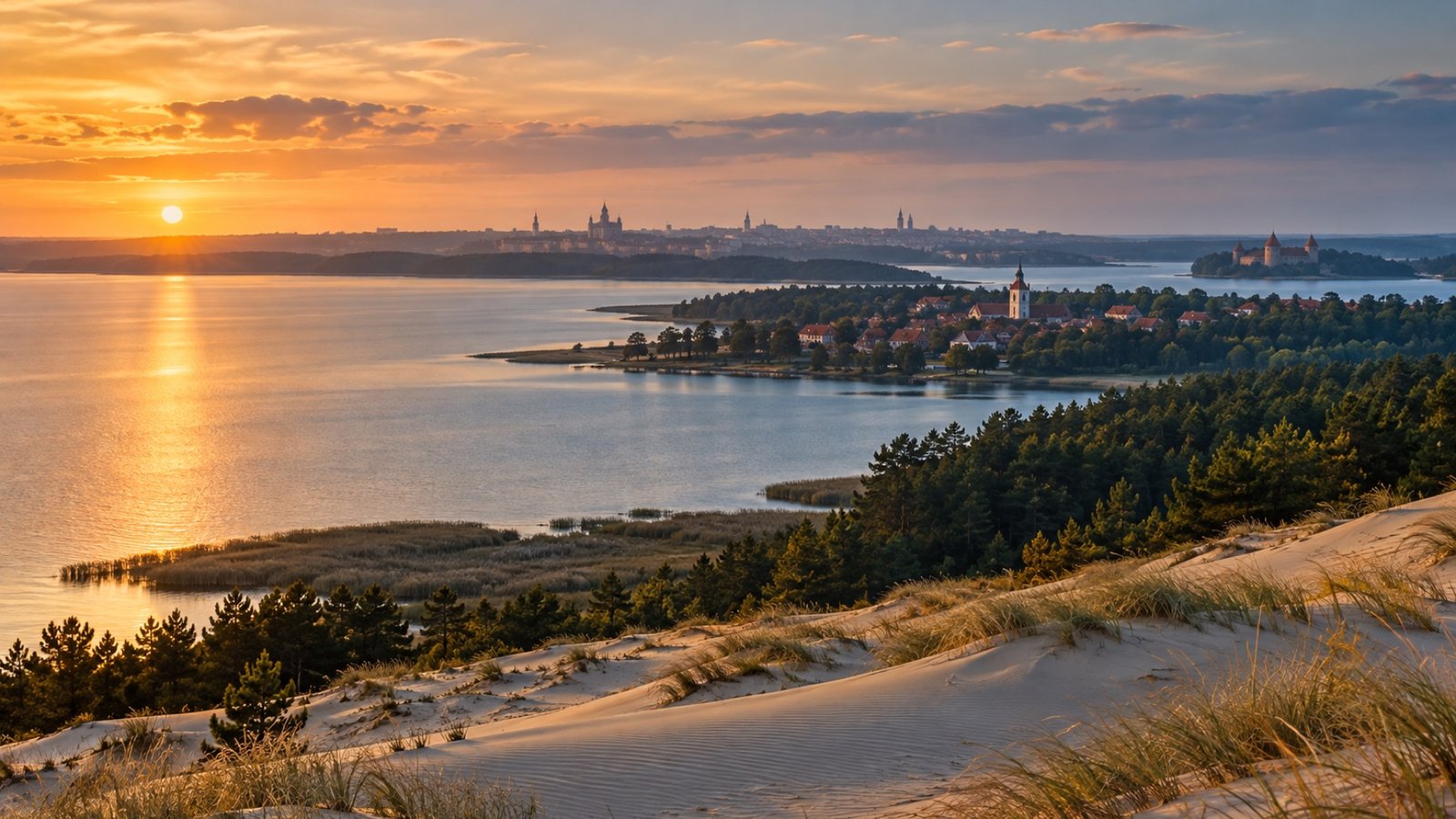
This guide uses official tourism, government and transport sources. Rules and prices can change, so check the linked official pages before booking.
Lithuania is not a single Vilnius weekend. Baroque and modernist cities, Baltic dunes, lake forests, wetlands, memorial landscapes and living regional traditions operate on different seasons and access rules. These fifty experiences help first-time visitors build a rail-aware route, separate reconstruction from surviving evidence, protect fragile coasts and give western, eastern and southern regions enough time to feel distinct.
Lithuania at a glance
- Ideal first trip: 9–13 days for Vilnius, Kaunas, Klaipėda or the Curonian Spit, and one park, spa or regional chapter.
- Currency: euro; cards are common, but rural makers, markets and remote services may require a backup payment method.
- Entry: Lithuania is in the Schengen Area; passport, visa, residence, purpose and funds rules depend on nationality and status.
- Transport: LTG Link connects major cities and selected international corridors; buses and ferries fill important gaps.
- Ethical rule: dunes, memorials, worship, living communities and operational port or military landscapes require authorised access and respectful behaviour.
Entry, visa and arrival planning
Use Lithuania’s Ministry of Foreign Affairs, Migration Department or the authority responsible for your passport for current rules. A short-stay Schengen visa generally allows no more than 90 days in any 180-day period, but nationality and restrictive measures control the exact answer.
Vilnius, Kaunas and Palanga airports are principal gateways. International trains, buses and Klaipėda ferries can support open-jaw routes only after the exact date, transfer, baggage and border rules are checked.
When to go
Late spring and early autumn often balance cities, coast and trails. Summer brings Curonian Spit, beach and festival demand; winter brings snow, ice, short daylight and a different urban atmosphere.
Storms, Baltic wind, wildfire danger, high water, dune closures and black ice can change parks, ferries and trains. Build a weather-safe alternative into every nature day.
Budget and places to stay
Compare live train, bus, ferry, park, museum, spa, accommodation and cancellation totals. A cheap distant room can lose value after late taxis or a missed Curonian connection.
Many landscapes are free, but safe access may require a visitor ticket, ferry, guide, equipment or rural transport. Never repeat an old price as a current promise.
Fifty things to do in Lithuania
1. Vilnius Old Town through layered evidence
Why go: Vilnius. A UNESCO-listed centre of Catholic, Orthodox, Jewish and civic histories rewards a route that distinguishes surviving fabric, reconstruction and changing use.
Good for: city breaks and first-time visitors
Know before you go: Cobbles, worship, courtyards and residential lanes require early timing and respectful photography.
2. Cathedral Square and Palace of the Grand Dukes
Why go: Vilnius. Cathedral, palace museum and public square can frame state and religious history when visitors choose a focused interior route.
Good for: history, architecture and cultural travellers
Know before you go: Services, ceremonies, separate tickets and reconstruction context require planning.
3. Gediminas Hill and tower only under current access rules
Why go: Vilnius. The hill, museum and panorama explain city geography and state symbolism when slope stability and official transport are respected.
Good for: history, architecture and cultural travellers
Know before you go: Closures, wind, ice and steep access can invalidate the visit.
4. St Anne and Bernardine ensemble with active-faith respect
Why go: Vilnius. Gothic and later religious architecture deserve a quiet visit scheduled around worship rather than an exterior photograph alone.
Good for: history, architecture and cultural travellers
Know before you go: Dress, services, photography and seasonal interiors take priority.
5. Vilnius University and courtyards on an authorised route
Why go: Vilnius. A public or guided route can connect education, books, architecture and scientific life without entering active teaching areas.
Good for: history, architecture and cultural travellers
Know before you go: Ceremonies, exams, worship and security can change access.
6. Jewish Vilnius through documented institutions
Why go: Vilnius. A museum, memorial and evidence-led walk can address centuries of Jewish life as well as destruction without reducing the story to one period.
Good for: history students, families and reflective travellers
Know before you go: Active community sites, security and memorial etiquette require care.
7. Museum of Occupations and Freedom Fights with recovery time
Why go: Vilnius. Documents, cells and testimony require factual language and protected reflection rather than dramatic staging.
Good for: history students, families and reflective travellers
Know before you go: Distressing content, confined spaces and security affect suitability.
8. MO Museum through one chosen art question
Why go: Vilnius. A selective contemporary-art visit can balance historical sites and show present cultural debate without gallery fatigue.
Good for: culture, families and rainy-day travellers
Know before you go: Temporary exhibitions and event schedules require a current check.
9. Užupis as a lived neighbourhood, not a novelty republic
Why go: Vilnius. Public art, river landscape and local businesses reward a slow route that treats declarations and symbols as civic play, not sovereign fact.
Good for: city breaks and first-time visitors
Know before you go: Private courtyards, residents and nightlife require restraint.
10. Lukiškės Prison only through an authorised programme
Why go: Vilnius. A documented tour or cultural event can interpret incarceration and later reuse without trespassing or sensational storytelling.
Good for: history students, families and reflective travellers
Know before you go: Access, age guidance and emotionally difficult history require advance checking.
11. National Museum of Lithuania with a focused collection
Why go: Vilnius. One selected branch can connect archaeology, ethnography and state history to places seen outside.
Good for: culture, families and rainy-day travellers
Know before you go: Multiple buildings and changing exhibitions make exact venue selection essential.
12. Pūčkoriai outcrop and Belmontas on marked paths
Why go: Vilnius region. A city-edge route can reveal river-valley geology and forest without assuming every viewpoint is open.
Good for: landscape, ecology and wildlife travellers
Know before you go: Erosion, ice, mud and informal cliff paths require conservative choices.
13. Trakai Island Castle with reconstruction explained
Why go: Trakai. Museum collections, lake geography and rebuilt architecture become useful when original evidence and twentieth-century reconstruction are clearly separated.
Good for: history, architecture and cultural travellers
Know before you go: Ferries, bridge access, crowds, ice and timed interiors vary by season.
14. Karaim Trakai through community institutions and food
Why go: Trakai. A museum, prayer-house context or community business can introduce Karaim history without treating cuisine or dress as spectacle.
Good for: history, architecture and cultural travellers
Know before you go: Worship, photography and community consent take priority.
15. Kernavė archaeological landscape from official trails
Why go: Kernavė. Hillforts, museum evidence and the Neris landscape reveal settlement history when reconstructions are labelled and protected slopes respected.
Good for: history, architecture and cultural travellers
Know before you go: Erosion, events, heat and winter ice can close parts of the route.
16. Kaunas Old Town, castle and confluence circuit
Why go: Kaunas. A compact route connects medieval trade, civic streets and two rivers when one museum anchors the evidence.
Good for: city breaks and first-time visitors
Know before you go: Flooding, events, worship and uneven surfaces require flexibility.
17. Kaunas interwar modernism on a documented public walk
Why go: Kaunas. Public buildings and streets can explain the temporary-capital era, design and civic ambition without intruding on private interiors.
How to do it: Follow a documented public route, study planning and labour context, and never enter operational, military or private structures without permission.
Good for: design, industrial history and urban travellers
Know before you go: Active institutions and residential entrances require permission boundaries.
18. National M. K. Čiurlionis Art Museum with protected time
Why go: Kaunas. Painting and music context provide a distinct national art chapter when visitors slow down instead of chasing every branch.
Good for: culture, families and rainy-day travellers
Know before you go: Loans, sound installations and temporary galleries require a current plan.
19. Ninth Fort memorial and museum with evidence-led conduct
Why go: Kaunas. Fortification, occupation, murder sites and commemoration require serious preparation and quiet behaviour.
Good for: history students, families and reflective travellers
Know before you go: Distressing content, weather and large outdoor distances need recovery time.
20. Pažaislis Monastery with worship and ensemble context
Why go: Kaunas. Baroque architecture and an active religious landscape deserve a visit that fits around services and current public areas.
Good for: history, architecture and cultural travellers
Know before you go: Events, dress, photography and separate hospitality access require checking.
21. Sugihara House and diplomatic-rescue history
Why go: Kaunas. A small museum can connect individual decisions, refugees and wartime bureaucracy without hero mythology or oversimplification.
Good for: history students, families and reflective travellers
Know before you go: Limited capacity and emotionally difficult material require advance booking and time.
22. Rumšiškės open-air museum with relocation explained
Why go: Kaunas region. Regional buildings and demonstrations can introduce rural life when moved, reconstructed and original elements are clearly identified.
Good for: culture, families and rainy-day travellers
Know before you go: Outdoor distances, weather, event traffic and seasonal opening affect the day.
23. Kaunas Lagoon from an authorised park route
Why go: Kaunas region. A marked trail or viewpoint can explain a human-made reservoir and its habitats without crossing unstable banks.
Good for: landscape, ecology and wildlife travellers
Know before you go: Water level, storms, ice and protected areas require park information.
24. Klaipėda old town and Danė riverfront
Why go: Klaipėda. Fachwerk buildings, port-city history and public waterfront reveal a Prussian and Lithuanian urban layer distinct from inland cities.
Good for: city breaks and first-time visitors
Know before you go: Operational port boundaries, bridges, wind and events require a mapped route.
25. Lithuanian Sea Museum and ferry logistics
Why go: Klaipėda coast. Maritime collections, fort history and marine interpretation can anchor a coastal day when ferry and conservation rules are checked.
Good for: culture, families and rainy-day travellers
Know before you go: Ferry capacity, weather, animal-welfare questions and separate activities require priorities.
26. Curonian Spit through one slow Neringa base
Why go: Neringa. A multi-night stay can connect dunes, lagoon, pine forest and villages without turning a fragile national park into a driving checklist.
Good for: landscape, ecology and wildlife travellers
Know before you go: Ferry, vehicle charges, fire risk, dune closures and nesting habitat require official information.
27. Nida settlement, lagoon and cultural landscape
Why go: Nida. A walking or cycling circuit can connect fishing heritage, artists and present island life without entering private yards.
Good for: city breaks and first-time visitors
Know before you go: Peak crowds, bicycle traffic and protected dunes require restraint.
28. Parnidis Dune only from marked access
Why go: Neringa. An authorised viewpoint can explain shifting sand and lagoon geography when visitors remain on hardened paths.
Good for: landscape, ecology and wildlife travellers
Know before you go: Wind erosion, heat, ice and closed dune zones make shortcuts unacceptable.
29. Juodkrantė forest, lagoon and cultural route
Why go: Neringa. One marked circuit can balance woodland, settlement history and public art without claiming folklore as archaeology.
Good for: landscape, ecology and wildlife travellers
Know before you go: Ticks, storms, cycling traffic and habitat restrictions require planning.
30. Ventė Cape bird migration through official facilities
Why go: Nemunas Delta. A station, museum or observation route can explain ringing and migration without promising close birds or interfering with research.
Good for: landscape, ecology and wildlife travellers
Know before you go: Seasonal closures, wind, insects and staff work take priority.
31. Nemunas Delta and Rusnė on a flood-aware route
Why go: Šilutė region. Wetlands, polders and island settlements reward one official cycling, boating or driving plan built around water levels.
Good for: landscape, ecology and wildlife travellers
Know before you go: Flooding, boat safety, mosquitoes and rural transport require live checks.
32. Dutchman’s Cap and Karklė from safe viewpoints
Why go: Baltic coast. A marked coastal route introduces Lithuania’s highest coastal cliff and moraine geology without approaching unstable edges.
Good for: landscape, ecology and wildlife travellers
Know before you go: Erosion, wind, storm surge and falling trees require distance.
33. Palanga Amber Museum and botanical park
Why go: Palanga. A focused collection and designed park can explain Baltic amber and resort history beyond souvenir stalls.
Good for: culture, families and rainy-day travellers
Know before you go: Counterfeit or imported amber, event closures and seasonal crowds require caution.
34. Palanga pier and beach under bathing rules
Why go: Palanga. A public shore walk offers Baltic light and resort life when swimming flags and dune protection control behaviour.
Good for: landscape, ecology and wildlife travellers
Know before you go: Cold water, rip currents, wind and crowded summer access require conservative decisions.
35. Kretinga manor museum and winter garden
Why go: Kretinga. A museum-led visit can connect estate history, collections and horticulture without relying on decorative nostalgia.
Good for: history, architecture and cultural travellers
Know before you go: Greenhouse conditions, event closures and separate displays require checking.
36. Aukštaitija National Park on one lake-and-forest route
Why go: Eastern Lithuania. A marked trail, visitor centre or licensed paddle can introduce old forests and lakes without trying to cover the entire park.
Good for: landscape, ecology and wildlife travellers
Know before you go: Fire risk, storms, cold water, rural transport and campsite rules require planning.
37. Žemaitija National Park and Lake Plateliai
Why go: Samogitia. One official route can connect lake ecology, forest and Samogitian regional identity when private shores are respected.
Good for: landscape, ecology and wildlife travellers
Know before you go: Water conditions, cycling safety, fire danger and seasonal services require checks.
38. Cold War Museum with military-history context
Why go: Žemaitija. An authorised former missile-site museum can explain Soviet infrastructure and nuclear risk without bunker-adventure framing.
Good for: culture, families and rainy-day travellers
Know before you go: Confined spaces, stairs and distressing content require suitability checks.
39. Dzūkija National Park through a village-and-forest corridor
Why go: South Lithuania. A marked route can connect pine forest, river landscape and local livelihoods without collecting or foraging beyond rules.
Good for: landscape, ecology and wildlife travellers
Know before you go: Fire risk, ticks, private land, mushrooms and rural transport require current park guidance.
40. Čepkeliai reserve only under permitted access
Why go: Dzūkija. Strict bog and forest protection can be understood through a visitor centre or authorised route, not an improvised hike.
Good for: landscape, ecology and wildlife travellers
Know before you go: Seasonal restrictions, guides, fire danger and fragile habitat may prohibit entry.
41. Druskininkai spa history and public river landscape
Why go: Druskininkai. A slow resort day can connect mineral-water history, parks and contemporary wellness without making health promises.
Good for: city breaks and first-time visitors
Know before you go: Treatments require medical suitability, current prices and informed consent.
42. Grūtas Park with dictatorship and display context
Why go: Druskininkai region. Removed Soviet monuments can be studied critically when curation, propaganda and victims remain central to interpretation.
Good for: history students, families and reflective travellers
Know before you go: Avoid humorous posing and distinguish the commercial setting from a neutral archive.
43. Birštonas resort and Nemunas loops
Why go: Birštonas. A public walking route and one wellness or museum choice can show river geography and spa history without overpromising treatment outcomes.
Good for: city breaks and first-time visitors
Know before you go: Flooding, cycling traffic and treatment contraindications require checks.
44. Hill of Crosses with pilgrimage respect
Why go: Šiauliai region. A living devotional landscape deserves quiet conduct and historical context rather than rearranging objects for photographs.
Good for: history, architecture and cultural travellers
Know before you go: Services, crowds, mud and memorial etiquette take priority.
45. Šiauliai city museums beyond the Hill of Crosses
Why go: Šiauliai. One focused museum or civic route can prevent the city from becoming merely a transport stop.
Good for: culture, families and rainy-day travellers
Know before you go: Branch locations and limited opening days require exact planning.
46. Anykščiai treetop route and forest context
Why go: Anykščiai. An official elevated path and marked forest circuit can explain canopy and landscape when height, weather and access rules are respected.
Good for: landscape, ecology and wildlife travellers
Know before you go: Wind, ice, lightning and mobility constraints can close or limit the route.
47. Anykščiai regional craft or Horse Museum
Why go: Anykščiai region. A community museum can connect transport, farm labour and craft practice when demonstrations credit real makers.
Good for: culture, families and rainy-day travellers
Know before you go: Animal welfare, event dates and rural transport require confirmation.
48. Panemunė castle road as one selective river corridor
Why go: Lower Nemunas. Choosing two well-documented castles or manor sites reveals river trade and estate history without a rushed photo marathon.
Good for: history, architecture and cultural travellers
Know before you go: Road safety, separate tickets, seasonal interiors and private property require a map.
49. Lithuanian Song Celebration tradition through an official programme
Why go: Lithuania. An official performance, archive or exhibition can explain mass singing and dance as living civic culture rather than tourist costume.
Good for: history, architecture and cultural travellers
Know before you go: Tickets, mass-crowd safety and performer consent require advance planning.
50. One verified Lithuanian craft workshop with the maker credited
Why go: Lithuania. A booked ceramics, weaving, wood or food workshop can connect material, region and skill while returning value to the practitioner.
Good for: history, architecture and cultural travellers
Know before you go: Fire, tools, allergens, purchases and photography follow the host’s safety and consent rules.
Food and drink worth planning around
Lithuanian food changes between rye bread, potatoes, dairy, mushrooms, berries, Baltic fish, Karaim dishes and regional baking. Verify allergens and producer origin.
Beer and spirits are optional, not cultural obligations. Never combine alcohol with driving, swimming, sauna heat, cycling or winter travel.
What to buy
For linen, amber, ceramics, woodwork and food, identify the maker, materials and production place. A national motif is not proof of Lithuanian manufacture.
Use established sellers for amber, antiques and heritage objects; retain receipts and check cultural-property, food, wildlife and customs rules before export.
Getting around
Use LTG Link for live trains and the exact ferry, bus or city operator for schedules, platforms, validation, bicycles and luggage. An annual PDF or saved timetable is not authority.
A car helps selected parks and castle roads but is unnecessary in Vilnius, Kaunas and central Klaipėda. Include ferry rules, winter tyres, parking, insurance, wildlife risk and a sober driver.
Easy access and family travel
Accessibility varies across cobbles, towers, fortresses, dunes, ferries, boardwalks and winter surfaces. Ask for exact gradients, steps, toilets, transfers and assistance.
Do not infer accessibility from one lift or low-floor train; the arrival surface, interior route, weather and last return are separate questions.
Stay safe
Use official weather, rescue, park, rail, road and bathing information. Cold water, wind, thin ice, unstable dunes, floods and storm-felled trees can close otherwise easy routes.
Stay on marked paths, keep wildlife distance, follow bathing flags and never enter unstable military, prison, port or industrial areas outside authorised access.
Mistakes to avoid
- Treating Vilnius as the whole country.
- Trusting old train or ferry timetables.
- Leaving marked dune paths for a photograph.
- Treating reconstructed castles as untouched medieval originals.
- Reducing Karaim or regional culture to food and costumes.
- Entering military or prison remains outside authorised visits.
- Expecting guaranteed birds, amber finds, snow or autumn colour.
- Compressing Kaunas, Klaipėda and the Curonian Spit into day trips from Vilnius.
Sample seven-day route
Use four Vilnius nights and three Kaunas, Trakai or Dzūkija nights with one carefully planned regional day.
Sample ten-day route
Use four Vilnius, three Kaunas and three Klaipėda or Neringa nights along checked transport links.
Sample fourteen-day route
Use four Vilnius, three Kaunas, four Klaipėda or Neringa and three nights in one eastern, southern or Samogitian region.
Lithuania travel FAQ
How many days are enough for Lithuania?
Seven days supports Vilnius and Kaunas with Trakai. Ten to fourteen days allows Klaipėda or the Curonian Spit and one park, spa or regional chapter.
Do I need a car?
No for Vilnius, Kaunas, Trakai, Šiauliai and Klaipėda. A car can help parks and castle roads, but trains, buses or a licensed guide may remove parking and alcohol risk.
Can I walk on Curonian dunes?
Only on currently open marked routes and viewpoints. Protected dune surfaces are fragile, and fire, wind or conservation closures can change access.
How should I visit memorial sites?
Use official museum information, factual language and quiet conduct. Avoid dramatic posing, allow recovery time and follow photography and security rules.
Official planning sources
- Lithuania official top sites
- Lithuania official Vilnius guide
- Lithuania official Klaipėda guide
- Lithuania official Baltic coast guide
- Lithuanian protected areas portal
- Lithuanian protected-area list
- Lithuanian MFA visa types
- Lithuanian MFA visa information
- LTG Link passenger rules
- LTG Link official timetable information
Disclosure: This independent editorial guide is informational, not a booking guarantee. No price, ranking, safety outcome, entry permission or availability is guaranteed. Recheck all time-sensitive details with the linked official source before purchase.