This guide uses official tourism, government and transport sources. Rules and prices can change, so check the linked official pages before booking.
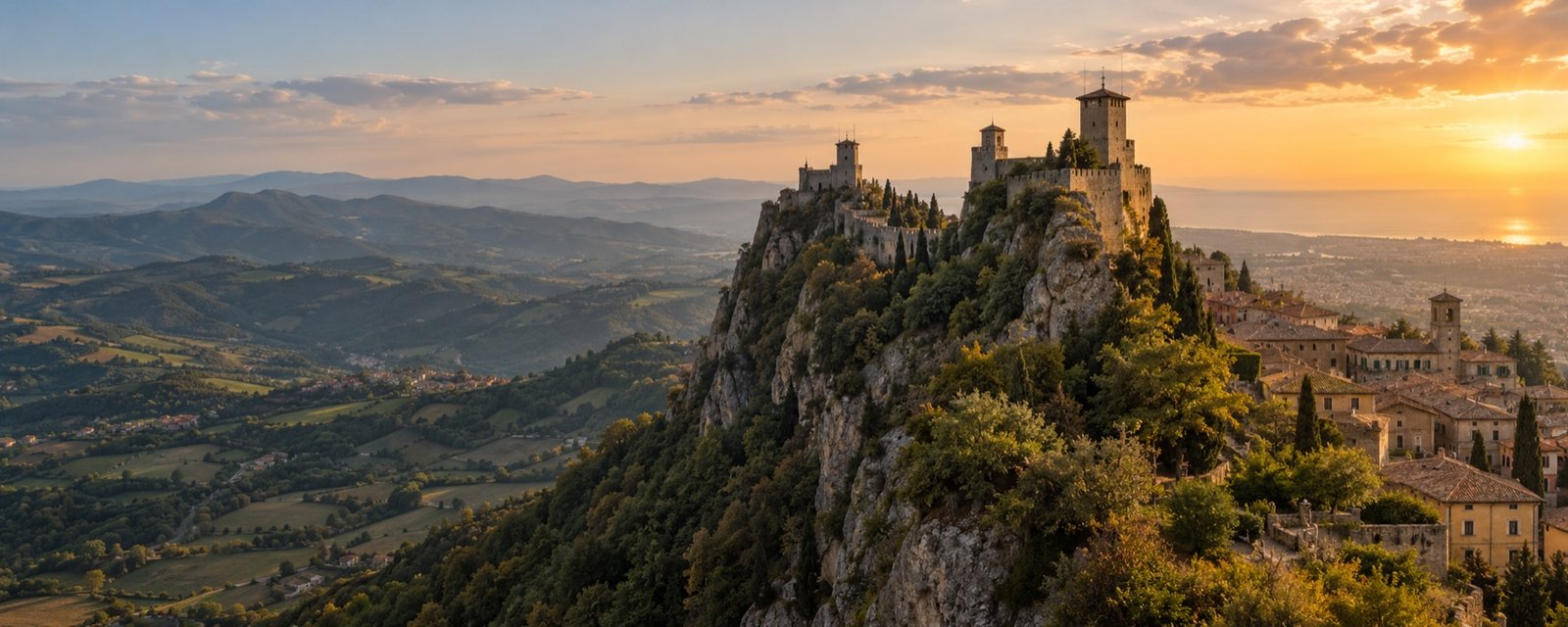
San Marino is a sovereign microstate built around Mount Titano, but a useful visit reaches beyond the postcard towers. The UNESCO-listed historic centre and Borgo Maggiore sit within a wider territory of nine municipalities, museums, institutions, trails and lived-in neighbourhoods. Because slopes are steep and opening patterns change around state ceremonies, events and weather, this guide uses official sources and describes conditional experiences as conditional.
San Marino at a glance
- Entry: San Marino has an open border with Italy in normal conditions; travellers must satisfy the rules for entering and remaining in Italy and the Schengen area.
- Language: Italian is official; English is available in many visitor settings but should not be assumed everywhere.
- Terrain: Mount Titano brings steep lanes, stone steps, ridge paths and large elevation changes over short map distances.
- Currency: the euro is used; card acceptance and opening hours should still be checked with small businesses.
- Emergency: use current Sammarinese emergency information and hold travel insurance appropriate to hiking, cycling or other planned activity.
Entry, visa and arrival planning
San Marino has no airport or international rail station. Most visitors arrive through Italy, commonly via Rimini and onward road or bus connections. Verify passports, visas and Schengen eligibility with official Italian and home-government sources rather than interpreting an open road border as permission to travel.
The nearest transport hub is not the same as the final hotel door. Check the current Rimini–San Marino bus operator, stops, seasonal timetable and luggage rules, or price a licensed road transfer. Drivers should choose an official car park and avoid attempting to navigate restricted historic lanes.
When to go
Spring and autumn often support comfortable walking, while summer brings longer hours, heat and larger day-trip crowds. Winter can be atmospheric but may bring fog, frost, snow or reduced attraction schedules on Mount Titano.
The calendar can matter more than average climate. Investitures, medieval events, crossbow ceremonies, races and public holidays can create memorable visits but also alter parking, museum access and transport. Verify the exact year’s programme.
Budget and places to stay
The state-museum ticket can be good value when several included venues are genuinely open and suitable for the group. Compare the current inclusions and hours with a slower plan of free streets, gardens, viewpoints and one paid museum.
A day trip from the Italian coast lowers accommodation cost but compresses the visit into bus times. One or two nights in San Marino can reveal quieter mornings and evenings; compare the final room price, parking and transport rather than a headline nightly rate.
Fifty things to do in San Marino
1. First Tower Guaita
Why go: Mount Titano, City of San Marino. The oldest and largest of the three towers introduces the republic’s defensive geography through its fortified courtyards and elevated position.
How to do it: Check the National Museums ticket and live opening information, then allow for steep paving and stairs rather than treating the tower as a quick viewpoint.
Good for: fortifications, political history and panoramic orientation
Know before you go: Upper areas involve gradients, uneven stone and exposed edges; parts may be inaccessible during weather or works.
2. Passo delle Streghe ridge walk
Why go: between the First and Second Towers. The Witches’ Pass links the two principal fortresses along the most recognisable section of Mount Titano’s ridge.
How to do it: Walk only on the maintained public route, wear shoes with grip and pause at safe terraces instead of narrow circulation points.
Good for: views, photography and a short historic walk
Know before you go: Stone can be slippery and the ridge exposed to wind, heat or ice; barriers are not invitations to climb.
3. Second Tower Cesta and Museum of Ancient Weapons
Why go: Mount Titano, City of San Marino. The thirteenth-century fortress houses a state collection that connects defensive architecture with the history of arms.
How to do it: Use the official museum page for the exact galleries and ticket conditions; combine it with Guaita only if the group can manage repeated climbs.
Good for: medieval architecture, collections and history
Know before you go: Displays and rooms can change, while stairs and narrow historic fabric limit step-free circulation.
4. Third Tower Montale exterior
Why go: Mount Titano ridge. The smallest and most remote tower completes the three-tower landscape and rewards a quieter ridge extension.
How to do it: Treat it as an exterior destination unless the state museums explicitly announce public entry, and return before light or weather deteriorates.
Good for: ridge walking, landscape and repeat visitors
Know before you go: Interior access is not normally assumed; exposed paths, drops and seasonal surface conditions require care.
5. Palazzo Pubblico official visit
Why go: Piazza della Libertà, City of San Marino. The seat of the republic’s institutions explains civic government through ceremonial rooms, architecture and the square outside.
How to do it: Confirm whether the palace is open to museum visitors because official business and ceremonies take priority.
Good for: civic history, architecture and first-time context
Know before you go: Security, dress, photography and room access can change without the building becoming an ordinary walk-in museum.
6. Piazza della Libertà and the Statue of Liberty
Why go: City of San Marino historic centre. The civic square brings together the Public Palace, the liberty monument and long views over the surrounding landscape.
How to do it: Visit early or late for a calmer reading of the space and keep official entrances and ceremonial routes clear.
Good for: architecture, civic symbolism and free views
Know before you go: The square remains an active institutional setting; events and security controls can alter circulation.
7. Changing of the Guard
Why go: Palazzo Pubblico, Piazza della Libertà. The seasonal ceremony presents a living institutional tradition in the republic’s main civic space.
How to do it: Check the tourism office’s current calendar and time rather than relying on an old daily schedule, then arrive without blocking public access.
Good for: ceremony, families and civic culture
Know before you go: Weather, state duties and seasonal programming can change or cancel the ceremony.
8. Basilica of Saint Marinus
Why go: Piazzale Domus Plebis. The principal basilica preserves the memory and relics of the republic’s founder while remaining an active place of worship.
How to do it: Check services, enter quietly and read the official account before interpreting devotional objects or traditions.
Good for: religious architecture, history and living faith
Know before you go: Worship, funerals and ceremonies take priority; dress, silence and photography rules must be respected.
9. Small Church of Saint Peter
Why go: beside the Basilica of Saint Marinus. The compact church adds a more intimate layer to the founder tradition and the sacred complex on Mount Titano.
How to do it: Use the official tourism listing to confirm reopening and permitted access, pairing it with the Basilica rather than scheduling a separate transfer.
Good for: sacred heritage and a focused short visit
Know before you go: Limited capacity and worship can restrict access; legends should not be presented as proven history.
10. Crossbowmen’s Quarry
Why go: Cava dei Balestrieri, City of San Marino. The former quarry is now associated with the republic’s crossbow traditions and public performances.
How to do it: Check the official events programme for a demonstration or ceremony; outside events, view the site without expecting continuous activity.
Good for: traditions, performance and public space
Know before you go: Temporary seating, rehearsals, wet stone and event controls can change access.
11. State Museum
Why go: Palazzo Pergami Belluzzi, Piazzetta del Titano. The state collections provide an archaeological, artistic and historical sequence for understanding San Marino beyond its skyline.
How to do it: Start with the official museum overview, select a chronological route and verify any gallery closures before arrival.
Good for: archaeology, art and first-time historical context
Know before you go: Objects and rooms rotate; never promise a specific display without checking the current catalogue.
12. San Marino National Gallery
Why go: Logge dei Volontari, Giardino dei Liburni. The national gallery presents modern and contemporary art in dialogue with the small republic’s cultural institutions.
How to do it: Check the current exhibition and opening day through the Cultural Institutes before making it the day’s anchor.
Good for: modern art, design and quiet indoor time
Know before you go: Exhibition content changes, and accessibility should be confirmed for the exact show and route.
13. Saint Francis Museum and Pinacoteca
Why go: Via Basilicius, historic centre. The museum connects sacred art and the former Franciscan complex with the development of local collections.
How to do it: Use the state-museum ticket information and visit with the adjacent church and gate area in one compact circuit.
Good for: sacred art, architecture and museum history
Know before you go: Religious spaces and museum rooms can follow different access or photography rules.
14. Stamp and Coin Museum
Why go: Piazza Garibaldi, historic centre. Philately and numismatics explain how San Marino has represented sovereignty, identity and international connections.
How to do it: Check the official museum listing and focus on one theme, such as design, postal history or commemorative issues.
Good for: graphic design, collecting and political history
Know before you go: Special exhibitions and objects on display change; shop products are not guaranteed investments.
15. Emigrant Museum
Why go: Contrada Omerelli, City of San Marino. The museum records migration stories that connect Sammarinese families with communities abroad.
How to do it: Confirm current opening and allow time for testimony and social context rather than treating the collection as a brief novelty.
Good for: social history, family history and diaspora studies
Know before you go: Personal histories deserve respectful reading; hours can be limited and group visits may require arrangement.
16. Natural History Museum
Why go: Borgo Maggiore. Natural-science collections add geology, biodiversity and landscape context to a country often reduced to monuments.
How to do it: Verify current galleries and pair the museum with Borgo Maggiore or the cable car to avoid an unnecessary separate journey.
Good for: families, geology and regional nature
Know before you go: Opening patterns can differ from central museums; specimens and displays may rotate.
17. Montale Tunnel and historic Bianco Azzurro train
Why go: Piazzale della Stazione, City of San Marino. The restored rail setting recalls the former Rimini–San Marino railway and wartime transport history.
How to do it: Check the tourism calendar for train operations or guided access, while treating the tunnel and station as historic infrastructure rather than a guaranteed ride.
Good for: railway history, engineering and families
Know before you go: The heritage train is event-dependent; tunnels and platforms can have restricted or uneven access.
18. Tactilia sensory route
Why go: Via Eugippo, City of San Marino. The tactile installation is designed to broaden how visitors encounter the World Heritage setting.
How to do it: Use the official accessibility material to understand the route and combine it with a step-free plan tailored to the visitor.
Good for: inclusive interpretation, families and sensory learning
Know before you go: A tactile feature does not make every adjoining street or monument accessible.
19. Porta San Francesco arrival walk
Why go: southern entrance to the historic centre. The historic gate creates a clear transition from modern access routes into the walled city.
How to do it: Begin at the official tourist map, note gradients and follow public lanes towards the museums without blocking the narrow gateway.
Good for: orientation, walls and architectural detail
Know before you go: Mixed pedestrian and service traffic, cobbles and crowds require attention.
20. Historic gates and walls circuit
Why go: City of San Marino. A selective circuit of surviving gates and walls reveals how the settlement adapted to Mount Titano’s terrain.
How to do it: Use the official map to choose a safe sequence of Porta San Francesco, Fratta-area and other lawful public viewpoints instead of improvising along edges.
Good for: urban history, walking and defensive architecture
Know before you go: Not every wall is a public path; steep lanes, traffic and private property must be respected.
21. Giardino dei Liburni and open-air art
Why go: City of San Marino historic centre. The garden and nearby public works provide a slower cultural pause between major monuments.
How to do it: Use the official accessibility or visitor map, read labels and keep sculpture bases and planted areas untouched.
Good for: public art, gardens and lower-pressure sightseeing
Know before you go: Temporary events and maintenance can alter paths or seating.
22. Orti Borghesi and panoramic terraces
Why go: City of San Marino. Terraced public green space offers a quieter perspective on the old town’s relationship with the mountain.
How to do it: Locate the lawful entrance on the official map and add it to a nearby museum route rather than chasing an unverified social-media viewpoint.
Good for: gardens, views and rest
Know before you go: Terraces can involve slopes and edges; opening and maintenance conditions should be rechecked.
23. Borgo Maggiore–San Marino cable car
Why go: Borgo Maggiore and City of San Marino. The cable car links two parts of the UNESCO property while overcoming roughly 200 metres of elevation in a short ride.
How to do it: Check the operator’s live hours, maintenance closure and return service, then keep a bus or road alternative.
Good for: views, practical transport and mobility planning
Know before you go: Wind, engineering works or seasonal schedules can suspend service; station access does not remove steep streets beyond it.
24. Borgo Maggiore historic centre
Why go: Borgo Maggiore. The old market settlement provides a lived-in counterpart to the capital and forms part of the UNESCO inscription.
How to do it: Walk a modest circuit around the historic core, church and public spaces, checking local events rather than assuming a market every day.
Good for: local history, neighbourhood life and slower travel
Know before you go: Residential privacy, traffic and business closing days matter.
25. Borgo Maggiore market-day visit
Why go: Borgo Maggiore. The town’s long market tradition is best understood through a current local market rather than a static monument.
How to do it: Confirm the date, location and vendor mix with official local information; bring a reusable bag and buy only permitted food for onward travel.
Good for: food culture, everyday life and local shopping
Know before you go: Schedules, stalls and payment methods change; crowding and parking require planning.
26. San Marino rose garden
Why go: official seasonal garden location. A spring visit can focus on horticulture and seasonal colour away from the busiest monument circuit.
How to do it: Use the tourism board’s current rose-garden page for the exact location, flowering window and access before travelling.
Good for: gardens, photography and a gentle seasonal stop
Know before you go: Flowering can never be guaranteed and weather may shorten the season.
27. Walk of Saint Marinus
Why go: signed religious and cultural route. The official walking concept connects faith, landscape and the founding tradition across the territory.
How to do it: Choose only a stage that matches fitness and daylight, obtain the current route information and separate devotional tradition from established history.
Good for: pilgrimage, long walking and cultural landscape
Know before you go: Route marking, gradients, road crossings and weather need current verification.
28. Rupe Path below Mount Titano
Why go: Mount Titano nature area. The cliff-side walking route reveals geology, woodland and the scale of the World Heritage ridge from below.
How to do it: Use an official or licensed guide when appropriate, check trail status and avoid the route in unsuitable wind, ice or rain.
Good for: hiking, geology and strong walkers
Know before you go: Exposed rock, steep gradients and falling-stone risk make this more than an urban stroll.
29. Mount Titano nature-trail circuit
Why go: Mount Titano. Signed trails allow visitors to experience the mountain as a natural landscape rather than only a monument platform.
How to do it: Select a named route from the tourism board’s current trail material and carry water, footwear and offline navigation.
Good for: hiking, woodland and landscape interpretation
Know before you go: Trail conditions, closures, hunting information and daylight must be checked locally.
30. Ca’ Vagnetto teaching arboretum
Why go: Domagnano area. The educational arboretum provides a plant-focused stop within the republic’s outdoor programme.
How to do it: Confirm public opening and any guided activity before visiting, keeping the arboretum paired with nearby nature or village stops.
Good for: botany, families and environmental education
Know before you go: It may not operate like a continuously staffed attraction; plants and paths vary by season.
31. Ausa Park
Why go: Serravalle area. The park offers everyday recreation and a change from the steep historic-centre itinerary.
How to do it: Check current facilities and access through official local information, then use it as a rest or family stop rather than a major monument.
Good for: families, green space and local life
Know before you go: Sports areas, events and maintenance can affect available space.
32. Monte Cerreto natural park
Why go: Acquaviva. The park gives Acquaviva a practical outdoor focus through woodland, paths and recreational space.
How to do it: Use the tourism board’s municipality information and current local signs; choose a loop that suits daylight and conditions.
Good for: walking, jogging and family recreation
Know before you go: Surfaces and facilities are not guaranteed step-free, and rural paths require weather awareness.
33. San Marino Adventure Park
Why go: Acquaviva area. A managed activity park offers a structured outdoor option distinct from independent hiking.
How to do it: Book only through the current operator, checking age, height, clothing, waiver and weather rules.
Good for: active families and supervised challenges
Know before you go: Activities carry inherent risk and may close in wind or rain; instructors’ rules override this guide.
34. Official road-cycling route
Why go: across the republic. Published cycling routes reveal how sharply terrain changes over a very small country.
How to do it: Choose one of the current official routes, inspect elevation and traffic, and use a roadworthy bicycle with appropriate safety equipment.
Good for: experienced cyclists and landscape travel
Know before you go: Steep descents, tunnels, traffic and weather can make a short route demanding.
35. Guided e-bike experience
Why go: designated routes across San Marino. Electric assistance can make the republic’s hills more approachable while still requiring confident handling.
How to do it: Reserve with a recognised operator, request a helmet and briefing, and test braking before joining traffic or gravel.
Good for: active adults and guided exploration
Know before you go: An e-bike does not remove balance, traffic or descent risk; route legality and battery range matter.
36. Managed climbing session
Why go: authorised outdoor wall or activity centre. San Marino’s official sports information includes equipped climbing opportunities for suitably prepared visitors.
How to do it: Use a qualified operator, verify the exact wall is open and follow equipment, age and weather rules.
Good for: climbers and supervised adventure
Know before you go: Never climb historic walls or unapproved rock; certification and insurance requirements vary.
37. Supervised archery experience
Why go: official activity provider. Archery connects contemporary recreation with San Marino’s visible crossbow traditions without confusing the two practices.
How to do it: Book a supervised session, confirm age and safety requirements and use only the equipment and range provided.
Good for: families, groups and skill-based activity
Know before you go: A ceremonial crossbow event is not a public shooting session; range commands are mandatory.
38. Serravalle historic-centre circuit
Why go: Serravalle. The republic’s largest urban municipality preserves a historic core linked to its former Malatesta frontier role.
How to do it: Follow public streets around the centre and combine heritage with a local café or park rather than inventing access to private remains.
Good for: municipal history and everyday San Marino
Know before you go: Modern traffic surrounds parts of the area; historic references do not mean a complete fortress is open.
39. San Marino Stadium event
Why go: Serravalle. A ticketed football or sporting event shows a contemporary national institution beyond the old town.
How to do it: Buy through the official federation or event organiser, verify the venue, transport and bag rules, and arrive for security checks.
Good for: sport, national culture and evening activity
Know before you go: Fixtures, entry requirements and spectator arrangements change; unofficial tickets carry risk.
40. Faetano village and Marano landscape
Why go: Faetano. The municipality combines a small civic centre with countryside around the River Marano and recreational lake.
How to do it: Use the official municipality overview, walk only signed public routes and confirm any fishing or activity permit locally.
Good for: rural scenery, village life and outdoor time
Know before you go: River conditions, private farmland and activity rules must be respected.
41. Domagnano and Montelupo viewpoint country
Why go: Domagnano. The municipality is associated with the former Montelupo fortress area and broad views towards Mount Titano and the sea.
How to do it: Choose a public signed viewpoint or road-safe walk from current local information; do not search for ruins across private land.
Good for: landscape, photography and municipal history
Know before you go: Traffic, private property and limited footways require a conservative route.
42. Chiesanuova landscape walk
Why go: Chiesanuova. The western municipality offers an Apennine-edge rural setting linked with the medieval court of Busignano.
How to do it: Plan a short public-lane or signed-path circuit using current maps and combine it with one nearby castello rather than a rushed checklist.
Good for: countryside, village scale and slow travel
Know before you go: Sparse transport, gradients and private agricultural land require advance planning.
43. Fiorentino heritage and public landscape route
Why go: Fiorentino. The municipality’s Malatesta history and archaeological finds provide context for the territories incorporated in 1463.
How to do it: Use official interpretation and public streets; treat archaeological history as context unless a specific site is confirmed open.
Good for: regional history and rural viewpoints
Know before you go: Do not imply excavations are publicly accessible; road safety and private boundaries matter.
44. Montegiardino old village
Why go: Montegiardino. The smallest municipality is valued for its compact historic architecture, hillside views and parish church.
How to do it: Walk quietly through public lanes, check church access and support a local business without treating homes as exhibits.
Good for: architecture, village atmosphere and photography
Know before you go: Narrow streets, worship and residential privacy require restraint.
45. Acquaviva village and spring tradition
Why go: Acquaviva. The municipality’s name and local identity are connected with a spring emerging from rock, alongside a green rural setting.
How to do it: Use the official municipal description and local signs, avoiding claims about water safety or access that are not posted on site.
Good for: local history, landscape and a small village stop
Know before you go: Natural features can be protected, seasonal or on restricted ground; never drink untreated water.
46. Licensed guided tour of the UNESCO centre
Why go: City of San Marino. A trained guide can connect institutions, fortifications and legends while clearly distinguishing evidence from tradition.
How to do it: Book through the official tourism experience portal or a recognised local service, confirming language, route length and inclusions.
Good for: first visits, groups and deeper context
Know before you go: Ask about accessibility and cancellation; “guided” does not guarantee entry to every monument.
47. Local-products tasting or cooking experience
Why go: recognised venue in San Marino. A structured tasting can introduce piadina-style breads, cheeses, wine and other regional products with sourcing context.
How to do it: Choose a current tourism-board-listed experience, disclose allergies and arrange sober transport if alcohol is included.
Good for: food culture, groups and rainy-day planning
Know before you go: Menus, producers and prices change; “local” should be verified rather than assumed.
48. Investiture of the Captains Regent
Why go: Piazza della Libertà and official ceremonial route. The twice-yearly investiture is a major constitutional ceremony that demonstrates San Marino’s living republican institutions.
How to do it: Consult the official annual programme for 1 April or 1 October, identify public viewing areas and follow all security instructions.
Good for: civic ceremony, history and careful event travel
Know before you go: Access is never guaranteed; crowds, closures and protocol make spontaneous close viewing inappropriate.
49. San Marino Medieval Days or official heritage festival
Why go: historic centre, when scheduled. A state-listed heritage event can animate crossbow, music, craft and performance traditions across the old town.
How to do it: Verify the exact year’s programme, ticketed areas and transport plan on the official events calendar.
Good for: families, performance and seasonal atmosphere
Know before you go: Event names, dates and content change; costumes and reenactment should not be mistaken for untouched history.
50. San Marino tourist-information orientation session
Why go: Piazzetta Giuseppe Garibaldi. The official information office is the best first stop for live museum, trail, transport and event changes in a compact but steep destination.
How to do it: Bring the draft itinerary, ask specifically about closures and accessibility, and collect only the current official map.
Good for: all first-time visitors and disruption-proof planning
Know before you go: Opening hours vary, and staff advice supplements rather than replaces immigration, medical or weather authorities.
Food and drink worth planning around
San Marino shares much of Romagna’s food landscape while maintaining local products and traditions. Use the official tourism listings and current menus to explore breads, pasta, cheese, wine and seasonal dishes without claiming one recipe as uniquely national.
Reserve only where needed, ask directly about allergens and designate a sober driver for tastings outside a walkable centre. Prices and menus change too quickly for an evergreen article to promise exact figures.
What to buy
Stamps, coins, books, museum editions and genuinely Sammarinese products can carry useful context. Ask who produced an item, where it was made and whether documentation accompanies a collectible.
Tax treatment and customs allowances depend on the product and destination. Do not assume every shop price is a bargain or that stamps, coins, watches or alcohol will appreciate in value.
Getting around
The cable car, interurban buses, regional road services and walking each solve different parts of the trip. Use the tourism board and exact operator for live schedules; keep a backup when wind or maintenance affects the cable car.
Within the historic centre, short distances can include severe gradients. Public car parks, lifts where available and a district-by-district route are more practical than repeatedly returning to a vehicle.
Easy access and family travel
San Marino publishes detailed “Hospitality without barriers” material, including gradients and practical route notes. Use it to plan the exact sequence, then contact each museum or operator because a generally accessible district can still contain steep paving or unavailable upper floors.
Families and mixed-ability groups should protect rest time, toilets and a shorter shared core. The cable car can reduce elevation but does not make the tower ridge or every old-town lane step-free.
Stay safe
The main predictable risks are steep stone, exposed ridge paths, heat, ice, traffic and event crowds. Follow barriers and local weather advice, carry water and turn back before conditions make a viewpoint unsafe.
Keep travel insurance and official emergency details available. Activities such as climbing, cycling and adventure courses require qualified providers, correct equipment and compliance with their age, health and weather rules.
Mistakes to avoid
- Treating San Marino as a two-hour photo stop and missing its museums, institutions and municipalities.
- Assuming the Third Tower interior, heritage train or changing of the guard operates continuously.
- Planning by distance without accounting for Mount Titano’s elevation and stone surfaces.
- Driving into restricted old-town streets instead of using an official car park and walking route.
- Repeating legends as verified history or using an old event schedule as if it were permanent.
Sample seven-day route
Spend two days on the UNESCO historic centre, towers and state museums; one on Borgo Maggiore and the cable car; one on a verified Mount Titano nature route; one on Serravalle and Domagnano; one on Acquaviva, Montegiardino or Faetano; and keep one flexible day for weather, a ceremony or deeper museum time.
Sample ten-day route
Add the remaining municipalities in logical clusters, a guided history walk, a food experience and either cycling or another supervised outdoor activity. Preserve a weather-safe museum day and avoid forcing every ridge walk into the same afternoon.
Sample fourteen-day route
Use a fortnight for slow travel rather than fourteen packed days. Revisit the capital at quiet times, explore all nine municipalities, attend one official event if dates fit and make lawful regional day trips through Italy without labelling Italian attractions as San Marino experiences.
San Marino travel FAQ
Is San Marino part of Italy?
No. San Marino is a sovereign republic surrounded by Italy.
How many days are enough?
One day covers a rushed headline circuit; two or three days support the main museums and towers, while five to seven days allow trails and the wider territory.
Do visitors need a separate San Marino visa?
San Marino normally has an open border with Italy, so travellers must meet the applicable Italian and Schengen entry rules; verify personal circumstances officially.
Can every tower be entered?
Do not assume so. The First and Second Towers operate as museum sites subject to current opening, while the Third Tower is generally approached as an exterior ridge destination unless officials announce otherwise.
Is the historic centre easy for limited mobility?
Some routes and venues are adapted, but slopes and historic surfaces remain significant. Use the official accessibility guide and contact venues for the exact route.
Official planning sources
- Visit San Marino official tourism portal
- Visit San Marino art and culture
- Visit San Marino trip planning
- Visit San Marino official experiences
- Visit San Marino nine municipalities
- Visit San Marino nature and outdoor travel
- Visit San Marino sports activities
- Visit San Marino cable car
- UNESCO: San Marino Historic Centre and Mount Titano
- San Marino Cultural Institutes and state museums
- San Marino official government portal
- San Marino hospitality without barriers guide
- San Marino official visitor map
- UK government travel advice for San Marino
Disclosure: This independent editorial guide is informational, not a booking guarantee. No price, ranking, safety outcome, entry permission or availability is guaranteed. Recheck all time-sensitive details with the linked official source before purchase.