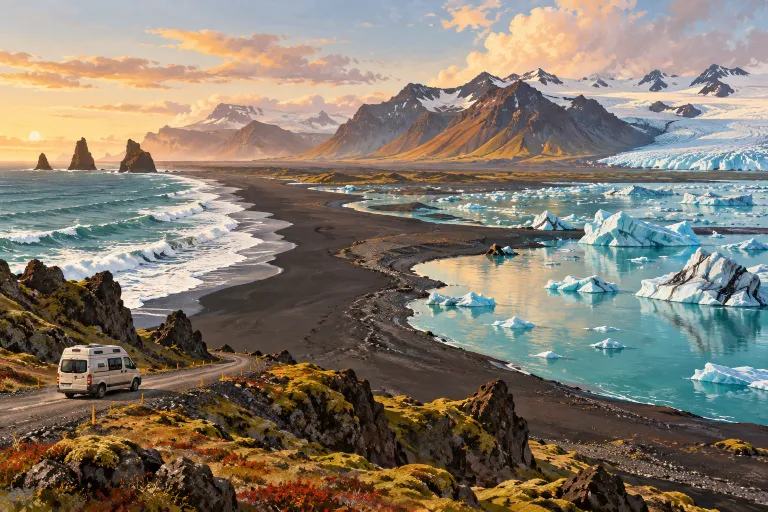
Iceland Ring Road: when a full loop makes sense
A ten-night route with space for weather changes and safer decisions. Updated 14 October 2026.
Quick answer: Route 1 circles much of Iceland, but driving the loop is not a test you need to pass. For a first self-drive trip, ten nights gives more breathing room than a fast week. In poor weather or with fewer nights, choose a smaller region. Check the Icelandic Road and Coastal Administration’s live road map and the Icelandic Meteorological Office alerts before every major drive. A booked hotel does not make a closed or unsafe road usable.
| Time | Better shape | Main trade-off |
|---|---|---|
| 4–6 nights | Reykjavík plus one or two nearby regions | Skip the full loop; gain time at each stop. |
| 7–9 nights | Possible loop only with disciplined stops and good conditions | Longer days and less weather slack. |
| 10–14 nights | Full Route 1 loop with flexible nights | More hotel cost, much easier pacing. |
Compare power banks ↗Compare weather-resistant daypacks ↗
What the Ring Road is—and is not
Route 1, often called the Ring Road, connects regions around Iceland. Visit Iceland describes a loop of about 1,322 km and says at least seven travel days, but its own two-week example is a better clue to comfortable sightseeing. The loop is a main route, not a guarantee of safe passage in every season or storm. Road conditions can change in hours.
The Ring Road does not include every famous detour. The Westfjords and Snæfellsnes are separate additions. Highland F-roads are a different category with access and vehicle restrictions. Do not let a map app send a standard rental car down an unapproved road simply because it is shorter. Read the car contract and live road status before following an alternate route.
Clockwise or counterclockwise is less important than weather and realistic daily travel. Decide a rough direction, but stay willing to shorten the loop if conditions demand it. If your flights begin and end near Reykjavík, leave a final night near departure instead of planning a long drive from the far side of the island on flight day.
A ten-night route to adapt
Use the route as a sequence of regions, not fixed hotel names. Night one can be near Reykjavík or your arrival airport. Nights two and three can focus on the south coast. Nights four and five cover the southeast and a calmer transfer east. Nights six and seven are for the north. Night eight can break up the westward journey. Nights nine and ten return toward the capital and your flight. Your actual stop points should follow live road information and where suitable lodging is available.
On arrival day, sleep before a major drive if you have flown overnight. The road may be unfamiliar, windy or dark. Book the first night with a manageable transfer. Pick up the vehicle only after you know the rental terms, insurance excess, fuel policy and any road restrictions.
The south coast has many popular stops close enough to tempt you into an overfilled day. Choose a few and enjoy them. At waterfalls, viewpoints and black-sand areas, obey barriers and local warnings. Ocean waves can be dangerous even when the beach looks calm. A photograph from someone else’s visit tells you nothing about current wind or surf.
Southeast and east: distance becomes real
Distances across the southeast and east can make a day feel longer than its kilometres suggest. Add fuel, meals, weather, short walks and photo stops to the drive. If you book a guided glacier activity, read the operator’s meeting place, equipment and cancellation terms. Do not walk onto a glacier without a qualified guide and appropriate gear.
Keep an extra option in mind if a road closes. That may mean staying another night or returning by the way you came rather than forcing a loop. Book accommodation with a sensible cancellation policy where possible. Never drive past a road closure because you have already paid for a room.
Before departure each morning, check the official road map at umferdin.is and Icelandic Meteorological Office warnings. SafeTravel also gives practical travel advice. Screenshot or save key information for the day, but refresh it when you regain signal. Old cached conditions are not current conditions.
North Iceland: a place to slow down
Use at least two nights in the north if you can. That gives one day that does not depend on a long drive. Choose activities by interest and weather rather than trying to fit every waterfall, geothermal area and town into a few hours. Some sights involve side roads that can be less suitable in poor conditions than Route 1 itself.
If you want a guided activity, compare the operator’s safety, accessibility and refund terms. A tour can be cancelled for weather; that is often the right decision. Keep a nearby indoor or short-walk alternative. On a long trip, the best day may be an ordinary town day after several hours on the road.
Drivers should take turns where possible. If only one person is licensed, plan shorter driving blocks. Wildlife, gravel, low sun and unfamiliar road surfaces deserve attention. Pull into proper parking areas for photos rather than stopping on the road.
Returning west: protect your final flight
Do not spend the last night far from the airport. A storm, vehicle problem or road closure on the final day could make a flight impossible. Put the last night within a comfortable, ordinary-weather drive of departure and allow time to refuel and return the car. This may feel less adventurous on paper, but it makes the entire trip calmer.
If the forecast looks poor, shift a flexible activity or skip a detour. Do not chase northern lights, a volcano or a viewpoint at the cost of a safe return. Some natural events cannot be promised. A road trip is successful when travellers get home safely with a few experiences they enjoyed.
Rental car: read the details
Compare vehicles by passengers, luggage, transmission, fuel use and seasonal suitability. Four-wheel drive may help in some conditions, but it does not make driving through closures or severe weather safe. Check whether the rental allows the roads you intend to use. Ask about damage excess, wind and gravel coverage, driver names, roadside help and what to do if a road becomes impassable.
A standard car can be suitable for many Route 1 trips in favourable conditions, according to Visit Iceland’s route description, but the exact vehicle choice depends on season and current weather. Do not take a general statement as a personal safety clearance. If you are uncomfortable driving in winter conditions, use guided transport or travel another time.
Fuel and food can be farther apart outside larger towns. Start long legs with a reasonable fuel level and know where your next planned stop is. Carry water, warm layers and a charged phone. Put the emergency number and rental assistance contact in your offline notes.
What a full loop costs
List flights, car rental, insurance, fuel, accommodation, food, parking, attractions and a reserve. A cheap car offer may carry a large damage excess or extra driver charge. A remote room may cost less but add driving. Compare the final checkout total for the whole trip, not one nightly rate or one rental headline.
Meals and lodging can be a meaningful part of the budget. Pick where you will stay before assuming a daily spend. A flexible booking may be worth more than a small discount on a nonrefundable room when the route depends on weather. Ask the provider what happens if roads close; do not assume a refund.
If costs are too high, choose a shorter regional route rather than compressing the loop into fewer nights. You will still see remarkable scenery and spend less of the holiday behind a steering wheel.
Daily decision routine
- Check official road conditions and weather alerts before breakfast.
- Decide whether the planned drive is sensible for your vehicle and driver.
- Keep one backup: a shorter drive, a rest day or a different safe route.
- Tell accommodation if a change is needed, then check cancellation terms.
- Refuel and prepare food before a long rural stretch.
- Stop when fatigue or conditions make driving uncomfortable.
Quick questions
Can I do the Ring Road in seven days?
Visit Iceland lists seven days as a minimum, but it will be a faster trip. Ten or more nights usually gives more room for stops and weather changes.
Is Route 1 always open?
No. Check umferdin.is and weather alerts daily. Closures and hazards can change the plan.
Do I need a 4×4?
Not automatically for Route 1 in favourable conditions. Season, rental restrictions and live road state matter more than a blanket rule.
Should I add the Westfjords?
Only with extra days and a separate route plan. They are not part of a basic Route 1 loop.
Leave a Reply